You're all caught up—no notifications available.
Explore All Exams at KGS


All Exams
Explore All Exams at KGS

Khan Sir Courses
Geography I Polity I History | World Map I Indian Map I Economics I Biology

UPSC & State PSC
UPSC I BPSC I UP-PSC I MP-PSC

State Exams
UP I Bihar I MP | Rajasthan

NEET | JEE | CUET | Boards
NEET | JEE | CUET | Boards

Defence Exams
NDA I CDS I CAPF I AFCAT I SSB I Agniveer

Police Exams
UP SI | Bihar SI | Delhi Police | UP Constable

SSC Exams
CGL I CPO I CHSL I MTS I SSC GD I Delhi Police

Foundation Courses
Physics I Chemistry I Biology I History I Geography I Polity I NCERT I Math I English | Map I Reasoning

Railway Exams
RRB | RPF

Teaching Exams
TET | Teaching | UGC

Banking Exams
SBI | RBI | IBPS

Engineering Exams
Civil | Electrical | Mechanical
UGC NET
UGC NET/JRF
Current Affairs provides you with the best compilation of the Daily Current Affairs taking place across the globe: National, International, Sports, Science and Technology, Banking, Economy, Agreement, Appointments, Ranks, and Report and General Studies

SYLLABUS
GS-2: Government Policies and Interventions for Development in various sectors and Issues arising out of their Design and Implementation.
Context: The Supreme Court bench comprising Justices Sanjay Karol and N Kotiswar Singh has urged the Union Law Secretary to consider initiating steps to curb the misuse of the Protection of Children from Sexual Offences (POCSO) Act, 2012.
More on the News:
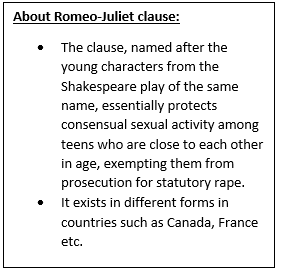
Argument in favour of Romeo-Juliet clause
• Protect genuine adolescent relationships: Any sexual activity involving a person under 18 is automatically criminalized in present legal framework, regardless of whether it is consensual or non-exploitative.
• Judicial anxiety: A study by the Enfold Proactive Health Trust and UNICEF found that nearly 25% of POCSO cases in the states of Maharashtra, Assam and West Bengal between 2016 and 2020 were “romantic” in nature — in which the victim and the accused were in a consensual relationship.
• Grim Societal Chasm: The court pointed out that the POCSO Act, which is a “solemn articulation of justice”, is frequently used by families to oppose relationships between young people.
• Demand for change: The push to amend the law is not new but it has gained a boost through a pending PIL in the Supreme Court related to protections and safeguards for women in the prosecution of sexual offences.
• Sexual Autonomy: Adolescents between the ages of 16 and 18 possess the “evolving capacity” to make decisions regarding their sexual autonomy.
• “Close-in-age” exception: To ensure that if both parties are adolescents and the act is consensual, it would not be treated as an offence.
• Health implications: The mandatory reporting provision in POCSO forces doctors to report underage pregnancies or sexual activity to the police. This fear of prosecution deters adolescents from seeking essential sexual and reproductive health services.
Union government Standing on Issue:
• No to Statutory Dilution: The Union government has opposed any reduction in the age of consent or the introduction of legislative exceptions.
• Irrelevancy of Consent: The government contended that minors lack the legal and developmental capacity to give meaningful consent. A strict liability framework where consent is irrelevant was necessary, it argued, because children are vulnerable to manipulation and coercion by adults in positions of trust.
• Prone to misuse: The government expressed fear that introducing exceptions or lowering the age of consent could open loopholes for child abuse and trafficking under the guise of consensual relationships.
• Old oil in New lamp effect: Since the Act was enacted to remedy the specific mischief of child abuse, diluting the age threshold, it argued, would reintroduce the very problem the law sought to solve.
Way forward
• Introduce a Carefully Drafted Close-in-Age Exception: Senior Advocate Indira Jaising, assisting the court as amicus curiae, has advocated for reading down the age of consent or introducing exceptions.
• Need for Nuanced Approach: Bring Close-in-age defences and adopt a maturity-based, child-centric approach to protect affectionate or harmless interactions from prosecution.
• Responsible Judicial Discretion: The courts can use sentencing discretion and grant relief at the stage of bail, quashing, or sentencing in clearly consensual cases.

The most trusted learning platform on your phone
With our training programs, learning online can be a very exciting experience! Take the next step toward achieving your professional and personal objectives



NCERT Books
Resources
We love learning. Through our innovative solutions, we encourage ourselves, our teams, and our Students to grow. We welcome and look for diverse perspectives and opinions because they enhance our decisions. We strive to understand the big picture and how we contribute to the company’s objectives. We approach challenges with optimism and harness the power of teamwork to accomplish our goals. These aren’t just pretty words to post on the office wall. This is who we are. It’s how we work. And it’s how we approach every interaction with each other and our Students.
Come with an open mind, hungry to learn, and you’ll experience unmatched personal and professional growth, a world of different backgrounds and perspectives, and the freedom to be you—every day. We strive to build and sustain diverse teams and foster a culture of belonging. Creating an inclusive environment where every students feels welcome, appreciated, and heard gives us something to feel (really) good about.
Get Free academic Counseling & Course Details