You're all caught up—no notifications available.
Explore All Exams at KGS


All Exams
Explore All Exams at KGS

Khan Sir Courses
Geography I Polity I History | World Map I Indian Map I Economics I Biology

UPSC & State PSC
UPSC I BPSC I UP-PSC I MP-PSC

State Exams
UP I Bihar I MP | Rajasthan

NEET | JEE | CUET | Boards
NEET | JEE | CUET | Boards

Defence Exams
NDA I CDS I CAPF I AFCAT I SSB I Agniveer

Police Exams
UP SI | Bihar SI | Delhi Police | UP Constable

SSC Exams
CGL I CPO I CHSL I MTS I SSC GD I Delhi Police

Foundation Courses
Physics I Chemistry I Biology I History I Geography I Polity I NCERT I Math I English | Map I Reasoning

Railway Exams
RRB | RPF

Teaching Exams
TET | Teaching | UGC

Banking Exams
SBI | RBI | IBPS

Engineering Exams
Civil | Electrical | Mechanical
UGC NET
UGC NET/JRF
Current Affairs provides you with the best compilation of the Daily Current Affairs taking place across the globe: National, International, Sports, Science and Technology, Banking, Economy, Agreement, Appointments, Ranks, and Report and General Studies

SYLLABUS
GS-1: Role of women and women’s organization, population and associated issues; Social Empowerment.
GS-2: Structure, organization and functioning of the Executive and the Judiciary.
Context: In a landmark ruling on women’s health, the Supreme Court has declared the right to menstrual health as a fundamental right.
More on the News
• The Supreme Court in Dr Jaya Thakur v. Government of India has declared that the right to menstrual health and access to menstrual hygiene management (MHM) measures in educational institutions is integral to the right to life with dignity under Article 21.
• The Court issued binding directions to all States and Union Territories for pan-India enforcement of the Union's Menstrual Hygiene Policy in schools for Classes 6-12, alongside additional mandates like free oxo-biodegradable sanitary napkins, gender-segregated toilets, etc.
• The Court held that the lack of menstrual hygiene facilities violates the right to privacy, bodily autonomy, dignity and education of adolescent girls.
• The Court interpreted the Right of Children to Free and Compulsory Education Act, 2009, through the lens of menstrual health and held that “free education” under Section 3 extends beyond waiver of tuition fees to removal of all financial barriers that hinder a child’s education.
• The court’s reasoning is anchored in the concept of “substantive equality”. While Article 14 of the Constitution guarantees equality before the law, the court noted that treating everyone exactly the same may perpetuate inequality.
Example: Providing reservations (quotas) or scholarships to ensure marginalized groups can actually secure those jobs.
Key Directions Issued by the Supreme Court
• All States/UT must ensure that every school, whether government-run or privately managed, in both urban and rural areas, is provided with functional gender segregated toilets with usable water connectivity.
• All existing or newly constructed toilets in schools shall be designed, constructed and maintained to ensure privacy and accessibility, including by catering to the needs of children with disabilities.
• All school toilets must be equipped with functional washing facilities and soap and water available at all times.
• States/UTs must supply free, ASTM D-6954-compliant oxo-biodegradable sanitary napkins in all schools (whether government-run or privately managed, in both urban and rural areas), made accessible to girls preferably through toilet vending machines or discreet designated areas.
The Court has also issued directions for the disposal of sanitary waste
Significance of the Judgement
• Constitutional Expansion of Article 21: The Supreme Court decisively expanded the scope of Article 21 by recognizing menstrual health as inseparable from life, dignity, privacy, and bodily autonomy under Article 21.
• Education with Dignity, Not Mere Access: By linking lack of menstrual hygiene facilities to absenteeism, unsafe practices, and school dropouts, the Court affirmed that education cannot be meaningful if it compromises dignity, and that the State cannot force a child to choose between schooling and self-respect.
• Accountability and Enforceability: By declaring that the State concerned would be held accountable if government-run schools did not comply with Section 19 of the Right to Education Act, the ruling ensures that menstrual health obligations are enforceable, measurable, and subject to legal consequences.

Two More Wetlands Get Ramsar Tag
Right to Menstrual Health a Fundamental Right
Amendments to New Drugs and Clinical Trials (NDCT) Rules, 2019
Supreme Court Stays UGC's New Equity Regulations
India’s infrastructure spend tops 3% of GDP as climate risks strain insurance cover: Report
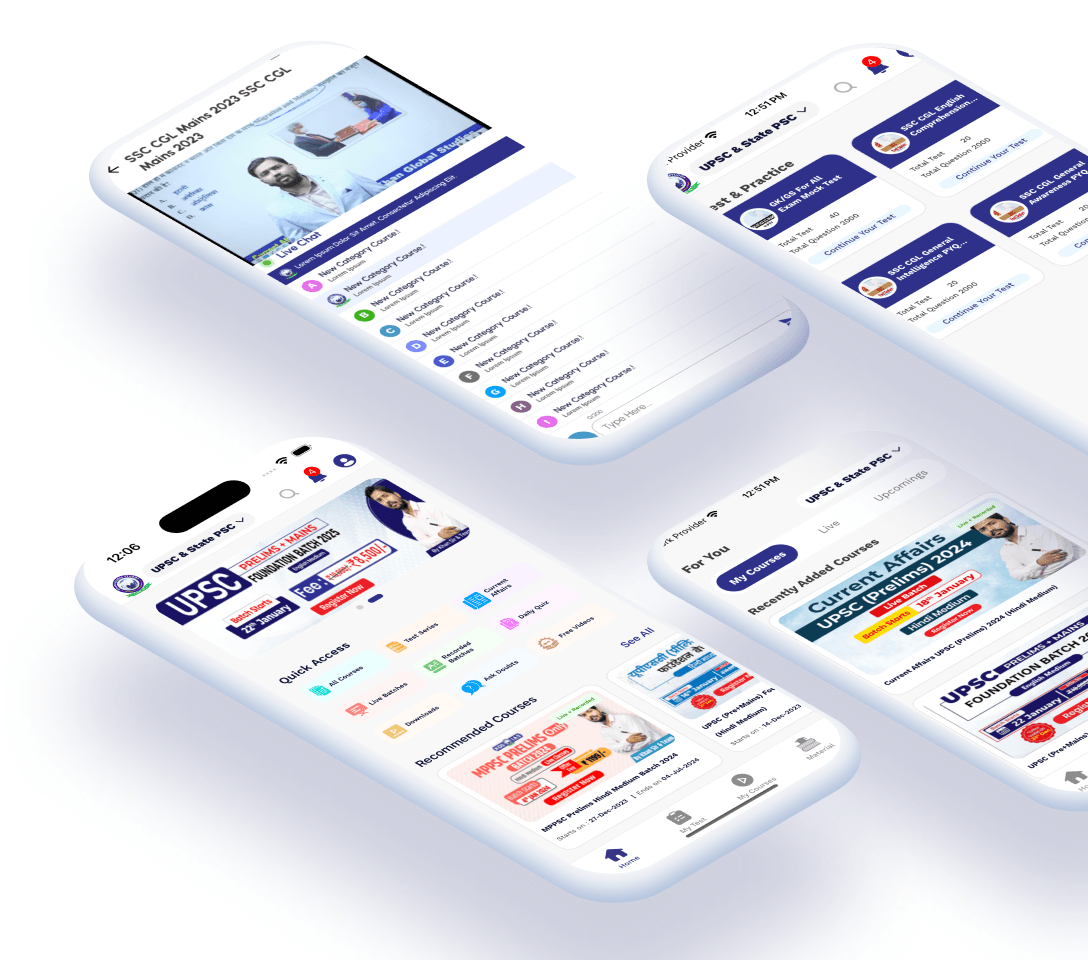
The most trusted learning platform on your phone
With our training programs, learning online can be a very exciting experience! Take the next step toward achieving your professional and personal objectives


NCERT Books
Resources
We love learning. Through our innovative solutions, we encourage ourselves, our teams, and our Students to grow. We welcome and look for diverse perspectives and opinions because they enhance our decisions. We strive to understand the big picture and how we contribute to the company’s objectives. We approach challenges with optimism and harness the power of teamwork to accomplish our goals. These aren’t just pretty words to post on the office wall. This is who we are. It’s how we work. And it’s how we approach every interaction with each other and our Students.
Come with an open mind, hungry to learn, and you’ll experience unmatched personal and professional growth, a world of different backgrounds and perspectives, and the freedom to be you—every day. We strive to build and sustain diverse teams and foster a culture of belonging. Creating an inclusive environment where every students feels welcome, appreciated, and heard gives us something to feel (really) good about.
Get Free academic Counseling & Course Details