You're all caught up—no notifications available.
Explore All Exams at KGS


All Exams
Explore All Exams at KGS

Khan Sir Courses
Geography I Polity I History | World Map I Indian Map I Economics I Biology

UPSC & State PSC
UPSC I BPSC I UP-PSC I MP-PSC

State Exams
UP I Bihar I MP | Rajasthan

NEET | JEE | CUET | Boards
NEET | JEE | CUET | Boards

Defence Exams
NDA I CDS I CAPF I AFCAT I SSB I Agniveer

Police Exams
UP SI | Bihar SI | Delhi Police | UP Constable

SSC Exams
CGL I CPO I CHSL I MTS I SSC GD I Delhi Police

Foundation Courses
Physics I Chemistry I Biology I History I Geography I Polity I NCERT I Math I English | Map I Reasoning

Railway Exams
RRB | RPF

Teaching Exams
TET | Teaching | UGC

Banking Exams
SBI | RBI | IBPS

Engineering Exams
Civil | Electrical | Mechanical
UGC NET
UGC NET/JRF
Current Affairs provides you with the best compilation of the Daily Current Affairs taking place across the globe: National, International, Sports, Science and Technology, Banking, Economy, Agreement, Appointments, Ranks, and Report and General Studies

SYLLABUS
GS-3: Conservation, environmental pollution and degradation, environmental impact assessment.
Context: The Union Ministry of Environment, Forest and Climate Change has notified the Solid Waste Management (SWM) Rules, 2026, superseding the Solid Waste Management Rules, 2016.
More on the News
• The rules have been notified under the Environment (Protection) Act, 1986 and will come into full effect from April 1, 2026.
• The rules introduce a more enforceable and compliance-driven framework for urban and rural waste management.
• The revised rules integrate the principles of Circular Economy and Extended Producer Responsibility, with a specific focus on efficient waste segregation and management.
Key reasons for the Introduction of the SWM Rules 2026.
• India generates over 620 lakh tonnes of solid waste annually, putting severe pressure on landfills.
• Implementation gaps under the 2016 Rules led to poor segregation and overburdened urban local bodies.
• The Centre aims to promote a circular economy by prioritising reduction, reuse and recycling.
• There was a need to shift responsibility from municipalities alone to all waste generators.
Key Changes Introduced Under SWM Rules, 2026
• Mandatory Four-Stream Segregation at Source
• Clear Definition and Expanded Responsibility of Bulk Waste Generators
• Introduction of Extended Bulk Waste Generator Responsibility (EBWGR)
• Digital Tracking: Development of a Centralised Online Portal to track all stages of solid waste management, including waste generation, collection, transportation, processing and disposal, as well as biomining and bioremediation of legacy waste dump sites.
• Faster Land Allocation for Waste Processing Facilities
• User Fees & Polluter Pays Principle:
• Strengthened Role of Local Bodies and Material Recovery Facilities
• Mandatory Use of Refuse-Derived Fuel by Industries
• Stricter Restrictions on Landfilling and Legacy Waste Management
• Special Provisions for Hilly Areas and Islands
• Institutional Mechanism for Effective Implementation
How SWM Rules, 2026 Differ from SWM Rules, 2016
• The 2016 Rules focused mainly on municipal responsibility and advisory compliance.
• The 2026 Rules assign shared legal responsibility to households, institutions and bulk generators.
• Segregation norms are stricter with clearer enforcement mechanisms.
• Penalties and tracking systems are more explicit and technology-driven.
• Legacy waste remediation receives stronger regulatory emphasis.
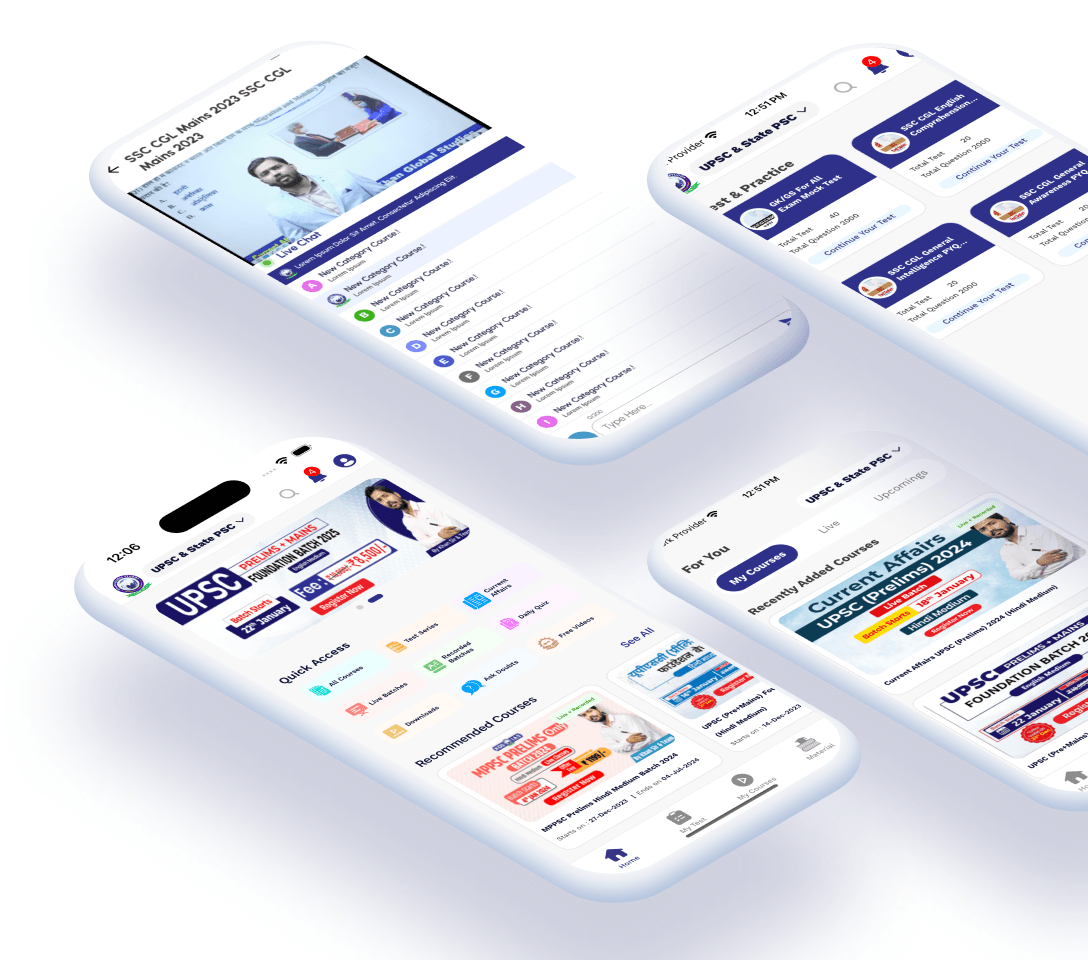
The most trusted learning platform on your phone
With our training programs, learning online can be a very exciting experience! Take the next step toward achieving your professional and personal objectives


NCERT Books
Resources
We love learning. Through our innovative solutions, we encourage ourselves, our teams, and our Students to grow. We welcome and look for diverse perspectives and opinions because they enhance our decisions. We strive to understand the big picture and how we contribute to the company’s objectives. We approach challenges with optimism and harness the power of teamwork to accomplish our goals. These aren’t just pretty words to post on the office wall. This is who we are. It’s how we work. And it’s how we approach every interaction with each other and our Students.
Come with an open mind, hungry to learn, and you’ll experience unmatched personal and professional growth, a world of different backgrounds and perspectives, and the freedom to be you—every day. We strive to build and sustain diverse teams and foster a culture of belonging. Creating an inclusive environment where every students feels welcome, appreciated, and heard gives us something to feel (really) good about.
Get Free academic Counseling & Course Details