You're all caught up—no notifications available.
Explore All Exams at KGS


All Exams
Explore All Exams at KGS

Khan Sir Courses
Geography I Polity I History | World Map I Indian Map I Economics I Biology

UPSC & State PSC
UPSC I BPSC I UP-PSC I MP-PSC

State Exams
UP I Bihar I MP | Rajasthan

NEET | JEE | CUET
NEET | JEE | CUET

Defence Exams
NDA I CDS I CAPF I AFCAT I SSB I Agniveer

Police Exams
UP SI | Bihar SI | Delhi Police | UP Constable

SSC Exams
CGL I CPO I CHSL I MTS I SSC GD I Delhi Police

Foundation Courses
Physics I Chemistry I Biology I History I Geography I Polity I NCERT I Math I English | Map I Reasoning

Railway Exams
RRB | RPF

Teaching Exams
TET | Teaching | UGC

Banking Exams
SBI | RBI | IBPS

Engineering Exams
Civil | Electrical | Mechanical
UGC NET
UGC NET/JRF
Current Affairs provides you with the best compilation of the Daily Current Affairs taking place across the globe: National, International, Sports, Science and Technology, Banking, Economy, Agreement, Appointments, Ranks, and Report and General Studies

SYLLABUS
GS-3: Infrastructure: Energy, Ports, Roads, Airports, Railways etc.
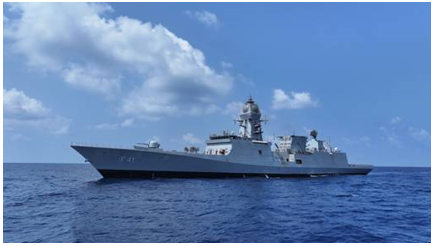
Context: Recently, the Indian Navy commissioned INS Taragiri at Visakhapatnam, marking a major step in enhancing India’s maritime power, self-reliance, and Indo-Pacific security presence.
About INS Taragiri
• INS Taragiri is the fourth Nilgiri-class (Project 17A) stealth guided-missile frigate.
• It is part of a 7-ship Project 17A programme, with 4 built by Mazagon Dock Shipbuilders Limited and 3 by GRSE.
• It is designated as F41 and inducted into the Eastern Fleet under the Eastern Naval Command.
• It is named after the Taragiri hills in Uttarakhand.
• It carries forward the legacy of the Leander-class INS Taragiri (1980–2013).
• Its motto is “Rise Above.”
• Construction & Indigenous Ecosystem:
• Design & Advanced Technology:
• Combat Capabilities:
• Operational Role & Versatility:
• Unique Features & Utility:
Significance
• Maritime Security Imperative: With a ~11,000 km coastline and ~95% of trade via sea, it ensures protection of sea lanes, choke points, energy routes, and undersea communication cables, thereby safeguarding India’s economic and digital infrastructure.
• Strengthening Naval Capability: As a stealth, multi-role warship with advanced sensors, supersonic missiles, and long endurance, it enhances operational reach, combat readiness, surveillance, and rapid response while strengthening presence from the Persian Gulf to the Malacca Strait.
• Aatmanirbhar Bharat in Defence: With over 75% indigenous content and participation of 200+ MSMEs, it reduces import dependence, strengthens the defence industrial ecosystem, reflects strong public-private partnership, and aligns with rising defence exports (~₹38,000+ crore).
• Strategic & Geopolitical Significance: Equipped for multi-domain warfare and deployed in the Eastern Fleet, it acts as a credible deterrent in Indo-Pacific geopolitics, supports India as a net security provider, remains relevant amid tensions like Strait of Hormuz disruptions, and complements naval modernisation including INS Aridhaman.
• Multi-Dimensional Role: Beyond combat, it enables carrier escort operations, anti-piracy missions, maritime surveillance, coastal security, disaster relief, evacuation missions, and humanitarian assistance, including power support during crises.
• Symbol of Maritime Power & Sovereignty: It represents Make in India, technological maturity, faster shipbuilding capability, and India’s transition to a self-reliant blue-water navy, reinforcing the vision of Viksit Bharat 2047 and a secure Indo-Pacific.
About the Project 17 & Project 17A (India’s Stealth Frigate Programme)
• Design work for India’s stealth frigates began in the 1990s under Project 17, which later evolved into the more advanced Project 17A programme.
• Project 17 (Shivalik-Class Frigates): A total of 3 multipurpose stealth frigates were constructed at Mazagon Dock Shipbuilders Limited (Mumbai) between 2001 and 2012.
• Transition to Project 17A: Project 17A was launched as an advanced follow-on to Project 17, focusing on enhanced stealth features, greater automation, and improved combat capabilities.
Construction began in December 2017, five years after the completion of Project 17.
• Project 17A (Nilgiri-Class Frigates): A total of 7 stealth frigates are being built under this programme, marking a significant expansion in India’s naval capability.
• The frigates are being constructed at two major shipyards: Mazagon Dock Shipbuilders Limited (4 ships) and Garden Reach Shipbuilders and Engineers (3 ships).
• INS Nilgiri was commissioned in January 2025, followed by INS Udaygiri and INS Himgiri in 2025.
• INS Taragiri has now been commissioned; INS Dunagiri has already been delivered to the Indian Navy, while the remaining ships—Mahendragiri and Vindhyagiri—are expected to join the fleet by 2026.
Sources:
Indian Express
PIB
The Hindu
New Indian Express
Economic Time

NEWS IN SHORT
INS Taragiri
INS Aridhaman
Report on Internet Shutdowns in 2025
The most trusted learning platform on your phone
With our training programs, learning online can be a very exciting experience! Take the next step toward achieving your professional and personal objectives



Course Related Query:
Ask Your DoubtsStore Related Query:[email protected]NCERT Books
Resources
We love learning. Through our innovative solutions, we encourage ourselves, our teams, and our Students to grow. We welcome and look for diverse perspectives and opinions because they enhance our decisions. We strive to understand the big picture and how we contribute to the company’s objectives. We approach challenges with optimism and harness the power of teamwork to accomplish our goals. These aren’t just pretty words to post on the office wall. This is who we are. It’s how we work. And it’s how we approach every interaction with each other and our Students.
Come with an open mind, hungry to learn, and you’ll experience unmatched personal and professional growth, a world of different backgrounds and perspectives, and the freedom to be you—every day. We strive to build and sustain diverse teams and foster a culture of belonging. Creating an inclusive environment where every students feels welcome, appreciated, and heard gives us something to feel (really) good about.
Get Free academic Counseling & Course Details