You're all caught up—no notifications available.
Explore All Exams at KGS


All Exams
Explore All Exams at KGS

Khan Sir Courses
Geography I Polity I History | World Map I Indian Map I Economics I Biology

UPSC & State PSC
UPSC I BPSC I UP-PSC I MP-PSC

State Exams
UP I Bihar I MP | Rajasthan

NEET | JEE | CUET
NEET | JEE | CUET

Defence Exams
NDA I CDS I CAPF I AFCAT I SSB I Agniveer

Police Exams
UP SI | Bihar SI | Delhi Police | UP Constable

SSC Exams
CGL I CPO I CHSL I MTS I SSC GD I Delhi Police

Foundation Courses
Physics I Chemistry I Biology I History I Geography I Polity I NCERT I Math I English | Map I Reasoning

Railway Exams
RRB | RPF

Teaching Exams
TET | Teaching | UGC

Banking Exams
SBI | RBI | IBPS

Engineering Exams
Civil | Electrical | Mechanical
UGC NET
UGC NET/JRF
Current Affairs provides you with the best compilation of the Daily Current Affairs taking place across the globe: National, International, Sports, Science and Technology, Banking, Economy, Agreement, Appointments, Ranks, and Report and General Studies

‘Bharat VISTAAR’ scheme
Context: Recently, the Union Minister for Agriculture and Farmers’ Welfare and Rural Development launched phase I of the ‘Bharat VISTAAR’ scheme in Jaipur, Rajasthan, as part of India’s push for AI-driven agricultural transformation.
About the Bharat VISTAAR
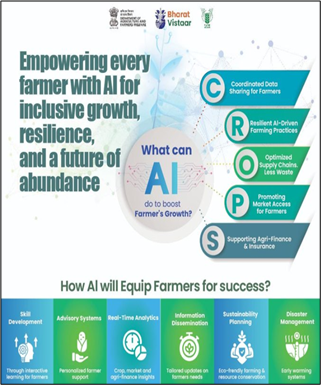
• Bharat-VISTAAR (Virtually Integrated System to Access Agricultural Resources) is an AI-powered digital public infrastructure (DPI) designed as a single digital gateway for farmers.
• It integrates data from sources such as AgriStack, ICAR advisories, IMD weather data, mandi prices (Agmarknet), and various government schemes to provide unified agricultural services.
• Objective:
o The scheme aims to provide farmers with real-time agriculture-related information and advisory services through technology.
• Key Features:
o Voice-first AI platform: Farmers can dial 155261 to ask queries, receive instant advisory, and check mandi prices, even using feature phones.
o Multilingual access: Initially available in Hindi and English, with plans to expand to 11 languages.
o Farmer Identity Card: A digital Farmer ID will store farmer profiles, scheme eligibility, and benefit tracking, initially linked with schemes like Pradhan Mantri Fasal Bima Yojana and Soil Health Card.
o Integrated services: Provides weather forecasts, pest alerts, crop advisory, soil and fertiliser guidance, scheme details, and complaint tracking.
o Multiple access modes: Available via helpline, chatbot, web interface, and upcoming mobile apps.
Project Vault
Context: The United States has launched Project Vault, a strategic initiative to create a domestic reserve of critical minerals aimed at safeguarding industries from geopolitical supply disruptions and economic coercion.
About Project Vault
• A public-private partnership designed as an independently governed and operated entity rather than a fully government-controlled reserve.
• Supported by up to $10 billion in financing from the Export-Import Bank of the United States (EXIM), along with additional private investment (~$2 billion).
• The project aims to stockpile 60 critical minerals identified in the U.S. Geological Survey (USGS) 2025 Critical Mineral List.
• EXIM will provide long-term loans to procure and store minerals domestically.
• The minerals will be procured and stored on behalf of participating companies based on upfront commitments.
• Withdrawal and replenishment will occur under predefined market disruption conditions, with participants paying storage premiums.
• Inspired by the model of the Strategic Petroleum Reserve (1975) as a buffer against supply shocks.
• The move follows growing concerns over supply chain vulnerabilities, especially due to China’s dominance in mining, processing, and rare earth magnet exports.
Significance of Project Vault
• The initiative treats critical minerals as strategic assets central to national power and economic security.
• The project reduces dependence on foreign-controlled supply chains vulnerable to coercion and disruption.
• The reserve provides an insurance mechanism for domestic manufacturers against volatile spot market prices.
• Strengthens resilience of U.S. industrial ecosystems and complements domestic mining and processing initiatives.
• May support alternative global supply chains by creating predictable demand beyond dominant suppliers.
‘Bee Corridors’ Along the National Highways
Context: Recently, the National Highways Authority of India (NHAI) announced a first-of-its-kind initiative to develop Pollinator or Bee Corridors along National Highways as part of sustainable infrastructure development.
Key Objectives
• To ensure year-round availability of nectar and pollen for pollinators.
• To reduce growing ecological stress on honeybees and wild pollinators.
• To address declining pollination services affecting agricultural, horticultural and ecological balance.
• To shift from ornamental roadside plantations to biodiversity-rich ecological plantations.
Ecological Design
• The corridor will include a mix of trees, shrubs, herbs, and grasses.
• Wild elements such as flowering weeds, dead wood, and hollow trunks will be retained.
• Plant species will ensure staggered flowering across seasons for a near-continuous blooming cycle.
• The initiative prioritises native and nectar-rich plant species.
Major Plant Species
• Native and nectar-rich species such as Neem, Karanj, Mahua, Palash, Bottle Brush, Jamun, and Siris will be planted along National Highways.
Implementation Strategy
• Corridors will be developed along National Highway stretches and vacant NHAI land parcels based on agro-climatic suitability.
• Plantation clusters will be created at intervals of 500 meters to 1 km.
• The spacing aligns with the average foraging range of honeybees and wild bees.
• NHAI field offices will identify suitable locations across the country.
Targets
• At least three pollinator corridors will be developed during 2026-27.
• Around 40 lakh trees will be planted along National Highways.
• Nearly 60% of plantations will be under the ‘Bee Corridor’ initiative.
• The initiative is expected to enhance habitat connectivity, improve pollination efficiency, and contribute to long-term ecological stability.
EXERCISE MILAN 2026
Context: The Indian Navy is conducting the 13th edition of MILAN under the aegis of the Eastern Naval Command t Visakhapatnam (Bay of Bengal) to strengthen maritime cooperation and enhance interoperability among friendly navies in the Indo-Pacific.
More on the News
• MILAN 2026 is one of the largest multilateral naval exercises in the Indo-Pacific, bringing together navies from across the globe
• The invitations have been extended to over 135, with around 70 nations confirming participation.
• The exercise will include both Harbour and Sea Phases, covering:
o Anti-submarine warfare
o Air defence operations
o Maritime domain awareness
o Search and rescue missions
o Cooperative security and HADR operations
• The theme of MILAN 26 is Camaraderie, Cooperation, Collaboration.
• The exercise reflects India’s commitment to maritime security, rules-based seas, regional stability and cooperative engagement in the Indo-Pacific.
• The exercise is being held alongside two major events in Visakhapatnam:
o International Fleet Review (IFR) 2026 and
o the IONS (Indian Ocean Naval Symposium) Conclave of Chiefs.
• MILAN 2026 aligns with the Prime Minister’s Mutual and Holistic Advancement for Security and Growth Across Regions (MAHASAGAR) vision, reinforcing India’s role as:
o Preferred security partner
o Bridge between Global South and major powers
o Stakeholder in global maritime commons.
Historical Background
• The MILAN exercise began in 1995 at the Andaman and Nicobar Islands with participation from Indonesia, Singapore, Sri Lanka and Thailand.
• It is a biennial multilateral naval exercise of the Indian Navy.
• Participation has steadily expanded:
o 2014: 17 nations
o 2022: 42 countries
o 2026: ~70 confirmed participants (largest edition so far).
India’s First Private Sector Helicopter Final Assembly Line (FAL)
Context: Recently, the Prime Minister of India and the President of France virtually inaugurated the Tata Advanced Systems Final Assembly Line for the Airbus H125 helicopter.
More on the News
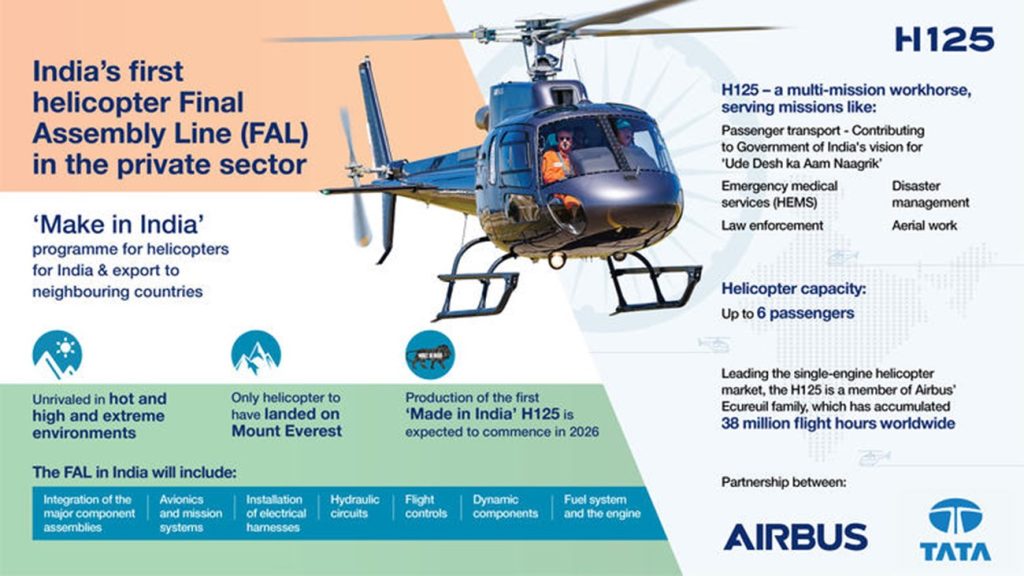
• The facility is located at Vemagal in Kolar district of Karnataka and is India’s first private sector helicopter Final Assembly Line.
• In aerospace manufacturing, a Final Assembly Line (FAL) is the concluding stage where all major pre-fabricated sections of an aircraft are integrated into a fully functional unit.
• The facility has been established by Tata Advanced Systems Limited (TASL) in partnership with Airbus.
• It marks a major step in India–France defence-industrial cooperation and supports the vision of Aatmanirbhar Bharat in aerospace.
Key highlights of the Development
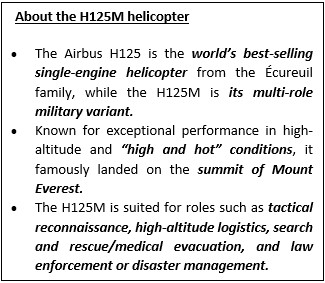
• The facility will initially manufacture the civil variant of the Airbus H125 helicopter in India.
• It may also produce the military variant H125M in the future with high levels of localisation.
• The first Made in India H125 helicopter is expected to be delivered in early 2027.
• The helicopters produced here will serve domestic demand and export markets in South Asia.
• The project marks the first time the Indian private sector will undertake manufacturing, integration, testing and maintenance of a sophisticated rotary wing platform.
• The Karnataka government has allotted about 17 acres of land for the project.
• Around 500 helicopters may be produced over the next twenty years.
• The programme is expected to generate significant direct and indirect employment and strengthen India’s aerospace ecosystem.
• This is the second major Tata–Airbus collaboration, after the C295 transport aircraft assembly line.
The most trusted learning platform on your phone
With our training programs, learning online can be a very exciting experience! Take the next step toward achieving your professional and personal objectives



Course Related Query:
Ask Your DoubtsStore Related Query:[email protected]NCERT Books
Resources
We love learning. Through our innovative solutions, we encourage ourselves, our teams, and our Students to grow. We welcome and look for diverse perspectives and opinions because they enhance our decisions. We strive to understand the big picture and how we contribute to the company’s objectives. We approach challenges with optimism and harness the power of teamwork to accomplish our goals. These aren’t just pretty words to post on the office wall. This is who we are. It’s how we work. And it’s how we approach every interaction with each other and our Students.
Come with an open mind, hungry to learn, and you’ll experience unmatched personal and professional growth, a world of different backgrounds and perspectives, and the freedom to be you—every day. We strive to build and sustain diverse teams and foster a culture of belonging. Creating an inclusive environment where every students feels welcome, appreciated, and heard gives us something to feel (really) good about.
Get Free academic Counseling & Course Details