You're all caught up—no notifications available.
Explore All Exams at KGS


All Exams
Explore All Exams at KGS

Khan Sir Courses
Geography I Polity I History | World Map I Indian Map I Economics I Biology

UPSC & State PSC
UPSC I BPSC I UP-PSC I MP-PSC

State Exams
UP I Bihar I MP | Rajasthan

NEET | JEE | CUET
NEET | JEE | CUET

Defence Exams
NDA I CDS I CAPF I AFCAT I SSB I Agniveer

Police Exams
UP SI | Bihar SI | Delhi Police | UP Constable

SSC Exams
CGL I CPO I CHSL I MTS I SSC GD I Delhi Police

Foundation Courses
Physics I Chemistry I Biology I History I Geography I Polity I NCERT I Math I English | Map I Reasoning

Railway Exams
RRB | RPF

Teaching Exams
TET | Teaching | UGC

Banking Exams
SBI | RBI | IBPS

Engineering Exams
Civil | Electrical | Mechanical
UGC NET
UGC NET/JRF
Current Affairs provides you with the best compilation of the Daily Current Affairs taking place across the globe: National, International, Sports, Science and Technology, Banking, Economy, Agreement, Appointments, Ranks, and Report and General Studies

SYLLABUS
GS-1: Urbanization, their problems and their remedies.
GS-2: Issues relating to development and management of Social Sector/Services relating to Human Resources; Important International institutions.
Context: A major new report by UN-Habitat, launched at the World Urban Forum 13 in Baku, highlights that the global housing crisis affecting billions can be addressed through inclusive, rights-based, and climate-resilient housing strategies.
Key Findings of the Report
• Scale of the Global Housing Crisis: Up to 3.4 billion people worldwide lack access to adequate housing.
• Major Drivers of the Crisis: The crisis is shaped by five interconnected challenges: affordability, displacement, informality, sustainability and declining liveability.
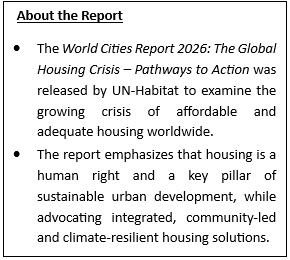
• Housing Affordability Challenges: Around 44% of households globally spend more than 30% of their income on housing.
• Informal Settlements and Urban Exclusion: Informal settlements increased from 895 million people in 2000 to around 1.13 billion in 2024.
• Displacement and Housing Insecurity: By the end of 2024, over 123 million people were forcibly displaced globally due to conflict, violence, persecution and disasters.
• Climate Change and Housing: Climate-related hazards could destroy nearly 167 million homes by 2040.
• Housing as a Human Right: The report highlights that forced evictions, insecure tenure and homelessness remain major human rights concerns.
• Successful Global Examples: Thailand’s Baan Mankong programme is highlighted for community-driven upgrading of informal settlements.
About the United Nations Human Settlements Programme (UN-Habitat)
• It is the United Nations agency responsible for human settlements and sustainable urban development.
• Established in 1978 after the Habitat I Conference (Vancouver, 1976), it promotes inclusive, safe, resilient and sustainable cities to ensure adequate shelter for all.
• Headquartered in Nairobi, UN-Habitat supports countries through research, policy support, technical assistance and capacity-building on sustainable urbanization.
• India and UN-Habitat: India has been associated with UN-Habitat since its inception and played a major role in establishing the United Nations Centre for Human Settlements in 1976.
• India’s Engagement with UN-Habitat and Urban Initiatives: India’s engagement with UN-Habitat aligns with major urban initiatives such as the Smart Cities Mission, AMRUT, HRIDAY, National Urban Livelihoods Mission and the National Rurban Mission.
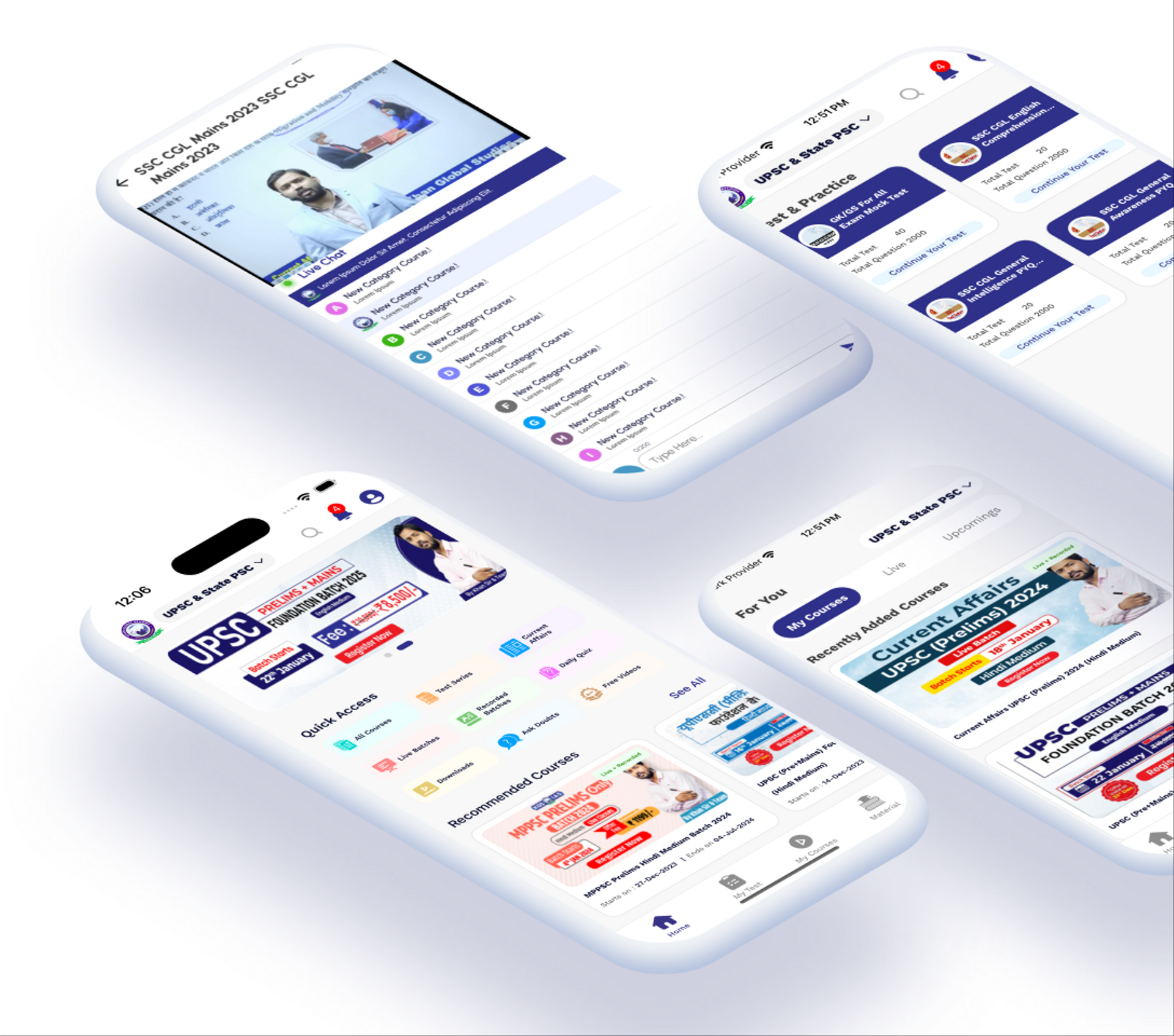
The most trusted learning platform on your phone
With our training programs, learning online can be a very exciting experience! Take the next step toward achieving your professional and personal objectives


Course Related Query:
Ask Your DoubtsStore Related Query:[email protected]NCERT Books
Resources
We love learning. Through our innovative solutions, we encourage ourselves, our teams, and our Students to grow. We welcome and look for diverse perspectives and opinions because they enhance our decisions. We strive to understand the big picture and how we contribute to the company’s objectives. We approach challenges with optimism and harness the power of teamwork to accomplish our goals. These aren’t just pretty words to post on the office wall. This is who we are. It’s how we work. And it’s how we approach every interaction with each other and our Students.
Come with an open mind, hungry to learn, and you’ll experience unmatched personal and professional growth, a world of different backgrounds and perspectives, and the freedom to be you—every day. We strive to build and sustain diverse teams and foster a culture of belonging. Creating an inclusive environment where every students feels welcome, appreciated, and heard gives us something to feel (really) good about.
Get Free academic Counseling & Course Details