You're all caught up—no notifications available.
Explore All Exams at KGS


All Exams
Explore All Exams at KGS

Khan Sir Courses
Geography I Polity I History | World Map I Indian Map I Economics I Biology

UPSC & State PSC
UPSC I BPSC I UP-PSC I MP-PSC

State Exams
UP I Bihar I MP | Rajasthan

NEET | JEE | CUET
NEET | JEE | CUET

Defence Exams
NDA I CDS I CAPF I AFCAT I SSB I Agniveer

Police Exams
UP SI | Bihar SI | Delhi Police | UP Constable

SSC Exams
CGL I CPO I CHSL I MTS I SSC GD I Delhi Police

Foundation Courses
Physics I Chemistry I Biology I History I Geography I Polity I NCERT I Math I English | Map I Reasoning

Railway Exams
RRB | RPF

Teaching Exams
TET | Teaching | UGC

Banking Exams
SBI | RBI | IBPS

Engineering Exams
Civil | Electrical | Mechanical
UGC NET
UGC NET/JRF
Current Affairs provides you with the best compilation of the Daily Current Affairs taking place across the globe: National, International, Sports, Science and Technology, Banking, Economy, Agreement, Appointments, Ranks, and Report and General Studies

SYLLABUS
GS-2: Statutory, Regulatory and various Quasi-judicial Bodies.
GS-3: Indian Economy and issues relating to planning, mobilization, of resources, growth, development and employment.
Context: Recently, the Lok Sabha has passed the Insolvency and Bankruptcy Code (Amendment) Bill, 2025 to strengthen India’s insolvency resolution framework through faster timelines, creditor-led processes, and alignment with global best practices.
More on the News
• The Bill was introduced on August 12, 2025, and later referred to a Select Committee, which submitted its report in December 2025.
• The government accepted all 11 recommendations of the Committee and added one additional provision, making a total of 12 amendments.
• The IBC has significantly improved banking sector health, with ₹1,04,099 crore recovered overall, including ₹54,528 crore (52.3%) through IBC, and 1,376 companies resolved with recoveries of about ₹4.11 lakh crore.
• The finance minister emphasised that the IBC is not merely a debt recovery tool but a resolution mechanism aimed at rescuing viable businesses, preserving value, and protecting jobs.
About the Insolvency and Bankruptcy Code, 2016
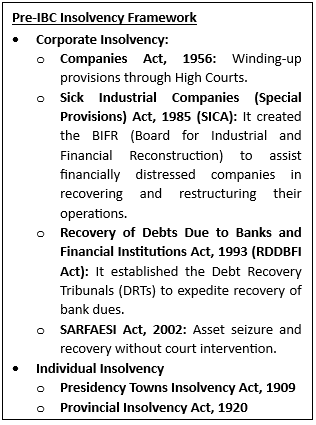
• It is an Act to consolidate and amend the laws relating to reorganisation and insolvency resolution of corporate persons, partnership firms and individuals in a time-bound manner.
• T.K. Viswanathan Committee, 2014 provided the draft Insolvency and Bankruptcy Code.
• Objectives:
• Key Institutions:
Key Amendments in IBC (Amendment) Bill, 2025
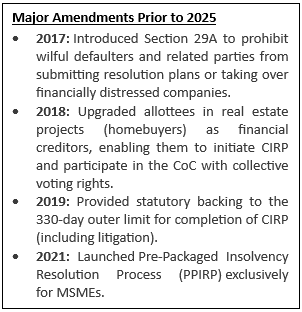
• Creditor-Initiated Insolvency Framework (CIIRP): The Bill replaces the underutilised fast-track CIRP with a creditor-initiated framework allowing out-of-court initiation.
• Strict Timelines for Faster Resolution: The amendments prescribe time-bound processes, including admission of cases within 14 days, approval of resolution plans within 30 days, and disposal of appeals within 3 months.
• Group and Cross-Border Insolvency: The Bill introduces enabling provisions for group insolvency and cross-border insolvency to address cases involving multiple entities and jurisdictions.
• Strengthening Role of Committee of Creditors (CoC): The CoC is empowered to appoint or remove the liquidator and supervise the liquidation process.
• Changes in Liquidation Process: The amendments remove the quasi-judicial powers of the liquidator and place the liquidation process under the supervision of the CoC.
• Measures to Reduce Delays and Litigation: To address delays caused by litigation, the Bill mandates admission of cases once default is established and requires written reasons for delays beyond 14 days.
• Penalties to Prevent Misuse: The Bill introduces penalties ranging from ₹1 lakh to ₹2 crore for filing frivolous or vexatious applications.
• Safeguards and Governance Reforms: The amendments address conflicts of interest among resolution professionals, strengthen oversight by the Insolvency and Bankruptcy Board of India, and enhance transparency in CoC functioning.
• Retention and Refinement of Existing Mechanisms: While removing the fast-track insolvency process, the Bill retains and strengthens the pre-packaged insolvency resolution process for MSMEs.
Sources:
Indian Express
The Hindu
Economic Times
New Indian Express
The Statesman

Government Revises PM e-DRIVE Scheme
Insolvency and Bankruptcy Code (Amendment) Bill, 2025

The most trusted learning platform on your phone
With our training programs, learning online can be a very exciting experience! Take the next step toward achieving your professional and personal objectives



Course Related Query:
Ask Your DoubtsStore Related Query:[email protected]NCERT Books
Resources
We love learning. Through our innovative solutions, we encourage ourselves, our teams, and our Students to grow. We welcome and look for diverse perspectives and opinions because they enhance our decisions. We strive to understand the big picture and how we contribute to the company’s objectives. We approach challenges with optimism and harness the power of teamwork to accomplish our goals. These aren’t just pretty words to post on the office wall. This is who we are. It’s how we work. And it’s how we approach every interaction with each other and our Students.
Come with an open mind, hungry to learn, and you’ll experience unmatched personal and professional growth, a world of different backgrounds and perspectives, and the freedom to be you—every day. We strive to build and sustain diverse teams and foster a culture of belonging. Creating an inclusive environment where every students feels welcome, appreciated, and heard gives us something to feel (really) good about.
Get Free academic Counseling & Course Details