You're all caught up—no notifications available.
Explore All Exams at KGS


All Exams
Explore All Exams at KGS

Khan Sir Courses
Geography I Polity I History | World Map I Indian Map I Economics I Biology
UPSC & State PSC
UPSC I BPSC I UP-PSC I MP-PSC

State Exams
UP I Bihar I MP | Rajasthan

NEET | JEE | CUET
NEET | JEE | CUET

Defence Exams
NDA I CDS I CAPF I AFCAT I SSB I Agniveer

Police Exams
UP SI | Bihar SI | Delhi Police | UP Constable

SSC Exams
CGL I CPO I CHSL I MTS I SSC GD I Delhi Police

Foundation Courses
Physics I Chemistry I Biology I History I Geography I Polity I NCERT I Math I English | Map I Reasoning

Railway Exams
RRB | RPF

Teaching Exams
TET | Teaching | UGC

Banking Exams
SBI | RBI | IBPS

Engineering Exams
Civil | Electrical | Mechanical
UGC NET
UGC NET/JRF
Current Affairs provides you with the best compilation of the Daily Current Affairs taking place across the globe: National, International, Sports, Science and Technology, Banking, Economy, Agreement, Appointments, Ranks, and Report and General Studies

Thomas & Uber Cup 2026
Context: The Thomas & Uber Cup 2026, held in Horsens, Denmark (24 April–3 May 2026), concluded with China winning the Thomas Cup and South Korea clinching the Uber Cup.
About the Thomas & Uber Cup 2026
• The tournament marked the 34th edition of the Thomas Cup and 31st edition of the Uber Cup, organised by the Badminton World Federation and hosted by Badminton Denmark.
• The Thomas Cup (men’s) and Uber Cup (women’s), named after Sir George Thomas and Betty Uber, are biennial team championships determining the best national teams in badminton.
• The competition featured 16 teams in each category, beginning with a group stage (4 groups of 4 teams) followed by knockout rounds.
• In the final results, China defeated France 3–1 to retain the Thomas Cup (continuing its dominance), while South Korea beat China 3–1 to win its third Uber Cup title.
• Denmark qualified automatically as host and China as defending champion, with remaining teams qualifying through continental championships and world rankings.
• India qualified for the Thomas & Uber Cup 2026 but did not reach the knockout stage.
CINBAX-II 2026
Context: The Indian Army has deployed a contingent to Cambodia for the second edition of the India–Cambodia bilateral military exercise CINBAX-II, scheduled from 4 to 17 May 2026.
About CINBAX-II
• CINBAX-II 2026 is the second edition of the bilateral joint military exercise between India and Cambodia, being conducted at the Techo Sen Phnom Thom Mreas Provincial Royal Cambodian Air Force Training Centre (Camp Basil) in Kampong Speu Province, Cambodia.
• The exercise is held under the framework of Chapter VII of the United Nations mandate and focuses on company-level joint operations in a sub-conventional environment.
• The Indian Army contingent consists of 120 personnel, primarily from a battalion of the Maratha Light Infantry Regiment, while the Cambodian side has deployed 160 personnel from the Royal Cambodian Army.
• The exercise is aligned with the evolving dynamics of counter-terrorism operations, particularly those encountered during UN peacekeeping missions.
• The training programme includes a mix of tactical drills, structured discussions, and a final validation exercise.
• Specialised modules such as drone operations, mortar handling, and sniper tactics are also part of the exercise, aimed at enhancing operational readiness.
• The primary objective of CINBAX-II is to improve interoperability, coordination, and operational synergy between the armed forces of both countries.
• It also serves as a platform for exchanging best practices and sharing operational experiences, especially in semi-urban combat environments.
Project Deepak (BRO)
Context: Project Deepak of the Border Roads Organisation (BRO) celebrated its 66th Raising Day at Shimla, marking over six decades of strategic infrastructure development in the Western Himalayas.
About Project Deepak
• Project Deepak is one of the oldest and most significant projects of the BRO, raised in May 1961 with its headquarters at Shimla under the leadership of Col S. N. Punj.
• Initially tasked with constructing the historic Hindustan-Tibet Road, one of the toughest road projects in India, its scope expanded over time to include extensive infrastructure development across challenging terrains.
• The project’s area of responsibility primarily covers key districts of Himachal Pradesh—Shimla, Kinnaur, Kullu, and Lahaul-Spiti—while earlier it also extended to Punjab, Haryana, Rajasthan, and parts of Uttar Pradesh.
• It has been entrusted with maintaining over 1,100 km of critical road network, including high-altitude and border roads essential for defence logistics.
• Project Deepak has played a pivotal role in developing strategic routes such as the Manali–Leh axis and the Rishikesh–Joshimath–Mana road.
• During the Kargil War (Operation Vijay), it ensured the operational readiness of alternate routes like Manali–Sarchu despite heavy military traffic, highlighting its importance in national security.
• The project also contributed to landmark infrastructure initiatives such as the Atal Tunnel, whose construction was initiated under its supervision before a separate project unit was created.
• Its name “Deepak” symbolises its mission to bring connectivity, development, and hope to far-flung regions.
Fugitive Economic Offenders
Context: According to its annual report, the Enforcement Directorate (ED) has declared 21 people, including businessmen Nirav Modi and Vijay Mallya, as fugitive economic offenders (FEOs) over the past seven years.
About FEO
• A Fugitive Economic Offender is a person accused of economic offences involving ₹100 crore or more who evades legal proceedings by remaining outside India.
• The framework is governed by the Fugitive Economic Offenders Act, 2018.
• Key features include:
Significance
• Strengthens deterrence against economic offences by targeting wealth rather than only individuals.
• Helps in the recovery of public money, especially from bank fraud cases.
• Enhances India’s credibility in global financial governance and anti-money laundering regimes.
Challenges
• Extradition hurdles due to legal complexities and differing judicial standards across countries.
• Delay in judicial processes, reducing the speed of asset recovery.
• Concerns over due process and property rights, as confiscation precedes conviction.
INS MAHENDRAGIRI
Context: The Indian Navy recently received the indigenous stealth frigate INS Mahendragiri from Mazagon Dock Shipbuilders Limited.
About INS Mahendragiri
• INS Mahendragiri is the sixth stealth guided-missile frigate of the Nilgiri-class under Project 17A, designed by the Indian Navy’s Warship Design Bureau and built by Mazagon Dock Shipbuilders Limited.
• It is a multi-role warship with capabilities spanning anti-surface, anti-air, and anti-submarine warfare, supported by an advanced suite of weapons and sensors.
• The ship has an approximate displacement of about 6,670 tonnes, placing it among the most advanced frigates in its class.
• It incorporates enhanced stealth features, including reduced radar cross-section and improved survivability, along with a high degree of automation.
• The propulsion system follows a CODOG (Combined Diesel or Gas) configuration with controllable pitch propellers, enabling optimal speed and fuel efficiency.
• With an indigenous content of nearly 75%, the platform reflects significant domestic capability and has involved over 200 MSMEs, generating substantial direct and indirect employment.
About Project 17A
• Project 17A is an advanced follow-on to Project 17 (Shivalik-class), aimed at building seven stealth guided-missile frigates with superior stealth, automation, and combat capabilities.
• The programme involves construction at two major shipyards: Mazagon Dock Shipbuilders Limited (4 ships) and Garden Reach Shipbuilders & Engineers (3 ships).
• The seven frigates under the project are Nilgiri, Himgiri, Udaygiri, Dunagiri, Taragiri, Mahendragiri, and Vindhyagiri.
• The project incorporates modular (integrated) construction techniques, leading to improved build efficiency, quality control, and reduced construction timelines.
• P17A frigates represent a quantum leap in indigenous naval design, featuring advanced stealth, improved survivability, and next-generation combat systems compared to the earlier Shivalik-class.
India’s First Portable MRI System
Context: The All India Institute of Medical Sciences (AIIMS) Delhi has introduced India’s first portable bedside MRI system, marking a major advancement in critical care diagnostics.
About MRI (Magnetic Resonance Imaging)
• MRI is a non-invasive imaging technique that uses strong magnetic fields and radio waves to generate detailed images of internal body structures.
• It is particularly effective for soft tissue imaging, including the brain, spinal cord, and organs, without using ionising radiation (unlike CT scans or X-rays).
• Conventional MRI machines are large, fixed installations requiring specialised infrastructure and patient transport.
About the Portable MRI System
• It is an ultra-low-field MRI device that can be wheeled directly to the patient’s bedside, eliminating the need for dedicated MRI suites.
• The system enables real-time brain imaging for conditions such as stroke, traumatic brain injury, and post-operative monitoring.
• It uses AI-assisted image reconstruction, improving scan efficiency and diagnostic accuracy.
• It does not require specialised infrastructure like shielded rooms, making it suitable for ICUs and resource-limited settings.
Significance
• Improved Critical Care Delivery: The system enhances patient safety by eliminating risks associated with transporting unstable patients for imaging.
• Faster Diagnosis and Treatment: It enables quicker clinical decision-making in neurological emergencies such as stroke and trauma, thereby improving patient outcomes.
• Healthcare Accessibility and Innovation: Its portable, low-infrastructure design expands access to advanced imaging and reflects the integration of AI and point-of-care technologies in India’s healthcare system.
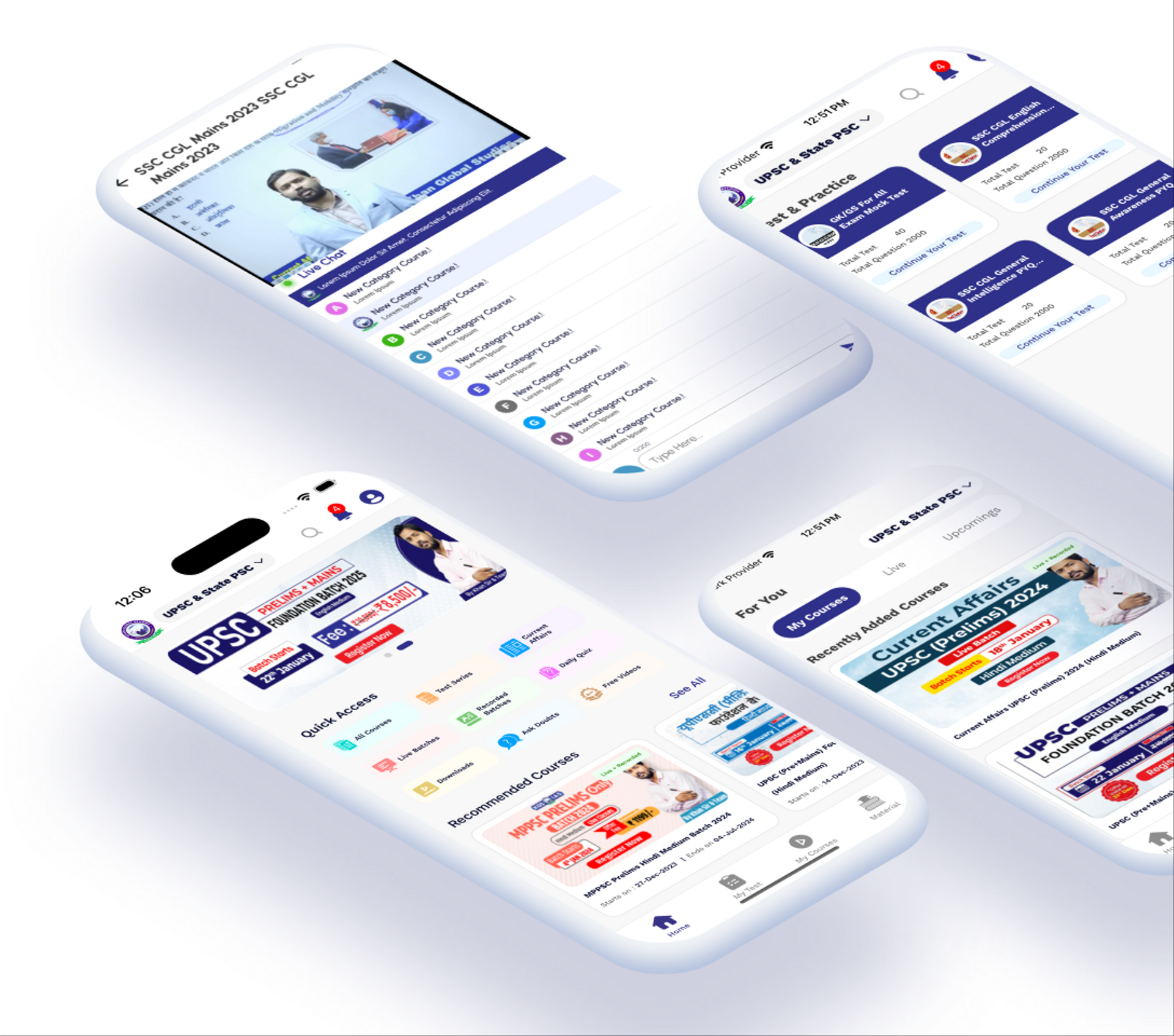
The most trusted learning platform on your phone
With our training programs, learning online can be a very exciting experience! Take the next step toward achieving your professional and personal objectives



Course Related Query:
Ask Your DoubtsStore Related Query:[email protected]NCERT Books
Resources
We love learning. Through our innovative solutions, we encourage ourselves, our teams, and our Students to grow. We welcome and look for diverse perspectives and opinions because they enhance our decisions. We strive to understand the big picture and how we contribute to the company’s objectives. We approach challenges with optimism and harness the power of teamwork to accomplish our goals. These aren’t just pretty words to post on the office wall. This is who we are. It’s how we work. And it’s how we approach every interaction with each other and our Students.
Come with an open mind, hungry to learn, and you’ll experience unmatched personal and professional growth, a world of different backgrounds and perspectives, and the freedom to be you—every day. We strive to build and sustain diverse teams and foster a culture of belonging. Creating an inclusive environment where every students feels welcome, appreciated, and heard gives us something to feel (really) good about.
Get Free academic Counseling & Course Details