logo

All Exams

Notifications

All Exams

Explore All Exams at KGS

All Exams
Home>Current Affairs>State of India’s Bats (SoIBats) 2024–25 Report
Current Affairs made simple.

Current Affairs provides you with the best compilation of the Daily Current Affairs taking place across the globe: National, International, Sports, Science and Technology, Banking, Economy, Agreement, Appointments, Ranks, and Report and General Studies

banner-image

State of India’s Bats (SoIBats) 2024–25 Report

SYLLABUS

GS-3: Conservation, environmental pollution and degradation, environmental impact assessment.

Context: The State of India’s Bats (SoIBats) 2024–25, the first-ever national bat assessment, highlights a serious lack of research centres and data gaps despite India hosting around 135 bat species, making bats the largest order of mammals in the country.

About State of India’s Bats (2024–25) Report

  • Thirty-four experts from 27 institutions carried out the two-year study titled ‘State of India’s Bats.
  • The SoIbats was conducted in collaboration with the Nature Conservation Foundation (NCF) and Bat Conservation International (BCI).

Key Findings of the Report

  • Data Deficit and Neglect: The report underlined that data deficit and neglect of bats is a major concern.
    • Around 35 species are either not assessed or data deficient, which means the current conservation picture is incomplete. This lack of data prevents accurate evaluation of species status and risks.
  • Ecological Importance of Bats: Bats play a crucial role in pollinating plants, dispersing fruit seeds, controlling pests that damage crops, and providing soil nutrition through their droppings. Their ecosystem services directly support agriculture, biodiversity, and soil health.
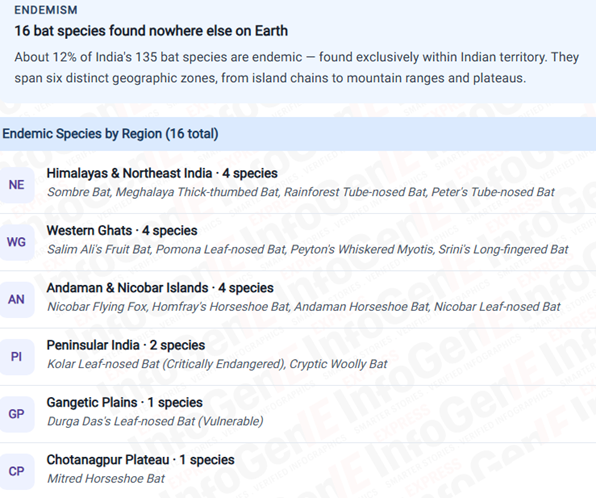
  • Endemism and Threat Status: Out of 135 bat species, 16 are endemic (about 12 percent), meaning they are found only in India.
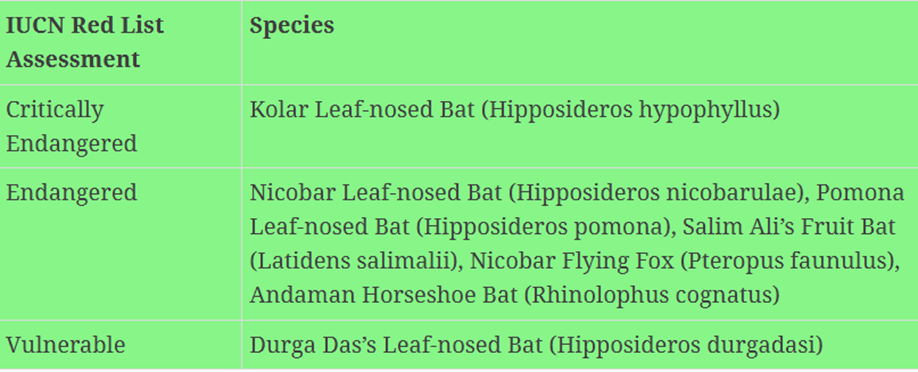
    •  Among these, seven species are listed under threatened categories by the International Union for Conservation of Nature Red List.
  • Distribution and Diversity Pattern: The report documented significant inter-variability in distribution. West Bengal leads with 68 species, followed by Meghalaya (66), Uttarakhand (52), Sikkim (43), and Kerala and Karnataka with 41 each.
    • In contrast, Haryana and Punjab recorded only five species, largely due to limited forest cover and farm expansion.
    • An important urban insight is that Delhi recorded 15 bat species despite urbanisation pressures, showing adaptability but also highlighting habitat stress.
  • Roosting Behaviour and Habitat: Bats were found to roost across natural habitats and man-made structures. Caves and trees are the most common roosting sites, with caves offering a stable microclimate and protection from environmental fluctuations and predators.
    • A notable example is the Robber’s cave in Mahabaleshwar, which hosts nearly 1 lakh individuals of Phillip’s long-fingered bat during the breeding season.
    • Certain species show extreme habitat specificity. The Critically Endangered Hipposideros hypophyllus is known from only one cave at the base of a granite hill in Kolar district, Karnataka.
  • Regional Research Bias: Most studies on the ecology and biology of bats are concentrated in the southern states, particularly the Western Ghats biodiversity hotspot, leaving large parts of India under-researched.

    Threats to Bat Species

  • Habitat loss driven by urbanisation, deforestation, land-use changes, and climate change is a major factor impacting bat populations.
  • Mining activities and hunting pose direct threats to certain species, especially those with restricted habitats.
  • Negative public perception of bats has intensified, particularly after the COVID-19 pandemic, leading to stigma and persecution.
  • Bats are often misrepresented only as disease carriers, ignoring their ecological importance, which further aggravates their conservation challenges.

Recommendations

  • Expand research and monitoring, particularly in under-studied regions, to address data gaps.
  • Strengthen disease surveillance systems, especially in biodiversity hotspots like the Northeast and Western Ghats.
  • Enhance public awareness to reduce stigma and promote understanding of bats’ ecological role.
  • Promote collaboration among government agencies, researchers, and conservation organisations.
  • Prioritise habitat protection, focusing on critical roosting sites such as caves and forests.

About Bats

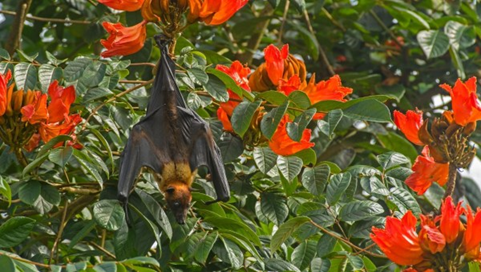
  • Bats are the only mammals capable of true flight and belong to the order Chiroptera.
  • They exhibit remarkable size variation, ranging from flying foxes with wingspans up to 2 metres and weighing 1.5 kilograms, to the bumblebee bat weighing only 2 grams, the smallest mammal in the world.

Key Characteristics:

  • Echolocation: Most microbats use echolocation, a highly refined biological sonar in which they emit ultrasonic calls (20–200 kHz) and interpret returning echoes to navigate and hunt. Contrary to popular belief, bats are not blind, and their vision varies across species.
  • Anatomy:Their characteristic upside-down roosting is an adaptation that enables efficient take-off, as their wings cannot generate lift from a stationary ground position and their hind limbs are not suited for running.
  • Bats and Zoonotic Diseases: Bats are recognised as reservoirs of several zoonotic pathogens, including Nipah virus, Hendra virus, Marburg virus, and SARS-like coronaviruses.
    • Their ecological traits—such as large colony sizes, long lifespan, seasonal migration, mixed-species roosting, and transplacental transmission—facilitate the maintenance and spread of viruses.
    • The Nipah virus is primarily associated with fruit bats of genus Pteropus, with transmission occurring through contaminated fruits or raw date palm sap.
    • The Marburg virus is linked to Rousettus fruit bats, while coronaviruses are commonly found in horseshoe bats.
  • Evolutionary Perspective: Evidence suggests that bats evolved around 52–50 million years ago, coinciding with a rise in global temperature and emergence of zoonotic viruses, indicating a long history of host-virus co-evolution.

Conclusion

The SoIBats 2024–25 report reveals that despite their ecological significance and diversity, bats in India remain understudied, underfunded, and often misunderstood. Bridging the data deficit, expanding research infrastructure, and protecting critical habitats are essential for ensuring their conservation and maintaining ecological balance.

footer image

The most trusted learning platform on your phone

With our training programs, learning online can be a very exciting experience! Take the next step toward achieving your professional and personal objectives


app-storeplay-store
logo
Khan Global Studies Pvt. Ltd. 5th Floor,
A13A, Graphix 1 Tower B, Sector 62,
Noida, Uttar Pradesh 201309

Course Related Query:

Ask Your DoubtsStore Related Query:[email protected]

Get Free Academic Counseling & Course Details

KGS best learning platform

About Khan Global Studies

We love learning. Through our innovative solutions, we encourage ourselves, our teams, and our Students to grow. We welcome and look for diverse perspectives and opinions because they enhance our decisions. We strive to understand the big picture and how we contribute to the company’s objectives. We approach challenges with optimism and harness the power of teamwork to accomplish our goals. These aren’t just pretty words to post on the office wall. This is who we are. It’s how we work. And it’s how we approach every interaction with each other and our Students.


What Makes Us Different

Come with an open mind, hungry to learn, and you’ll experience unmatched personal and professional growth, a world of different backgrounds and perspectives, and the freedom to be you—every day. We strive to build and sustain diverse teams and foster a culture of belonging. Creating an inclusive environment where every students feels welcome, appreciated, and heard gives us something to feel (really) good about.

Copyright 2026 KhanGlobalStudies

Have a question?

Get Free academic Counseling & Course Details

floatButton
State of India’s Bats (SoIBats) 2024–25 Report | Current Affairs