Explore All Exams at KGS


All Exams
Explore All Exams at KGS

Khan Sir Courses
Geography I Polity I History | World Map I Indian Map I Economics I Biology

UPSC & State PSC
UPSC I BPSC I UP-PSC I MP-PSC

Judiciary
CLAT

State Exams
UP I Bihar I MP | Rajasthan

NEET | JEE | CUET
NEET | JEE | CUET

Defence Exams
NDA I CDS I CAPF I AFCAT I SSB I Agniveer

Police Exams
UP SI | Bihar SI | Delhi Police | UP Constable

SSC Exams
CGL I CPO I CHSL I MTS I SSC GD I Delhi Police

Foundation Courses
Physics I Chemistry I Biology I History I Geography I Polity I NCERT I Math I English | Map I Reasoning

Railway Exams
RRB | RPF

Teaching Exams
TET | Teaching | UGC

Banking Exams
SBI | RBI | IBPS

Engineering Exams
Civil | Electrical | Mechanical
UGC NET
UGC NET/JRF
Current Affairs provides you with the best compilation of the Daily Current Affairs taking place across the globe: National, International, Sports, Science and Technology, Banking, Economy, Agreement, Appointments, Ranks, and Report and General Studies
Current Affairs
SYLLABUS
GS-3: Conservation, environmental pollution and degradation, environmental impact assessment.
Context: The Ministry of Environment, Forest and Climate Change (MoEFCC) and the National Biodiversity Authority (NBA) have launched a five-year (2025–2030) project to strengthen grassroots biodiversity governance through community-led planning and innovative financing.
About the Project
• The project titled “Strengthening Institutional Capacities for Securing Biodiversity Conservation Commitments” is a joint initiative of the Government of India, the Global Environment Facility (GEF), and the United Nations Development Programme, with a grant of USD 4.88 million.
• It seeks to integrate biodiversity conservation into Gram Panchayat Development Plans (GPDPs), ensuring that conservation becomes a core component of village-level governance rather than a standalone environmental activity.
• The governance architecture follows a bottom-up approach, with Panchayati Raj Institutions (PRIs) playing a central managerial role, supported by Biodiversity Management Committees (BMCs).
• The project also adopts a “Whole-of-Government” and “Whole-of-Society” approach, ensuring convergence across departments, institutions, and communities.
• The project is rooted in two ecologically rich landscapes:
• These landscapes serve as pilot regions for community-led, landscape-level biodiversity governance models.
• Key Objectives and Strategic Components:
Policy Alignment and Global Linkages
• India’s Updated National Biodiversity Strategy and Action Plan (NBSAP 2024–2030).
• The 30×30 target under the Kunming-Montreal Global Biodiversity Framework.
• India’s Nationally Determined Contributions (NDCs) under the Paris Agreement.
• State-level visions such as Tamil Nadu Vision 2030 and Meghalaya Vision 2030.
Significance
• Operationalizes Global Biodiversity Goals: Provides a practical model for achieving the 30×30 target through community-led conservation and OECMs.
• Decentralizes Environmental Governance: Embeds biodiversity into GPDPs, transforming over 2.6 lakh Gram Panchayats into active conservation units.
• Strengthens Climate Action: Links local biodiversity conservation with India’s climate commitments under NDCs and adaptation strategies.
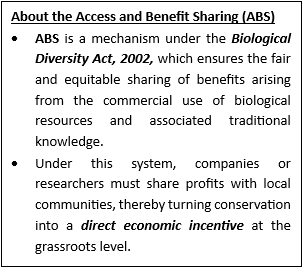
• Promotes Sustainable Livelihoods: Creates economic incentives through ABS, CSR funding, and green micro-enterprises.
• Reduces Human-Wildlife Conflict: Enhances community stewardship in ecologically sensitive corridors like Sathyamangalam and Garo Hills.
• Empowers Marginalized Communities: Strengthens participation and leadership of women, Scheduled Castes, and tribal groups.
• Enables Scalable Governance Models: Captures and replicates successful biodiversity financing and governance innovations across India’s districts.
• Supports Inclusive Development Vision: Aligns conservation with the broader goal of “Viksit Bharat” through sustainable and participatory growth.
Khan Global Studies App
With our training programs, learning online can be a very exciting experience. Take the next step toward achieving your professional and personal objectives.


Course Related Query:
Ask Your DoubtsStore Related Query:[email protected]NEET | JEE | CUET
NCERT Books
Resources
We love learning. Through our innovative solutions, we encourage ourselves, our teams, and our Students to grow. We welcome and look for diverse perspectives and opinions because they enhance our decisions. We strive to understand the big picture and how we contribute to the company’s objectives. We approach challenges with optimism and harness the power of teamwork to accomplish our goals. These aren’t just pretty words to post on the office wall. This is who we are. It’s how we work. And it’s how we approach every interaction with each other and our Students.
Come with an open mind, hungry to learn, and you’ll experience unmatched personal and professional growth, a world of different backgrounds and perspectives, and the freedom to be you—every day. We strive to build and sustain diverse teams and foster a culture of belonging. Creating an inclusive environment where every students feels welcome, appreciated, and heard gives us something to feel (really) good about.