You're all caught up—no notifications available.
Explore All Exams at KGS


All Exams
Explore All Exams at KGS

Khan Sir Courses
Geography I Polity I History | World Map I Indian Map I Economics I Biology

UPSC & State PSC
UPSC I BPSC I UP-PSC I MP-PSC

State Exams
UP I Bihar I MP | Rajasthan

NEET | JEE | CUET
NEET | JEE | CUET

Defence Exams
NDA I CDS I CAPF I AFCAT I SSB I Agniveer

Police Exams
UP SI | Bihar SI | Delhi Police | UP Constable

SSC Exams
CGL I CPO I CHSL I MTS I SSC GD I Delhi Police

Foundation Courses
Physics I Chemistry I Biology I History I Geography I Polity I NCERT I Math I English | Map I Reasoning

Railway Exams
RRB | RPF

Teaching Exams
TET | Teaching | UGC

Banking Exams
SBI | RBI | IBPS

Engineering Exams
Civil | Electrical | Mechanical
UGC NET
UGC NET/JRF
Current Affairs provides you with the best compilation of the Daily Current Affairs taking place across the globe: National, International, Sports, Science and Technology, Banking, Economy, Agreement, Appointments, Ranks, and Report and General Studies

SYLLABUS
GS-2: Government Policies and Interventions for Development in various sectors and Issues arising out of their Design and Implementation; Issues Relating to Development and Management of Social Sector/Services relating to Health, Education, Human Resources.
Context: NITI Aayog has released a comprehensive report titled “School Education System in India: Temporal Analysis and Policy Roadmap for Quality Enhancement”.
More on the News
• The report undertakes a longitudinal assessment of India’s school education system over a decade and proposes a policy roadmap aligned with the objectives of the National Education Policy (NEP), 2020.
• It examines the performance of school education across key parameters such as access and enrolment, infrastructure, equity and inclusion, and learning outcomes.
• It draws on secondary data from UDISE+ 2024-25, PARAKH Rashtriya Sarvekshan 2024, NAS 2017 and 2021, and ASER 2024.
• This Report reviews the present state of the system, identifies the challenges that must be addressed, and recommends policy interventions and an implementation roadmap to achieve the vision of achieving universal access, raising learning standards, and ensuring equity across all stages of schooling.
Present State of School Education in India
Scale and Access
• India's school education system today spans 14.71 lakh schools, serving over 24.69 crore students, making it the largest system in the world.
• Gross Enrolment Ratio (GER) at the elementary stage remains high (90.9%), but participation drops at the secondary (78.7%) and higher secondary (58.4%) levels.
Improvement in Infrastructure
• Significant improvements have been recorded in basic school infrastructure:
• Availability of ICT infrastructure, internet connectivity, and smart classrooms has also improved over the past decade, though regional disparities remain significant.
Equity and Inclusion
• Gender Parity Index (GPI) has improved across most stages of education, indicating greater participation of girls in schooling.
• Enrolment of Scheduled Castes (SCs), Scheduled Tribes (STs), and Other Backward Classes (OBCs) has increased steadily, particularly at elementary levels.
Government vs Private Schooling Trends
• The report notes a gradual decline in enrolment in government schools and an increasing preference for private institutions in many states.
• Government school enrolment declined from around 71% in 2005 to nearly 49% in 2024–25.
Learning Outcomes Remain Weak
• Despite progress in access and infrastructure, learning outcomes remain a major concern:

Key Recommendations of the Report
A. Systemic Recommendations
1. Reform School System and Ensure Structural Continuity: Expansion of integrated/composite schools and seamless stage-wise transition
2. Strengthen School Infrastructure: Universal access to classrooms, electricity, ICT, labs, libraries, and inclusive facilities
3. Reform Governance and Enhance Administrative Capacity: Data-driven governance, institutional leadership, and administrative efficiency
4. Institutionalise a “Whole-of-Society” Approach through State and District Task Forces on School Quality: Multi-stakeholder coordination and decentralised reform monitoring
5. Strengthen School Management Committees (SMCs/SDMCs) and Institutionalise Bottom-Up Planning: Community participation, decentralised planning, and local accountability
6. Elevate Teacher Deployment, Professional Capacity, and Career Progression: Rational teacher deployment, continuous training, and merit-based progression
7. Strengthen and Expand Digital and Broadcast-Based Learning for Inclusive Education: Expansion of digital learning platforms, connectivity, and broadcast education
8. Promote Equity and Inclusion: Targeted support for disadvantaged groups and reduction of regional disparities
A. Academic Recommendations
1. Transform Pedagogy, Assessment, and Foundational Learning: Competency-based learning, FLN strengthening, and assessment reforms
2. Promote Holistic Education and Student Wellbeing: Mental health, socio-emotional learning, arts, sports, and life skills
3. Strengthen Vocational Education and Skill Integration in Schooling: Mainstreaming vocational education and industry-linked skilling
4. Strengthen ECCE: Anganwadi-school integration and improved school readiness programmes
5. Integrate Artificial Intelligence for Pedagogical Innovation and System Readiness: AI-enabled personalised learning and future-ready education systems
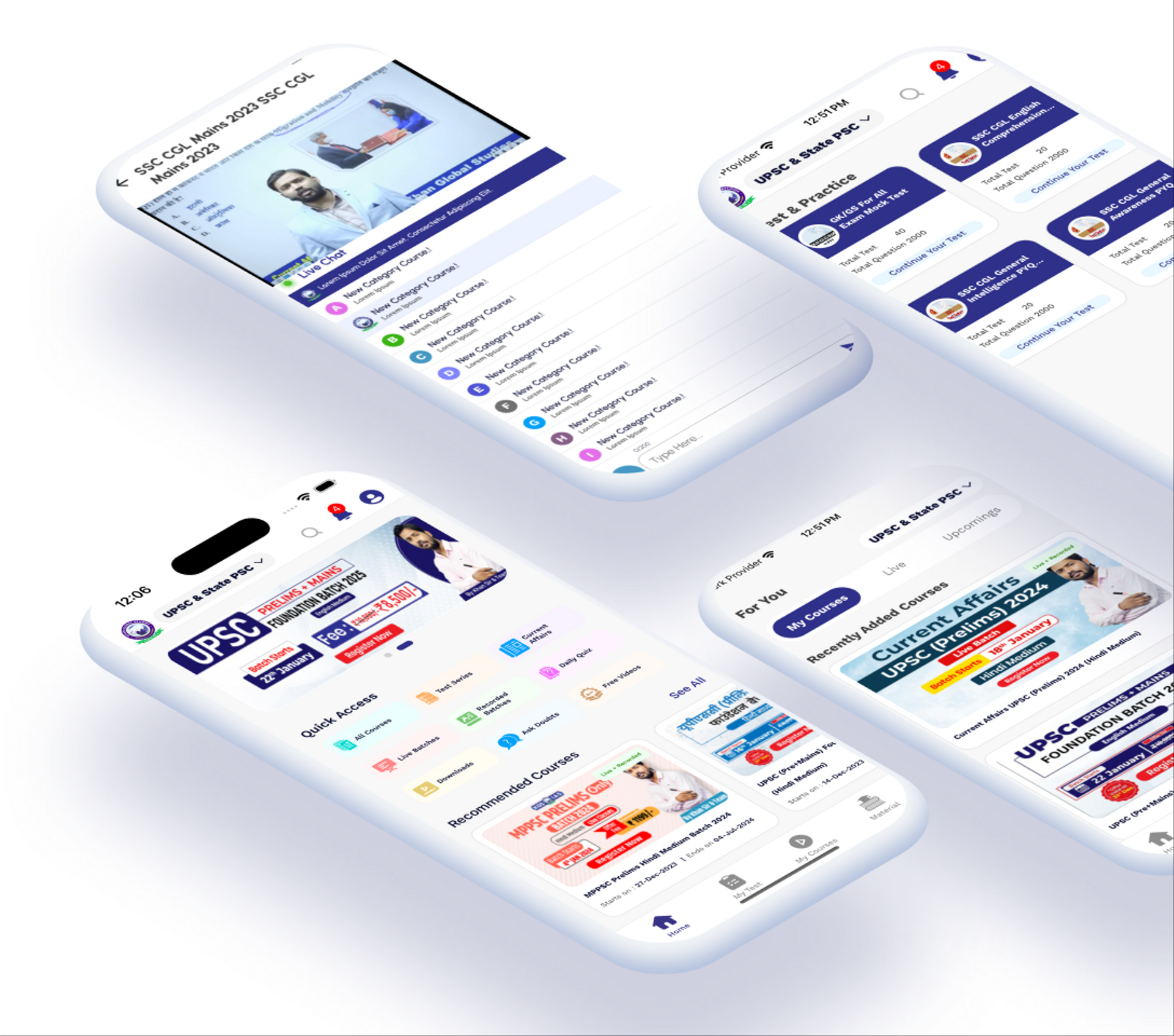
The most trusted learning platform on your phone
With our training programs, learning online can be a very exciting experience! Take the next step toward achieving your professional and personal objectives



Course Related Query:
Ask Your DoubtsStore Related Query:[email protected]NEET | JEE | CUET
NCERT Books
Resources
We love learning. Through our innovative solutions, we encourage ourselves, our teams, and our Students to grow. We welcome and look for diverse perspectives and opinions because they enhance our decisions. We strive to understand the big picture and how we contribute to the company’s objectives. We approach challenges with optimism and harness the power of teamwork to accomplish our goals. These aren’t just pretty words to post on the office wall. This is who we are. It’s how we work. And it’s how we approach every interaction with each other and our Students.
Come with an open mind, hungry to learn, and you’ll experience unmatched personal and professional growth, a world of different backgrounds and perspectives, and the freedom to be you—every day. We strive to build and sustain diverse teams and foster a culture of belonging. Creating an inclusive environment where every students feels welcome, appreciated, and heard gives us something to feel (really) good about.
Get Free academic Counseling & Course Details