You're all caught up—no notifications available.
Explore All Exams at KGS


All Exams
Explore All Exams at KGS

Khan Sir Courses
Geography I Polity I History | World Map I Indian Map I Economics I Biology

UPSC & State PSC
UPSC I BPSC I UP-PSC I MP-PSC

State Exams
UP I Bihar I MP | Rajasthan

NEET | JEE | CUET
NEET | JEE | CUET

Defence Exams
NDA I CDS I CAPF I AFCAT I SSB I Agniveer

Police Exams
UP SI | Bihar SI | Delhi Police | UP Constable

SSC Exams
CGL I CPO I CHSL I MTS I SSC GD I Delhi Police

Foundation Courses
Physics I Chemistry I Biology I History I Geography I Polity I NCERT I Math I English | Map I Reasoning

Railway Exams
RRB | RPF

Teaching Exams
TET | Teaching | UGC

Banking Exams
SBI | RBI | IBPS

Engineering Exams
Civil | Electrical | Mechanical
UGC NET
UGC NET/JRF
Current Affairs provides you with the best compilation of the Daily Current Affairs taking place across the globe: National, International, Sports, Science and Technology, Banking, Economy, Agreement, Appointments, Ranks, and Report and General Studies

SYLLABUS
GS-3: Awareness in the fields of Space; Achievements of Indians in science & technology; indigenization of technology and developing new technology.
Context: Over the last 12 years, India's space sector has transformed into a global space power through scientific achievements, commercialisation, private-sector participation, and international cooperation, aligned with the vision of Aatmanirbhar Bharat and Viksit Bharat 2047.
About Space Sector Status in India
• The space sector was opened to private participation in 2020, followed by the Indian Space Policy 2023.
• The number of registered space startups increased from 1 in 2014 to over 400 by February 2026.
• Investment in Indian space startups crossed $500 million, including nearly $150 million in 2025 alone.
• Major emerging companies include Pixxel, Skyroot Aerospace, Agnikul Cosmos, Dhruva Space, and Bellatrix Aerospace.
• Space Economy: India's space economy is currently valued at approximately $8 billion.
• Institutional Framework
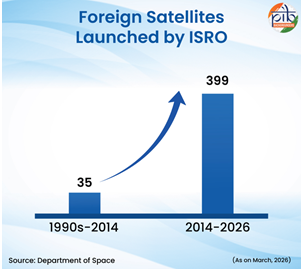
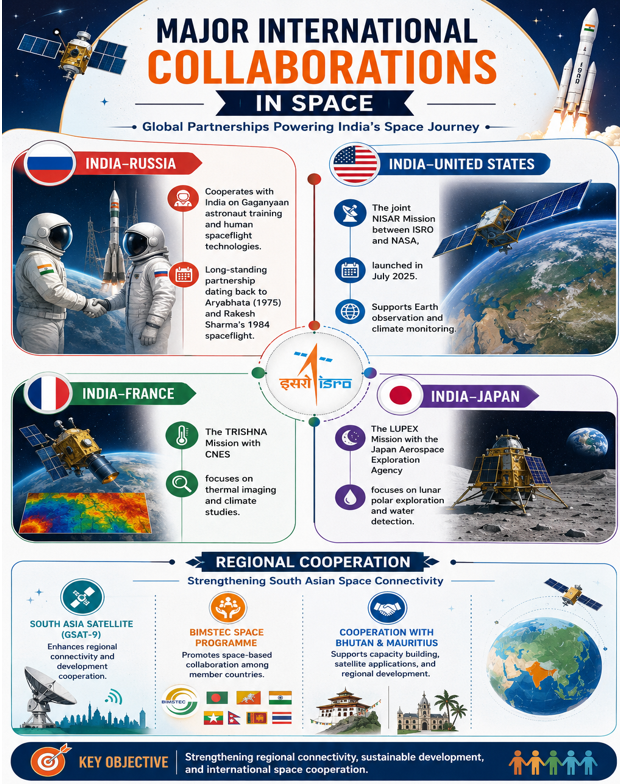
India's Major Space Milestones
• Lunar Exploration Programme (Chandrayaan):
• Mars Orbiter Mission (Mangalyaan): Successfully entered Martian orbit on 24 September 2014, making India the first country to reach Mars on its maiden attempt, and remained operational for more than eight years.
• Aditya-L1 Mission: India's first dedicated solar observatory, positioned at the Sun-Earth L1 Lagrange Point (1.5 million km from Earth), studies the solar corona, solar winds, and space weather, with more than 27 TB of scientific data released.
• Space Science Missions:
• Space Docking Experiment (SPADEX): Successfully demonstrated autonomous docking and undocking in space in January 2025, making India the fourth nation after the United States, Russia, and China to achieve this capability and validating the indigenous Bharatiya Docking System.
• Human Spaceflight Programme (Gaganyaan): Approved in January 2019, Gaganyaan aims to send up to three astronauts to a 400 km Low Earth Orbit for up to three days through two uncrewed missions and one crewed mission.
• Axiom-4 Experience: Group Captain Shubhanshu Shukla participated in the Axiom-4 mission in 2025 and conducted seven microgravity experiments aboard the International Space Station.
• Bharatiya Antariksh Station (BAS): India's planned modular space station under Space Vision 2047, with its first module (BAS-01) approved for launch by 2028, will support long-duration human spaceflight and microgravity research.
• Future Planetary Exploration: Targeted for launch in March 2028, the Venus Orbiter Mission will study Venus' atmosphere, geology, ionosphere, and climate evolution.
Space Sector Reforms and Commercialisation
• Norms, Guidelines and Procedures (NGP) 2024 Framework: Introduced by IN-SPACe, it provides authorization, compliance, and regulatory guidelines for space activities.
• Liberalised Foreign Direct Investment (FDI) Policy (2024): Allows 74% FDI (automatic route) in satellite manufacturing and services, 49% FDI in launch vehicles and spaceports, and 100% automatic route FDI in satellite components and subsystems manufacturing.
• Government Support Measures: Includes the ₹1,000 crore Venture Capital Fund, ₹500 crore Technology Adoption Fund, IN-SPACe Seed Fund Scheme, and the Pre-Incubation Entrepreneurship Programme.
• Operational Launch Vehicles: India's operational launch vehicles include PSLV, GSLV, and LVM3.
• Next Generation Launch Vehicle (NGLV): Being developed with a payload capacity of 30 tonnes to Low Earth Orbit.
• Reusable Launch Vehicle (RLV): Developed to reduce launch costs through reusable space transportation.
• Space Infrastructure Expansion: Includes the second spaceport at Kulasekarapattinam and the approval of a third launch pad at Satish Dhawan Space Centre with an investment of ₹3,984.86 crore.
The most trusted learning platform on your phone
With our training programs, learning online can be a very exciting experience! Take the next step toward achieving your professional and personal objectives



Course Related Query:
Ask Your DoubtsStore Related Query:[email protected]NEET | JEE | CUET
NCERT Books
Resources
We love learning. Through our innovative solutions, we encourage ourselves, our teams, and our Students to grow. We welcome and look for diverse perspectives and opinions because they enhance our decisions. We strive to understand the big picture and how we contribute to the company’s objectives. We approach challenges with optimism and harness the power of teamwork to accomplish our goals. These aren’t just pretty words to post on the office wall. This is who we are. It’s how we work. And it’s how we approach every interaction with each other and our Students.
Come with an open mind, hungry to learn, and you’ll experience unmatched personal and professional growth, a world of different backgrounds and perspectives, and the freedom to be you—every day. We strive to build and sustain diverse teams and foster a culture of belonging. Creating an inclusive environment where every students feels welcome, appreciated, and heard gives us something to feel (really) good about.
Get Free academic Counseling & Course Details