KGS

All Exams

Explore All Exams at KGS

All Exams
Home>Current Affairs>Western Ghats Ecologically Sensitive Area (ESA) Draft Notification
Current Affairs made simple.

Current Affairs provides you with the best compilation of the Daily Current Affairs taking place across the globe: National, International, Sports, Science and Technology, Banking, Economy, Agreement, Appointments, Ranks, and Report and General Studies

banner-image

Current Affairs

Western Ghats Ecologically Sensitive Area (ESA) Draft Notification

SYLLABUS

GS-3: Conservation, environmental pollution and degradation, environmental impact assessment.

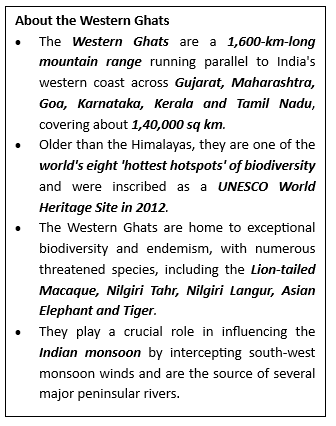
Context: The Union Ministry of Environment, Forest and Climate Change (MoEFCC) has issued the seventh draft notification proposing 56,825.7 sq. km of the Western Ghats as an Ecologically Sensitive Area (ESA) after the previous draft lapsed without being finalised.

Key Highlights of the Draft Notification

  • The draft proposes 56,825.7 sq. km of the Western Ghats as ESA across six StatesKarnataka (20,668 sq. km), Maharashtra (17,340 sq. km), Kerala (9,993.7 sq. km), Tamil Nadu (6,914 sq. km), Goa (1,461 sq. km) and Gujarat (449 sq. km).
  • Gujarat and Goa have largely agreed on the proposed ESA; Maharashtra's revised proposal is under appraisal, Karnataka continues to oppose the notification, while discussions with Kerala and Tamil Nadu are continuing.
  • An expert committee, constituted in April 2022 and headed by Sanjay Kumar (former Director General of Forests, MoEFCC), is examining State objections regarding village names, area discrepancies and other suggestions.
    • Its tenure has been extended till July 2027.

Restrictions Proposed in ESA

  • Complete prohibition on mining, quarrying and sand mining, with all existing mines to be phased out within five years from the final notification or expiry of the lease, whichever is earlier.
  • Ban on new thermal power plants and expansion of existing thermal power plants.
  • Prohibition on establishment and expansion of Red Category (highly polluting) industries.
  • Ban on new and expansion building and construction projects with a built-up area of 20,000 sq. metres and above, and township/area development projects of 50 hectares and above.
  • Activities such as hydropower projects, diversion of forest land for non-forest purposes, and Orange and White Category industries will be regulated.
  • A monitoring mechanism will oversee implementation of the ESA provisions.

About Ecologically Sensitive Area (ESA)

  • ESZs are ecologically important areas notified by the Ministry of Environment, Forest and Climate Change (MoEFCC) under the Environment (Protection) Act, 1986 to conserve fragile ecosystems.
  • The National Environment Policy (2006) defines ESZs as areas possessing unique environmental resources that require special protection due to their ecological, biodiversity and natural significance.
  • ESZs act as buffer zones around protected areas, balancing environmental conservation with sustainable development and the livelihood needs of local communities.
  • The MoEFCC issued Guidelines for Declaration of ESZs in 2011, specifying prohibited, regulated and permissible activities within these areas.
  • Activities such as commercial mining, quarrying and highly polluting industries are prohibited or strictly regulated, while agriculture and other traditional livelihood activities are generally permitted.

Evolution of the Western Ghats ESA Proposal

  • In 2011, the Western Ghats Ecology Expert Panel (WGEEP) chaired by Madhav Gadgil recommended declaring the entire 1,29,000 sq. km Western Ghats as ecologically sensitive with graded levels of protection.
  • In 2012, the High-Level Working Group (HLWG) chaired by K. Kasturirangan reviewed the Gadgil Report and recommended notifying 59,940 sq. km (about 37% of the natural landscape) as ESA.
  • Following Kerala's field verification, the proposed ESA in the State was reduced from 13,108 sq. km to 9,993.7 sq. km.
  • The first draft notification was issued in March 2014, followed by drafts in 2015, 2017, 2018, 2022, 2024 and 2026.
  • Successive draft notifications have sought to reconcile biodiversity conservation with the concerns of the six States.

Challenges / Issues

  • Centre–State Deadlock: The Centre and the six States continue to differ over the villages and regions to be included in the ESA, delaying the final notification.
  • Development Concerns: States have raised concerns over the impact of ESA declaration on agriculture, plantations, infrastructure and developmental activities, making consensus difficult.
  • Demarcation Issues: Differences regarding village names, area boundaries and State proposals continue to be examined by the expert committee.

Way Forward

  • Consensus-Based Demarcation: Finalise ESA boundaries through scientific field verification, stakeholder consultations and agreement with the six States.
  • Balanced Conservation: Balance ecological conservation with the rights, privileges, needs and developmental aspirations of local communities while protecting the disaster-prone Western Ghats ecosystem.
  • Timely Implementation: Finalise the notification at the earliest and ensure effective monitoring and sustainable regulation of developmental activities in the ESA.

Khan Global Studies App

The most trusted learning platform on your phone

With our training programs, learning online can be a very exciting experience. Take the next step toward achieving your professional and personal objectives.


Download on the App StoreGet it on Google Play
Khan Global Studies mobile app screens
logo
Khan Global Studies Pvt. Ltd. 5th Floor,
A13A, Graphix 1 Tower B, Sector 62,
Noida, Uttar Pradesh 201309

Course Related Query:

Ask Your DoubtsStore Related Query:[email protected]

Get Free Academic Counseling & Course Details

KGS best learning platform

About Khan Global Studies

We love learning. Through our innovative solutions, we encourage ourselves, our teams, and our Students to grow. We welcome and look for diverse perspectives and opinions because they enhance our decisions. We strive to understand the big picture and how we contribute to the company’s objectives. We approach challenges with optimism and harness the power of teamwork to accomplish our goals. These aren’t just pretty words to post on the office wall. This is who we are. It’s how we work. And it’s how we approach every interaction with each other and our Students.


What Makes Us Different

Come with an open mind, hungry to learn, and you’ll experience unmatched personal and professional growth, a world of different backgrounds and perspectives, and the freedom to be you—every day. We strive to build and sustain diverse teams and foster a culture of belonging. Creating an inclusive environment where every students feels welcome, appreciated, and heard gives us something to feel (really) good about.

©Copyright 2026 KhanGlobalStudies