Explore All Exams at KGS


All Exams
Explore All Exams at KGS

Khan Sir Courses
Geography I Polity I History | World Map I Indian Map I Economics I Biology

UPSC & State PSC
UPSC I BPSC I UP-PSC I MP-PSC

State Exams
UP I Bihar I MP | Rajasthan

NEET | JEE | CUET
NEET | JEE | CUET

Defence Exams
NDA I CDS I CAPF I AFCAT I SSB I Agniveer

Police Exams
UP SI | Bihar SI | Delhi Police | UP Constable

SSC Exams
CGL I CPO I CHSL I MTS I SSC GD I Delhi Police

Foundation Courses
Physics I Chemistry I Biology I History I Geography I Polity I NCERT I Math I English | Map I Reasoning

Railway Exams
RRB | RPF

Teaching Exams
TET | Teaching | UGC

Banking Exams
SBI | RBI | IBPS

Engineering Exams
Civil | Electrical | Mechanical
UGC NET
UGC NET/JRF
Current Affairs provides you with the best compilation of the Daily Current Affairs taking place across the globe: National, International, Sports, Science and Technology, Banking, Economy, Agreement, Appointments, Ranks, and Report and General Studies

Current Affairs
SYLLABUS
GS-3: Infrastructure: Energy.
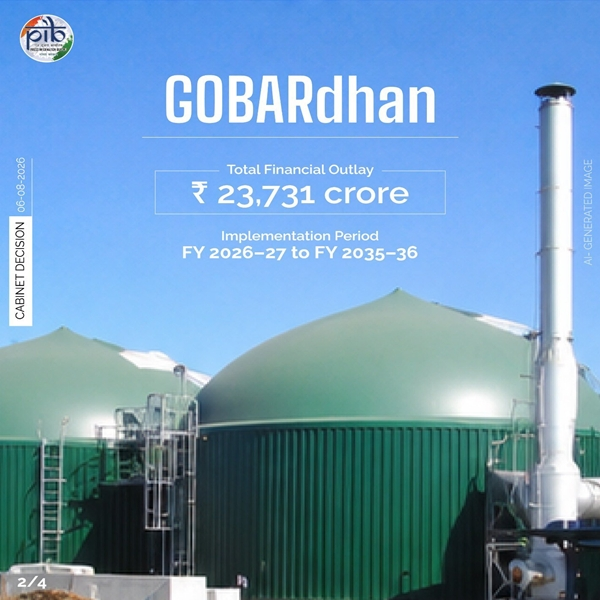
Context: The Union Cabinet has approved the National Circular Bioenergy Scheme – GOBARdhan with a total outlay of ₹23,731 crore to catalyse the growth of Compressed Biogas (CBG) and establish it as a major pillar of India’s future energy mix.
About the National Circular Bioenergy Scheme – GOBARdhan
• The Scheme will be implemented from FY 2026–27 to FY 2035–36.
• It is administered by the Ministry of Petroleum and Natural Gas.
• Objective: It aims to increase domestic Compressed Biogas (CBG) production nearly ten-fold, mobilize large-scale private investment and create a vibrant circular bioeconomy across the country.
• The Scheme converts Agricultural residue, Cattle dung, Press mud, Municipal organic waste and other biomass into clean fuel, Organic manure, Rural income and National economic value.
• The Scheme builds on:
Six Components of GOBARdhan
• Assured CBG Offtake: The Scheme establishes a dedicated CBG Offtake Assurance framework to provide a reliable and predictable market for producers.
• Stable Pricing Framework: The Scheme introduces a stable administered CBG price of ₹2,110 per Metric Million British Thermal Unit (MMBTU) under a minimum 10-year pricing framework.
• Capital Assistance: Eligible greenfield CBG projects will receive capital assistance of up to ₹2 crore per tonne per day (TPD) of installed CBG capacity, while brownfield expansion projects will also be eligible.
• Development of Pipeline Infrastructure: Supports cluster-based and standalone pipeline infrastructure connecting CBG plants with trunk pipelines and City Gas Distribution networks.
• Credit Guarantee Support: A dedicated Credit Guarantee mechanism will expand institutional credit to eligible MSME-based CBG projects by improving access to affordable finance and reducing collateral requirements.
• CBG Ecosystem Challenge Fund: Supports feedstock resource assessment and mapping, feedstock aggregation infrastructure, district-level CBG development planning, technology adoption, organic manure value addition, capacity building and stakeholder awareness.
Impact of the Scheme
• Increase domestic CBG production nearly ten-fold and achieve a target of 5 million Metric Standard Cubic Metres per Day (MMSCMD).
• Reduce dependence on imported fossil fuels, resulting in foreign exchange savings of over ₹40,000 crore.
• Mobilise large-scale private investment, creating an estimated ₹75,000 crore CBG industry through assured offtake, stable pricing, capital assistance, pipeline connectivity and credit support.
• Generate around 1.5 lakh jobs and create additional income opportunities for farmers, feedstock aggregators, cooperatives, MSMEs and rural entrepreneurs.
• Improve scientific utilisation of agricultural residue, cattle dung, press mud and municipal organic waste, expand the organic manure economy (FOM and LFOM), and reduce greenhouse gas emissions.
Need and Significance of the Scheme
• Addresses Key Bottlenecks in the CBG Sector: Addresses long-standing challenges such as uncertain offtake, pricing volatility, financing constraints, inadequate pipeline connectivity and fragmented feedstock aggregation, thereby improving the viability of CBG projects.
• Strengthens Energy Security: Promotes domestic production of renewable Compressed Biogas (CBG) to reduce dependence on imported natural gas and strengthen India's long-term energy security.
• Promotes Circular Bioeconomy and Scientific Waste Management: Converts agricultural residue, cattle dung, press mud, municipal organic waste and other biomass into clean fuel and organic manure, promoting a circular bioeconomy and scientific waste management.
• Enhances Rural Economy and Sustainable Agriculture: Creates opportunities for farmers, MSMEs, cooperatives and rural entrepreneurs, while promoting organic manure production to improve soil health and support sustainable agriculture.
• Supports National Development Goals: Advances the objectives of Atmanirbhar Bharat, Viksit Bharat, clean energy transition and climate commitments through a nationally integrated CBG ecosystem.
Khan Global Studies App
With our training programs, learning online can be a very exciting experience. Take the next step toward achieving your professional and personal objectives.



Course Related Query:
Ask Your DoubtsStore Related Query:[email protected]NEET | JEE | CUET
NCERT Books
Resources
We love learning. Through our innovative solutions, we encourage ourselves, our teams, and our Students to grow. We welcome and look for diverse perspectives and opinions because they enhance our decisions. We strive to understand the big picture and how we contribute to the company’s objectives. We approach challenges with optimism and harness the power of teamwork to accomplish our goals. These aren’t just pretty words to post on the office wall. This is who we are. It’s how we work. And it’s how we approach every interaction with each other and our Students.
Come with an open mind, hungry to learn, and you’ll experience unmatched personal and professional growth, a world of different backgrounds and perspectives, and the freedom to be you—every day. We strive to build and sustain diverse teams and foster a culture of belonging. Creating an inclusive environment where every students feels welcome, appreciated, and heard gives us something to feel (really) good about.