KGS

All Exams

Explore All Exams at KGS

All Exams
Current Affairs made simple.

Current Affairs provides you with the best compilation of the Daily Current Affairs taking place across the globe: National, International, Sports, Science and Technology, Banking, Economy, Agreement, Appointments, Ranks, and Report and General Studies

Current Affairs

UNEP Report Warns 1.5°C Global Warming Breach Is Now Inevitable

SYLLABUS

GS-3: Environment Conservation, environmental pollution and degradation, environmental impact assessment.

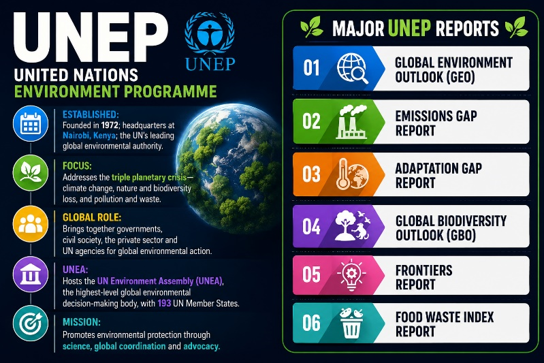
Context: The UN Environment Programme (UNEP), in its report Limiting Overshoot, warns that the world is likely to cross 1.5°C of global warming within the next few years.

More on the News

  • Report puts best-case scenario peak temperature rise at 1.8°C; others suggest over 2°C
  • Above 1.5°C, climate impacts and risks of tipping points intensify with every fraction of a degree.
  • ‘Overshoot, peak and decline’ pathway best remaining option to help vulnerable nations and communities cope and return to below 1.5°C .

Why is 1.5°C Important?

  • The 1.5°C limit under the Paris Agreement represents an important effort to limit climate risks.
  • UNEP warns that once warming exceeds this level, climate impacts and risks increase with every additional fraction of a degree and every passing year.
  • The most optimistic scenario in the report projects a peak temperature rise of 1.8°C, while most other scenarios indicate higher peaks.
  • Higher warming could intensify extreme weather, ecosystem loss and damage to human health, food security, water supplies, infrastructure, cities and economies. It could also increase risks to Small Island Developing States and low-lying coastal cities.

Why Is the Breach Considered Inevitable?

  • Shrinking Carbon Budget: Earlier IPCC assessments provided a narrow window to limit warming to 1.5°C, but UNEP now says this is no longer scientifically plausible.
  • Carbon Budget Exhaustion: The Indicators of Global Climate Change report estimates that the 1.5°C carbon budget could be exhausted in around three years if emissions continue at current levels.
  • New Priority: The focus is now on limiting the extent of warming beyond 1.5°C.

Recent Temperature Trends

  • 2024 Breach: Global temperature reached around 1.55°C above pre-industrial levels, making 2024 the warmest year recorded.
  • Monthly Breaches: Several months between July 2023 and December 2024 recorded temperatures of at least 1.5°C above pre-industrial levels.
  • Role of El Niño: The 2024 record was significantly influenced by El Niño, while warming declined to around 1.45°C in 2025.
  • Long-Term Concern: UNEP warns that annual temperatures are now moving towards consistently remaining above 1.5°C.

Growing Risk of Climate Tipping Points

  • The magnitude and duration of higher temperatures also increase the likelihood of crossing irreversible climate tipping points.
  • These include the destabilisation of major ice sheets, degradation of the Amazon rainforest and disruption of the Atlantic Meridional Overturning Circulation (AMOC), which transports warm surface water northward and cold deep water southward.
  • Some impacts could occur abruptly, while others may accumulate gradually.

Mitigation and Adaptation: Two Sides of Climate Action

  • UNEP stresses that mitigation and adaptation must advance together.
  • Rapid emissions reductions and a transition away from fossil fuels towards renewable energy can limit warming while also providing benefits such as better air quality, improved public health, lower energy costs and greater electricity access.
  • At the same time, adaptation must reduce the vulnerability of communities, economies and societies to current and future climate impacts. The report calls for transformational and responsive adaptation, particularly as climate risks can become non-linear or emerge suddenly.
  • Measures that provide both mitigation and adaptation benefits, such as nature-based cooling, should receive greater attention.

Role of Carbon Dioxide Removal

  • The report considers net-zero a milestone towards net-negative emissions. CDR will be necessary for bringing temperatures below 1.5°C, but it must be used in addition to sustained emissions reductions, not as a substitute for them.
  • CDR can credibly contribute to a return below 1.5°C only if peak warming remains well below 2°C and residual emissions are reduced.
  • Strong governance will also be required to address concerns related to environmental integrity, equity and scale.

Way Forward

  • Climate action should focus on sustained emissions reduction, responsible scaling of CDR, stronger climate finance, and unified global action to minimise the 1.5°C overshoot.
  • The success of this pathway depends on strong political will, multilateralism, effective policies, inclusive governance and adequate finance. Equity and justice must remain central to climate responses.
  • Countries with greater responsibility for climate change should undertake faster and more ambitious action.

Khan Global Studies App

The most trusted learning platform on your phone

With our training programs, learning online can be a very exciting experience. Take the next step toward achieving your professional and personal objectives.


Download on the App StoreGet it on Google Play
KGS learning dashboard and mobile application
logo
Khan Global Studies Pvt. Ltd. 5th Floor,
A13A, Graphix 1 Tower B, Sector 62,
Noida, Uttar Pradesh 201309

Course Related Query:

Ask Your DoubtsStore Related Query:[email protected]

Get Free Academic Counseling & Course Details

KGS best learning platform

About Khan Global Studies

We love learning. Through our innovative solutions, we encourage ourselves, our teams, and our Students to grow. We welcome and look for diverse perspectives and opinions because they enhance our decisions. We strive to understand the big picture and how we contribute to the company’s objectives. We approach challenges with optimism and harness the power of teamwork to accomplish our goals. These aren’t just pretty words to post on the office wall. This is who we are. It’s how we work. And it’s how we approach every interaction with each other and our Students.


What Makes Us Different

Come with an open mind, hungry to learn, and you’ll experience unmatched personal and professional growth, a world of different backgrounds and perspectives, and the freedom to be you—every day. We strive to build and sustain diverse teams and foster a culture of belonging. Creating an inclusive environment where every students feels welcome, appreciated, and heard gives us something to feel (really) good about.

©Copyright 2026 KhanGlobalStudies