Explore All Exams at KGS


All Exams
Explore All Exams at KGS

Khan Sir Courses
Geography I Polity I History | World Map I Indian Map I Economics I Biology

UPSC & State PSC
UPSC I BPSC I UP-PSC I MP-PSC

State Exams
UP I Bihar I MP | Rajasthan

NEET | JEE | CUET
NEET | JEE | CUET

Defence Exams
NDA I CDS I CAPF I AFCAT I SSB I Agniveer

Police Exams
UP SI | Bihar SI | Delhi Police | UP Constable

SSC Exams
CGL I CPO I CHSL I MTS I SSC GD I Delhi Police

Foundation Courses
Physics I Chemistry I Biology I History I Geography I Polity I NCERT I Math I English | Map I Reasoning

Railway Exams
RRB | RPF

Teaching Exams
TET | Teaching | UGC

Banking Exams
SBI | RBI | IBPS

Engineering Exams
Civil | Electrical | Mechanical
UGC NET
UGC NET/JRF
Current Affairs provides you with the best compilation of the Daily Current Affairs taking place across the globe: National, International, Sports, Science and Technology, Banking, Economy, Agreement, Appointments, Ranks, and Report and General Studies
Current Affairs
SYLLABUS
GS 2: Issues relating to development and management of Social Sector/Services relating to Health, Education, Human Resources.
Context: A recent WHO–UNICEF Joint Monitoring Programme (JMP) report, Progress on Drinking Water, Sanitation and Hygiene in Schools 2015–2025, highlights India’s progress in school drinking-water coverage while also pointing to significant gaps in sanitation and hygiene services.
More on the News:
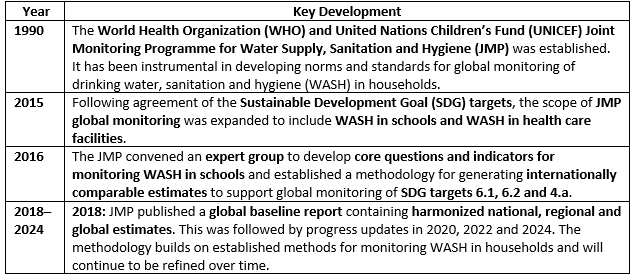
• WHO–UNICEF JMP provides internationally comparable estimates on drinking water, sanitation and hygiene (WASH) and monitors related SDG targets globally.
• The JMP updates WASH estimates in households in odd years and WASH in schools and health care facilities in even years.
• This report presents updated country, regional and global estimates for WASH in schools up to 2025.
• It also includes examples of national data on additional indicators that could support advanced monitoring of WASH in schools post-2030.
Key Findings: India’s School WASH Status
• Sanitation Remains a Major Challenge: In 2025, around 50 million Indian children had no sanitation service at their schools, out of a global total of 244 million children. India had the largest number of children without school sanitation services, followed by Nigeria (34 million), Ethiopia (26 million), the Democratic Republic of the Congo (11 million) and Indonesia (8 million).
• Hygiene Services Continue to Require Attention: Globally, 362 million children had no hygiene service at school in 2025.Around 20 million of these children were in India.
• Progress in School Drinking-Water Coverage: India has performed better on the basic drinking-water indicator.In 2025, 258 million children globally lacked drinking-water services at school.
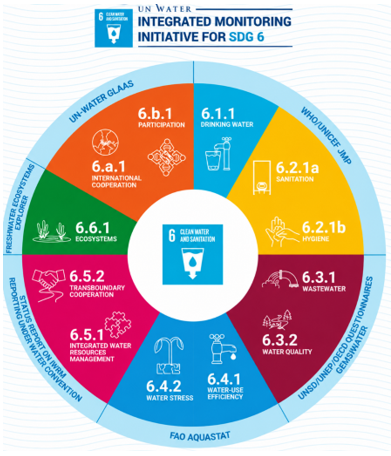
Global Progress on WASH in Schools
• Drinking Water in Schools: 142 countries and all SDG regions had estimates for basic drinking water services. Globally, 78% of schools had basic drinking water services, 9% limited services, and 13% no service.
• Sanitation in Schools: 146 countries and all SDG regions had estimates for basic sanitation services. Globally, 77% of schools had basic sanitation services, 11% limited services, and 12% no service.
• Hygiene in Schools: 136 countries and all SDG regions had estimates for basic hygiene services. Globally, 72% of schools had basic hygiene services, 9% limited services, and 18% no service.
JMP Methods
Khan Global Studies App
With our training programs, learning online can be a very exciting experience. Take the next step toward achieving your professional and personal objectives.


Course Related Query:
Ask Your DoubtsStore Related Query:[email protected]NEET | JEE | CUET
NCERT Books
Resources
We love learning. Through our innovative solutions, we encourage ourselves, our teams, and our Students to grow. We welcome and look for diverse perspectives and opinions because they enhance our decisions. We strive to understand the big picture and how we contribute to the company’s objectives. We approach challenges with optimism and harness the power of teamwork to accomplish our goals. These aren’t just pretty words to post on the office wall. This is who we are. It’s how we work. And it’s how we approach every interaction with each other and our Students.
Come with an open mind, hungry to learn, and you’ll experience unmatched personal and professional growth, a world of different backgrounds and perspectives, and the freedom to be you—every day. We strive to build and sustain diverse teams and foster a culture of belonging. Creating an inclusive environment where every students feels welcome, appreciated, and heard gives us something to feel (really) good about.