Explore All Exams at KGS


All Exams
Explore All Exams at KGS

Khan Sir Courses
Geography I Polity I History | World Map I Indian Map I Economics I Biology

UPSC & State PSC
UPSC I BPSC I UP-PSC I MP-PSC

Judiciary
CLAT

State Exams
UP I Bihar I MP | Rajasthan

NEET | JEE | CUET
NEET | JEE | CUET

Defence Exams
NDA I CDS I CAPF I AFCAT I SSB I Agniveer

Police Exams
UP SI | Bihar SI | Delhi Police | UP Constable

SSC Exams
CGL I CPO I CHSL I MTS I SSC GD I Delhi Police

Foundation Courses
Physics I Chemistry I Biology I History I Geography I Polity I NCERT I Math I English | Map I Reasoning

Railway Exams
RRB | RPF

Teaching Exams
TET | Teaching | UGC

Banking Exams
SBI | RBI | IBPS

Engineering Exams
Civil | Electrical | Mechanical
UGC NET
UGC NET/JRF
Current Affairs provides you with the best compilation of the Daily Current Affairs taking place across the globe: National, International, Sports, Science and Technology, Banking, Economy, Agreement, Appointments, Ranks, and Report and General Studies
Current Affairs
SYLLABUS
GS-2: India and its neighborhood- relations.
Context: At the invitation of Prime Minister Narendra Modi, Nepalese Prime Minister Balendra Shah undertook his first State Visit to India on 22–23 November 2026 since assuming office in March 2026, aimed at strengthening bilateral relations and advancing development cooperation.
Key Outcomes of the Visit
• Development Assistance: India announced ₹15,000 crore (NPR 24,000 crore): ₹3,500 crore in grants and ₹11,500 crore as a Line of Credit for energy projects.
• Joint Vision: Adopted the “Viksit Bharat and Samunnat Nepal” Vision covering economy, connectivity, energy, climate resilience and technology.
• Connectivity: Nepal received transit access through Kandla Port. Access to Paradip Port will be available once the requisite infrastructure is in place.
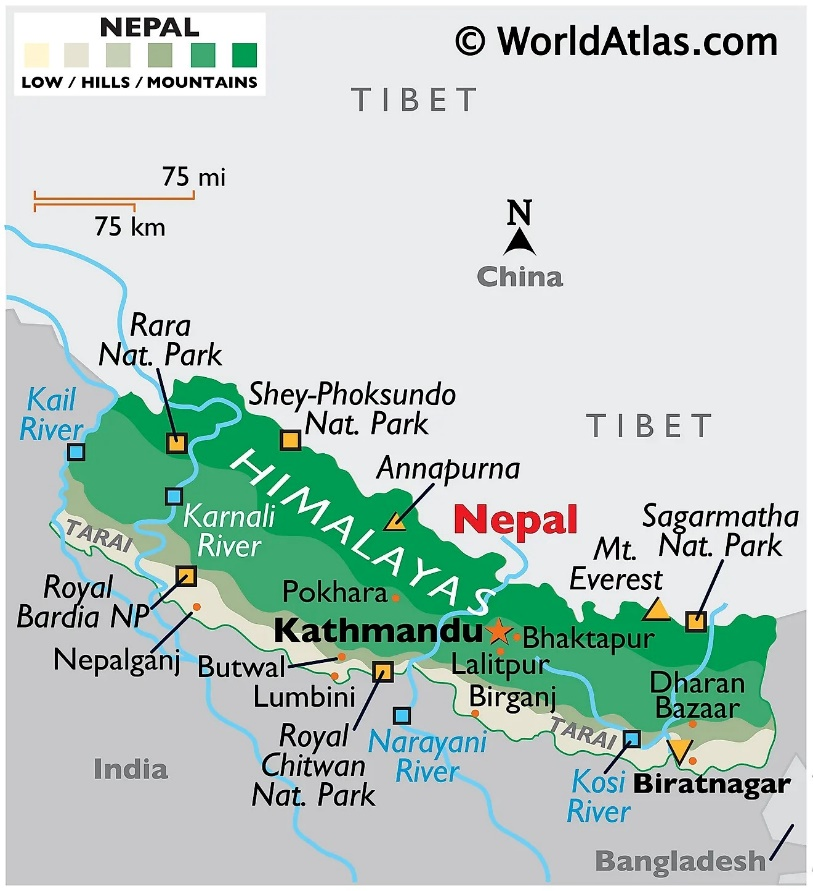
• Infrastructure: Flagged off the Sarayu-Kamala Express (Ayodhya–Janakpur), inaugurated the Dharchula–Darchula bridge and announced a new Integrated Check Post at Banbasa.
• Energy Cooperation: Dedicated Phase II of the Motihari–Amlekhgunj pipeline and laid the foundation stone for the 669 MW Lower Arun Project. Both sides agreed to expedite multipu
• rpose water projects and cross-border transmission lines.
• Development and Technology: India announced an offshore IIT campus, start-up incubator and innovation hub in Nepal. An Agro-Industrial Park will be established in Chitwan with Indian grant assistance.
• Agreements: Exchanged eight MoUs covering security, education, health, Ayurveda, satellite communication, urban development, livestock and fisheries.
India–Nepal Bilateral Relations
|
Historical Relations and Diplomatic Exchanges |
·
India and Nepal
share deep-rooted civilisational, cultural and religious ties. ·
The 1950
Treaty of Peace and Friendship provides the foundation for bilateral
relations. ·
An open border
and shared traditions strengthen people-to-people ties. |
|
Political and Diplomatic Relations |
·
Nepal is a key pillar of India's Neighbourhood
First Policy. ·
Both countries engage through
BIMSTEC, SASEC, SAARC, BBIN, UN, NAM, SCO (Nepal is a Dialogue Partner) and
Colombo Plan. |
|
Economic Cooperation and Development Partnership |
·
India is
Nepal's largest trading partner and the biggest source of foreign investment. ·
Bilateral goods
trade reached approximately US$9.38 billion in FY 2025–26, accounting for
over 60% of Nepal's external goods trade. ·
India accounts
for nearly one-third of Nepal's total Foreign Direct Investment (FDI). ·
In June 2026,
India and Nepal launched a Peer-to-Peer (P2P) remittance mechanism. It
links India's UPI with Nepal's NPI for real-time cross-border
personal remittances. |
|
Defence, Security and Emerging Areas of Cooperation |
·
India and Nepal
conduct joint military exercises, including Exercise Surya Kiran,
and cooperate in military training and equipment. ·
Both countries
traditionally confer the Honorary General rank on each other's Chiefs
of Army Staff. ·
The
Mutual Legal Assistance Agreement in Criminal Matters (MLAA) was signed in February 2026. |
|
Water Resources, Energy and Petroleum Cooperation
|
·
The 2022
Joint Vision Document promotes
joint hydropower projects, cross-border transmission lines and electricity
trade. ·
Nepal exported
around 1,100 MW of electricity to India and also supplied power to
Bangladesh through the Indian grid. ·
India's SJVN is
developing the 900 MW Arun-III and 669 MW Lower Arun hydropower
projects in Nepal. ·
The 41-km
Motihari–Amlekhgunj Petroleum Pipeline became operational in 2019, while
its Phase II was dedicated during the November 2026 visit.
|
|
People-to-People and Cultural Cooperation
|
·
India provides 1,500
scholarships annually to Nepali students, while over 3,700 Nepali
professionals and officials have received training under ITEC since 2001. ·
Cooperation
includes the Indian diaspora, tourism, shared cultural heritage, festivals,
Buddhist studies, AI-based language translation, startup partnerships
(IN-SPAN) and cricket.
|
Khan Global Studies App
With our training programs, learning online can be a very exciting experience. Take the next step toward achieving your professional and personal objectives.


Course Related Query:
Ask Your DoubtsStore Related Query:[email protected]NEET | JEE | CUET
NCERT Books
Resources
We love learning. Through our innovative solutions, we encourage ourselves, our teams, and our Students to grow. We welcome and look for diverse perspectives and opinions because they enhance our decisions. We strive to understand the big picture and how we contribute to the company’s objectives. We approach challenges with optimism and harness the power of teamwork to accomplish our goals. These aren’t just pretty words to post on the office wall. This is who we are. It’s how we work. And it’s how we approach every interaction with each other and our Students.
Come with an open mind, hungry to learn, and you’ll experience unmatched personal and professional growth, a world of different backgrounds and perspectives, and the freedom to be you—every day. We strive to build and sustain diverse teams and foster a culture of belonging. Creating an inclusive environment where every students feels welcome, appreciated, and heard gives us something to feel (really) good about.