Explore All Exams at KGS


All Exams
Explore All Exams at KGS

Khan Sir Courses
Geography I Polity I History | World Map I Indian Map I Economics I Biology

UPSC & State PSC
UPSC I BPSC I UP-PSC I MP-PSC

Judiciary
CLAT

State Exams
UP I Bihar I MP | Rajasthan

NEET | JEE | CUET
NEET | JEE | CUET

Defence Exams
NDA I CDS I CAPF I AFCAT I SSB I Agniveer

Police Exams
UP SI | Bihar SI | Delhi Police | UP Constable

SSC Exams
CGL I CPO I CHSL I MTS I SSC GD I Delhi Police

Foundation Courses
Physics I Chemistry I Biology I History I Geography I Polity I NCERT I Math I English | Map I Reasoning

Railway Exams
RRB | RPF

Teaching Exams
TET | Teaching | UGC

Banking Exams
SBI | RBI | IBPS

Engineering Exams
Civil | Electrical | Mechanical
UGC NET
UGC NET/JRF
Current Affairs provides you with the best compilation of the Daily Current Affairs taking place across the globe: National, International, Sports, Science and Technology, Banking, Economy, Agreement, Appointments, Ranks, and Report and General Studies
Current Affairs
SYLLABUS
GS-3: Science and Technology—Developments and their Applications and Effects in Everyday Life; Achievements of Indians in science & technology; Indigenization of technology and developing new technology.
Context: India ranked 38th out of 139 economies in the Global Innovation Index (GII) 2026, retaining its position from 2025 and remaining the top-ranked economy in Central and Southern Asia.
About the Global Innovation Index (GII)
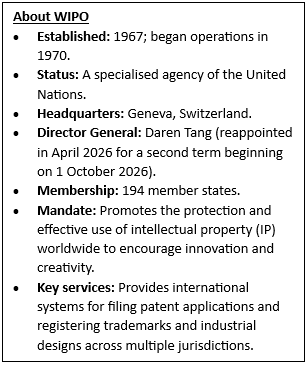
• The Global Innovation Index (GII) is an annual assessment published by the World Intellectual Property Organization (WIPO), a specialised agency of the United Nations. First introduced in 2007, the 2026 edition is its 19th edition.
• Origin: First introduced in 2007, the 2026 edition is its 19th edition.
• Purpose: The GII assesses how effectively economies develop and translate their capacity for innovation into tangible outcomes.
• Coverage: The 2026 edition ranks 139 economies using 79 indicators, covering areas such as research, education, infrastructure, business activity, technology and creative outputs.
• Methodology: The indicators are organised into two equally weighted sub-indices, comprising seven pillars in total.
A. Innovation Input Sub-Index: Measures the conditions that support innovation through five pillars—Institutions; Human Capital and Research; Infrastructure; Market Sophistication; and Business Sophistication.
B. Innovation Output Sub-Index: Measures the results of innovation through two pillars—Knowledge and Technology Outputs, and Creative Outputs.
• Overall ranking: The overall GII score is calculated as the average of the two sub-indices.
• Theme of GII 2026: “Powering Entrepreneurs at the Frontier of Science”, focusing on deep-science startups and the translation of scientific advances into commercial applications.
Key Global Findings
A. Top-ranked economies
• Switzerland ranked first for the 16th consecutive year.
• The top five were Switzerland (1st), Sweden (2nd), the United States (3rd), the Republic of Korea (4th) and Singapore (5th).
• China ranked 10th, remaining the only middle-income economy in the global top 30.
B. Regional leaders
• Northern America: United States
• Latin America and the Caribbean: Chile
• Europe: Switzerland
• Northern Africa and Western Asia: Israel
• Central and Southern Asia: India
• South-East Asia, East Asia and Oceania: Republic of Korea
• Sub-Saharan Africa: Mauritius
C. Leaders by income group
• High-income economies: Switzerland
• Upper-middle-income economies: China
• Lower-middle-income economies: India
• Low-income economies: Rwanda
D. Global innovation clusters
• Top three clusters: Shenzhen–Hong Kong–Guangzhou (1st), Tokyo–Yokohama (2nd) and San Jose–San Francisco (3rd).
• Distribution of the top 100 clusters: China had 25 clusters, the United States 20, Germany seven, and India and the United Kingdom four each.
India’s Performance in GII 2026
• Overall position: India ranked 38th among 139 economies, first among 36 lower-middle-income economies and first among 11 economies in Central and Southern Asia.
• Ranking trend: India improved from 48th in 2020 to 38th in 2025 and maintained the same position in 2026.
• Inputs versus outputs: India ranked 49th in the Innovation Input Sub-Index and 25th in the Innovation Output Sub-Index.
• Pillar-wise performance:
• Indian innovation clusters: Four Indian clusters featured in the global top 100:
• Notable strengths: India ranked first in ICT services exports, third in domestic market scale, fourth in late-stage venture-capital deal count and eighth in finance for startups and scale-ups.
• Areas of weakness: India ranked 83rd in researchers per million population, 94th in electricity output per million population and 98th in knowledge-intensive employment.
Khan Global Studies App
With our training programs, learning online can be a very exciting experience. Take the next step toward achieving your professional and personal objectives.



Course Related Query:
Ask Your DoubtsStore Related Query:[email protected]NEET | JEE | CUET
NCERT Books
Resources
We love learning. Through our innovative solutions, we encourage ourselves, our teams, and our Students to grow. We welcome and look for diverse perspectives and opinions because they enhance our decisions. We strive to understand the big picture and how we contribute to the company’s objectives. We approach challenges with optimism and harness the power of teamwork to accomplish our goals. These aren’t just pretty words to post on the office wall. This is who we are. It’s how we work. And it’s how we approach every interaction with each other and our Students.
Come with an open mind, hungry to learn, and you’ll experience unmatched personal and professional growth, a world of different backgrounds and perspectives, and the freedom to be you—every day. We strive to build and sustain diverse teams and foster a culture of belonging. Creating an inclusive environment where every students feels welcome, appreciated, and heard gives us something to feel (really) good about.