Explore All Exams at KGS


All Exams
Explore All Exams at KGS

Khan Sir Courses
Geography I Polity I History | World Map I Indian Map I Economics I Biology

UPSC & State PSC
UPSC I BPSC I UP-PSC I MP-PSC

Judiciary
CLAT

State Exams
UP I Bihar I MP | Rajasthan

NEET | JEE | CUET
NEET | JEE | CUET

Defence Exams
NDA I CDS I CAPF I AFCAT I SSB I Agniveer

Police Exams
UP SI | Bihar SI | Delhi Police | UP Constable

SSC Exams
CGL I CPO I CHSL I MTS I SSC GD I Delhi Police

Foundation Courses
Physics I Chemistry I Biology I History I Geography I Polity I NCERT I Math I English | Map I Reasoning

Railway Exams
RRB | RPF

Teaching Exams
TET | Teaching | UGC

Banking Exams
SBI | RBI | IBPS

Engineering Exams
Civil | Electrical | Mechanical
UGC NET
UGC NET/JRF
Current Affairs provides you with the best compilation of the Daily Current Affairs taking place across the globe: National, International, Sports, Science and Technology, Banking, Economy, Agreement, Appointments, Ranks, and Report and General Studies
Current Affairs
SYLLABUS
GS-2: Functions and responsibilities of the Union and the States, issues and challenges pertaining to the federal structure, devolution of powers and finances up to local levels and challenges therein.
Context: President Droupadi Murmu has given assent to the Frontier Nagaland Territorial Authority (FNTA) BillS, 2026, paving the way for a decentralised self-governing authority in six eastern districts of Nagaland.
More on the News
• The Nagaland Legislative Assembly unanimously passed the Bill on 3 September 2026, following the withdrawal of an earlier version introduced in March.
• The Act follows a 5 February 2026 Memorandum of Agreement (MoA) signed by the Governments of India and Nagaland and the Eastern Nagaland Peoples’ Organisation (ENPO);
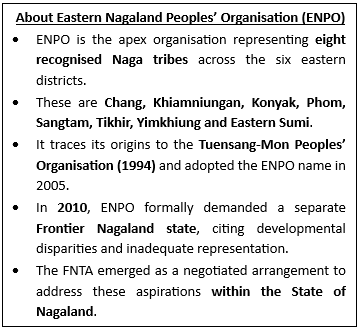
Key Features of the Act
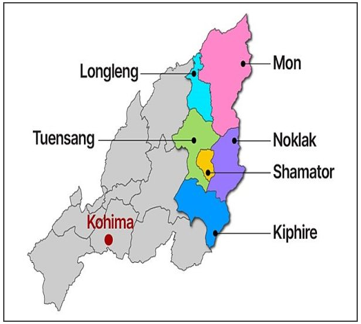
• Territorial Coverage: The FNTA covers six districts—Tuensang, Mon, Longleng, Kiphire, Noklak and Shamator.
• Composition: The Authority will have 62 members:
• Tenure and Elections: Elected and nominated members will ordinarily have a five-year tenure, while elections will be overseen by the State Election Commission.
• Executive Council: An Executive Council of up to nine members, headed by a Chief Executive Member (CEM), will exercise executive powers.
• Powers and Functions: The FNTA will exercise legislative, executive, administrative and financial powers over 46 transferred subjects, including agriculture, health, school education, rural development, tourism, social welfare, village councils, urban local bodies and specified public works.
• Legislative Powers: The Authority may initiate laws on transferred subjects.
• Interim Council: Until elections are held, the State Government may constitute an Interim Council of up to 13 members, recommended by ENPO in consultation with tribal councils.
• Financial Provisions: The Authority will receive annual allocations under a separate major subhead in the State Budget, with development funds subject to Comptroller and Auditor General (CAG) audit.
• Constitutional Safeguards: The arrangement preserves, without amendment or dilution, Article 371A, the Bengal Eastern Frontier Regulation, 1873, and the existing exemption from Panchayati Raj provisions.
• Review: The FNTA arrangement is envisaged to be reviewed after 10 years.
Need and Significance
• Addressing Regional Disparities: Enables focused intervention to tackle long-standing gaps in infrastructure, healthcare, education and connectivity in eastern Nagaland.
• Decentralised Self-Governance: Transfers decision-making over 46 subjects closer to local communities, allowing policies to reflect regional priorities.
• Inclusive Federalism: Provides substantial territorial autonomy within Nagaland, demonstrating constitutional flexibility without creating a separate state.
• Political Representation: Direct elections, women’s reservation and representation for under-represented tribes strengthen democratic participation and inclusion.
• Peace and Stability: Addresses long-standing regional grievances through negotiated and democratic mechanisms while preserving Article 371A and Nagaland’s territorial unity.
Khan Global Studies App
With our training programs, learning online can be a very exciting experience. Take the next step toward achieving your professional and personal objectives.


Course Related Query:
Ask Your DoubtsStore Related Query:[email protected]NEET | JEE | CUET
NCERT Books
Resources
We love learning. Through our innovative solutions, we encourage ourselves, our teams, and our Students to grow. We welcome and look for diverse perspectives and opinions because they enhance our decisions. We strive to understand the big picture and how we contribute to the company’s objectives. We approach challenges with optimism and harness the power of teamwork to accomplish our goals. These aren’t just pretty words to post on the office wall. This is who we are. It’s how we work. And it’s how we approach every interaction with each other and our Students.
Come with an open mind, hungry to learn, and you’ll experience unmatched personal and professional growth, a world of different backgrounds and perspectives, and the freedom to be you—every day. We strive to build and sustain diverse teams and foster a culture of belonging. Creating an inclusive environment where every students feels welcome, appreciated, and heard gives us something to feel (really) good about.