Explore All Exams at KGS


All Exams
Explore All Exams at KGS

Khan Sir Courses
Geography I Polity I History | World Map I Indian Map I Economics I Biology

UPSC & State PSC
UPSC I BPSC I UP-PSC I MP-PSC

Judiciary
CLAT

State Exams
UP I Bihar I MP | Rajasthan

NEET | JEE | CUET
NEET | JEE | CUET

Defence Exams
NDA I CDS I CAPF I AFCAT I SSB I Agniveer

Police Exams
UP SI | Bihar SI | Delhi Police | UP Constable

SSC Exams
CGL I CPO I CHSL I MTS I SSC GD I Delhi Police

Foundation Courses
Physics I Chemistry I Biology I History I Geography I Polity I NCERT I Math I English | Map I Reasoning

Railway Exams
RRB | RPF

Teaching Exams
TET | Teaching | UGC

Banking Exams
SBI | RBI | IBPS

Engineering Exams
Civil | Electrical | Mechanical
UGC NET
UGC NET/JRF
Current Affairs provides you with the best compilation of the Daily Current Affairs taking place across the globe: National, International, Sports, Science and Technology, Banking, Economy, Agreement, Appointments, Ranks, and Report and General Studies
Current Affairs
SYLLABUS
GS-2: Statutory, Regulatory and various Quasi-judicial Bodies; Functions and Responsibilities of the Union and the States, Issues and Challenges Pertaining to the Federal Structure, devolution of powers and finances up to local levels and challenges therein.
Context: The Union Home Minister chaired the 28th meeting of the Western Zonal Council in Panaji, Goa, on 7 September 2026, focusing on inter-State coordination, development, public welfare and internal security.
More on the News
• The meeting was attended by the Chief Ministers of Goa, Gujarat and Maharashtra, the Administrator of Dadra and Nagar Haveli and Daman and Diu, and senior officials of the Centre, States and UT.
• The meeting reflected the evolving role of Zonal Councils as platforms for monitoring welfare and development outcomes, including child malnutrition, Aadhaar penetration, Ayushman Bharat coverage, PACS computerisation, cybercrime and coastal security.
• Home Minister described the Western Region as the “WEST Engine” of India’s growth—Wealth & Finance, Exports & Ports, Start-ups & Semiconductors, and Tourism & Blue Economy.
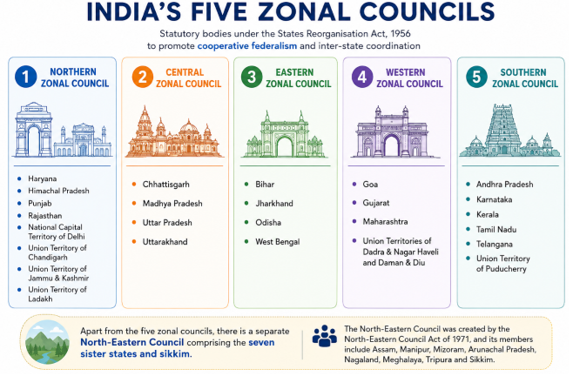
Understanding Zonal Councils
• Genesis and Nature
The North Eastern Council (NEC) functions separately under the North-Eastern Council Act of 1971.
• Composition
• Functions of Zonal Councils: Under the States Reorganisation Act, Zonal Councils discuss and make recommendations on:
Significance of Zonal Councils in Indian Federalism
• Institutionalised Dialogue & Consensus: Provides a regular platform for Centre–State and inter-State consultation, enabling regional issues to be addressed through dialogue and consensus rather than adversarial mechanisms.
• Policy Coordination & Best Practices: Facilitates coordinated implementation of national programmes, convergence among States and sharing of effective governance practices.
• Regional Development & Security: Enables coordinated responses to common challenges such as Left Wing Extremism (LWE), cybercrime, disaster management, infrastructure gaps and regional disparities.
• National Integration & Cooperative Governance: Regular political and administrative interaction strengthens national integration, while the growing focus on monitoring welfare and development outcomes is expanding Zonal Councils from discussion and dispute-resolution forums into more action-oriented platforms for cooperative governance.
Khan Global Studies App
With our training programs, learning online can be a very exciting experience. Take the next step toward achieving your professional and personal objectives.


Course Related Query:
Ask Your DoubtsStore Related Query:[email protected]NEET | JEE | CUET
NCERT Books
Resources
We love learning. Through our innovative solutions, we encourage ourselves, our teams, and our Students to grow. We welcome and look for diverse perspectives and opinions because they enhance our decisions. We strive to understand the big picture and how we contribute to the company’s objectives. We approach challenges with optimism and harness the power of teamwork to accomplish our goals. These aren’t just pretty words to post on the office wall. This is who we are. It’s how we work. And it’s how we approach every interaction with each other and our Students.
Come with an open mind, hungry to learn, and you’ll experience unmatched personal and professional growth, a world of different backgrounds and perspectives, and the freedom to be you—every day. We strive to build and sustain diverse teams and foster a culture of belonging. Creating an inclusive environment where every students feels welcome, appreciated, and heard gives us something to feel (really) good about.