Explore All Exams at KGS


All Exams
Explore All Exams at KGS

Khan Sir Courses
Geography I Polity I History | World Map I Indian Map I Economics I Biology

UPSC & State PSC
UPSC I BPSC I UP-PSC I MP-PSC

State Exams
UP I Bihar I MP | Rajasthan

NEET | JEE | CUET
NEET | JEE | CUET

Defence Exams
NDA I CDS I CAPF I AFCAT I SSB I Agniveer

Police Exams
UP SI | Bihar SI | Delhi Police | UP Constable

SSC Exams
CGL I CPO I CHSL I MTS I SSC GD I Delhi Police

Foundation Courses
Physics I Chemistry I Biology I History I Geography I Polity I NCERT I Math I English | Map I Reasoning

Railway Exams
RRB | RPF

Teaching Exams
TET | Teaching | UGC

Banking Exams
SBI | RBI | IBPS

Engineering Exams
Civil | Electrical | Mechanical
UGC NET
UGC NET/JRF
Current Affairs provides you with the best compilation of the Daily Current Affairs taking place across the globe: National, International, Sports, Science and Technology, Banking, Economy, Agreement, Appointments, Ranks, and Report and General Studies

Current Affairs
SYLLABUS
GS-2: Issues relating to development and management of Social Sector/Services relating to Health, Education, Human Resources.
Context: The Union Ministry of Education released the All-India Survey on Higher Education (AISHE) Reports for 2022-23 and 2023-24, highlighting continued growth in enrolment, Gross Enrolment Ratio (GER), gender parity, and social inclusion in India's higher education sector.
About the All-India Survey on Higher Education (AISHE)
• It is an annual survey launched by the Ministry of Education in 2010–11 to collect comprehensive institution-level data on India's higher education sector, serving as the primary source of official statistics for policy formulation, planning and monitoring.
• Data is collected through a web-based Data Capture Format (DCF) developed by the Department of Higher Education and the National Informatics Centre (NIC), covering student enrolment, faculty and staff, infrastructure, examination results, research and institutional profile.
• Institutions voluntarily upload self-reported data, which is validated and scrutinised by the Ministry before publication.
• AISHE also generates key indicators such as the Gross Enrolment Ratio (GER), Gender Parity Index (GPI) and Pupil-Teacher Ratio (PTR), and supports the implementation and monitoring of the National Education Policy (NEP) 2020.
Key Findings of AISHE 2023-24
• Institutional Coverage: A total of 59,553 Higher Education Institutions (HEIs) participated out of 64,756 registered institutions, recording a participation rate of around 92%.
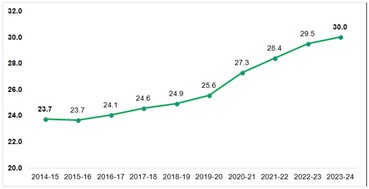
• Gross Enrolment Ratio (GER): The Gross Enrolment Ratio (GER) increased to 30.0 in 2023-24 from 29.5 in 2022-23 and 23.7 in 2014-15.
• Gender Parity: The Gender Parity Index (GPI) stood at 1.08 and has remained above 1.0 since 2017-18, indicating higher female participation than males in higher education.
• Student Enrolment: Total student enrolment reached a record 4.50 crore, an increase of 31.5% since 2014-15.
• Social Inclusion: Enrolment of disadvantaged groups increased to 69.72 lakh (SC), 28.83 lakh (ST) and 1.80 crore (OBC).
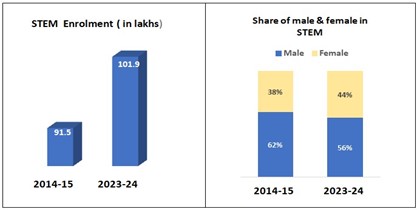
• STEM Education: STEM enrolment increased to 1.02 crore, accounting for 22.5% of total enrolment.
• Faculty and Teaching Workforce: Total faculty strength increased to 17.32 lakh, with women accounting for 44.9% of faculty members.
• Institutional Profile: India has 1,289 registered universities and 48,246 registered colleges, including 18 women's universities and 19 open universities.
• Foreign Students: India hosted 58,134 foreign students from 173 countries.
• Out-turn (Graduates): Total pass-outs exceeded 1.1 crore.
Significance
• Expansion of Higher Education: Reflects the sustained growth and increasing reach of India's higher education system over the past decade.
• NEP 2020 Implementation: Demonstrates progress towards the National Education Policy (NEP) 2020 goals of improving access, equity and quality in higher education.
• Inclusive Growth: Rising GER and enrolment among women, SCs and STs indicate greater educational inclusion and social equity.
• Gender Empowerment: Higher female participation and a Gender Parity Index (GPI) above 1 highlight improved gender representation in higher education.
• STEM Workforce: Increasing STEM enrolment, particularly among women, strengthens India's future scientific, technological and innovation ecosystem.
• Evidence-based Governance: AISHE provides reliable data for policy formulation, resource allocation, institutional planning and monitoring of the higher education sector.
Khan Global Studies App
With our training programs, learning online can be a very exciting experience. Take the next step toward achieving your professional and personal objectives.



Course Related Query:
Ask Your DoubtsStore Related Query:[email protected]NEET | JEE | CUET
NCERT Books
Resources
We love learning. Through our innovative solutions, we encourage ourselves, our teams, and our Students to grow. We welcome and look for diverse perspectives and opinions because they enhance our decisions. We strive to understand the big picture and how we contribute to the company’s objectives. We approach challenges with optimism and harness the power of teamwork to accomplish our goals. These aren’t just pretty words to post on the office wall. This is who we are. It’s how we work. And it’s how we approach every interaction with each other and our Students.
Come with an open mind, hungry to learn, and you’ll experience unmatched personal and professional growth, a world of different backgrounds and perspectives, and the freedom to be you—every day. We strive to build and sustain diverse teams and foster a culture of belonging. Creating an inclusive environment where every students feels welcome, appreciated, and heard gives us something to feel (really) good about.