logo

All Exams

Notifications

All Exams

Explore All Exams at KGS

All Exams
Home>Current Affairs>Antarctic Ozone Hole Closes Early in 2025
Current Affairs made simple.

Current Affairs provides you with the best compilation of the Daily Current Affairs taking place across the globe: National, International, Sports, Science and Technology, Banking, Economy, Agreement, Appointments, Ranks, and Report and General Studies

banner-image

Antarctic Ozone Hole Closes Early in 2025

SYLLABUS

GS-3: Conservation, environmental pollution and degradation, environmental impact assessment.

Context: Recently, Copernicus Atmosphere Monitoring Service (CAMS) reported that the 2025 Antarctic ozone hole came to an end on 1 December, marking the earliest closure since 2019, which shows clear signs of atmospheric recovery driven by global action on ozone-depleting substances.

Key Highlights of the Report
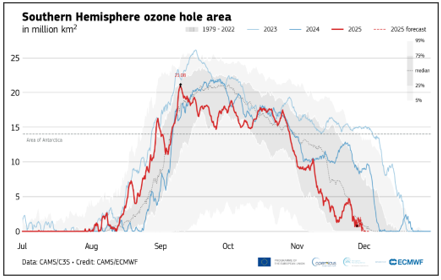
  • The 2025 ozone hole was relatively small for the second consecutive year when compared to the large and long-lasting ozone holes observed from 2020 to 2023.
  • It also showed higher ozone concentrations, strengthening hopes for the continued recovery of the ozone layer.
  • The 2025 Antarctic ozone hole developed early in mid-August, following a pattern similar to the large 2023 event, and initially showed a slight reduction before expanding to a maximum area of 21.08 million square kilometres in early September, which is typical for the season but much smaller than the 26.1 million square kilometres recorded in 2023.
  • The closure, initially expected earlier, was delayed by a persistent small patch of low ozone and finally occurred on 1 December, marking the earliest closure since 2019 and one of the earliest in nearly forty years. The early closure and smaller size reflect steady progress driven by the global phase-out of ozone-depleting substances.

About the Ozone Hole

  • An ozone hole is a region of severely depleted ozone layer in the stratosphere, primarily over the polar regions, especially Antarctica.
  • The ozone hole is measured by monitoring the total amount of ozone in a vertical column of atmosphere above a specific area, expressed in Dobson Units (DU), with a "hole" defined as levels falling below 220 DU.
  • One DU is the thickness of a layer of pure ozone if compressed to 0.01 millimeters at standard temperature (0°C) and pressure (1 atmosphere).

About the Ozone Layer

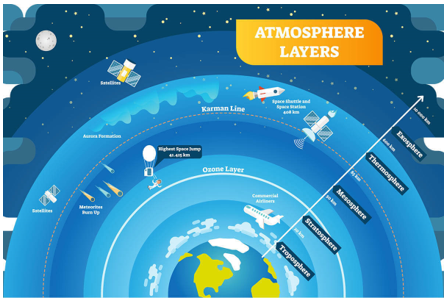
  • The ozone layer is a vital protective shield in the Earth's atmosphere that absorbs harmful ultraviolet (UV) radiation from the Sun.
  • It exists in the Stratosphere (a layer of Earth’s atmosphere), between 10 KM and 40 KM above the Earth's surface and protects us from UV radiation from the Sun.
  • There are two types of ozone: 
    • Stratospheric ozone is considered "good" ozone found in the upper atmosphere (the stratosphere) that protects life by absorbing harmful UV radiation. 
    • Tropospheric ozone is considered "bad" ozone, a pollutant in the lower atmosphere (the troposphere) that is harmful to health and is a component of smog. 

International Actions to Protect the Ozone Layer

Vienna Convention

  • The Vienna Convention for the Protection of the Ozone Layer (Vienna Convention) was adopted on 22 March 1985 and entered into force on 22 September 1988 to serves as a framework treaty for legal and practical action to protect the planet’s ozone layer.
  • Its parties aim to promote cooperation by means of systematic observations, research and information exchange on the effects of human activities on the ozone layer.

Montreal Protocol

  • The Montreal Protocol on Substances that Deplete the Ozone Layer is the landmark multilateral environmental agreement that regulates the production and consumption of nearly 100 man-made chemicals referred to as ozone-depleting substances (ODS). 
  • Ozone-depleting substances (ODS) are human-made chemicals that damage the Earth's protective ozone layer, such as chlorofluorocarbons (CFCs), hydrochlorofluorocarbons (HCFCs), halons, and methyl bromide.
  • Montreal Protocol was signed on September 16, on the International Day for the Preservation of the Ozone Layer, in 1987 to protect the Earth’s ozone layer. It is to date one of the rare treaties to achieve universal ratification. India has been a Party to the Montreal Protocol since June 1992.
  • The Multilateral Fund for the Implementation of the Montreal Protocol was established in 1991.
  • Later on, through the Kigali Amendment on the Montreal Protocol, climate action is being further accelerated by countries committing to phase down the production and consumption of hydrofluorocarbons (HFCs).
  • India ratified the Kigali Amendment to the Montreal Protocol in 2021 and will begin phasing down hydrofluorocarbons (HFCs) by 2028, further aiming to cut emissions by 15% of the 2024-26 baseline levels by 2047.
  • Researcher says if the Kigali Amendment is fully ratified and implemented, up to 0.5°C of warming could be avoided by 2100.

About Copernicus

  • Copernicus is the Earth observation component of the European Union’s Space Programme and provides environmental information for the benefit of European citizens.
  • The programme delivers services based on satellite Earth observation data and in-situ or ground-based measurements.
  • The European Commission manages the programme on behalf of the European Union.
  • The Copernicus Atmosphere Monitoring Service (CAMS) is an operational service that provides continuous, free, and open data and information on the composition of the Earth's atmosphere at a global and regional (European) scale.

Source:
Downtoearth
Moneycontrol
Atmosphere
Atmosphere

footer image

The most trusted learning platform on your phone

With our training programs, learning online can be a very exciting experience! Take the next step toward achieving your professional and personal objectives


app-storeplay-store
logo
Khan Global Studies Pvt. Ltd. 5th Floor,
A13A, Graphix 1 Tower B, Sector 62,
Noida, Uttar Pradesh 201309

Course Related Query: [email protected] Store Related Query: [email protected]

Get Free Academic Counseling & Course Details

KGS best learning platform

About Khan Global Studies

We love learning. Through our innovative solutions, we encourage ourselves, our teams, and our Students to grow. We welcome and look for diverse perspectives and opinions because they enhance our decisions. We strive to understand the big picture and how we contribute to the company’s objectives. We approach challenges with optimism and harness the power of teamwork to accomplish our goals. These aren’t just pretty words to post on the office wall. This is who we are. It’s how we work. And it’s how we approach every interaction with each other and our Students.


What Makes Us Different

Come with an open mind, hungry to learn, and you’ll experience unmatched personal and professional growth, a world of different backgrounds and perspectives, and the freedom to be you—every day. We strive to build and sustain diverse teams and foster a culture of belonging. Creating an inclusive environment where every students feels welcome, appreciated, and heard gives us something to feel (really) good about.

Copyright 2025 KhanGlobalStudies

Have a question?

Get Free academic Counseling & Course Details

floatButton