KGS

All Exams

Explore All Exams at KGS

All Exams
Current Affairs made simple.

Current Affairs provides you with the best compilation of the Daily Current Affairs taking place across the globe: National, International, Sports, Science and Technology, Banking, Economy, Agreement, Appointments, Ranks, and Report and General Studies

Current Affairs

CAG Audit Flags Major Gaps in Green India Mission Implementation

SYLLABUS

GS-3: Conservation, Environmental Pollution and Degradation, Environmental Impact Assessment.

Context: The Comptroller and Auditor General of India (CAG) has flagged significant deficiencies in the implementation of the Green India Mission (GIM), highlighting gaps in achieving its objectives of enhancing forest and tree cover and improving the quality of existing forests.

Key Findings of the CAG Audit

The CAG examined the planning, implementation and monitoring of GIM interventions in 16 States/UTs during 2015–16 to 2024–25 and found:

  • Severe shortfall in improving forest quality: Against the target of improving the quality of forest cover over 1.4 million hectares, improvement was observed in only 0.11384 million hectares, representing a 91.87% shortfall.
  • Severe shortfall in increasing forest cover: Forest-cover enhancement was recorded over only 0.03409 million hectares against the target of 1.4 million hectares, resulting in a 97.57% shortfall.
  • Weak convergence and funding: Planned convergence with CAMPA and MGNREGS was not effectively achieved, while Nagar Van Yojana and School Nursery Yojana largely operated in silos. The Mission also failed to secure ₹10,600 crore of proposed funding support.
  • Low budgetary support: Against ₹2,000 crore approved by the CCEA for the initial four years and ₹400 crore from 13th Finance Commission grants towards States’ share, only ₹1,149.14 crore (47.88%) was received through budgetary support during the audited period.
  • Weak financial controls: Eight States/UTs did not maintain annual accounts, while accounts prepared in other cases were often unaudited or contained discrepancies with subsidiary records.
  • Planning and monitoring deficiencies: The audit attributed the implementation gaps to inadequate convergence, insufficient funding, deficiencies in planning and weak monitoring mechanisms, limiting achievement of the Mission’s intended outcomes.

About the Green India Mission

  • Part of NAPCC: The National Mission for a Green India (GIM) is one of the missions under the National Action Plan on Climate Change (NAPCC). It aims to protect, restore and enhance India’s forest and tree cover while addressing climate change. GIM activities began in FY 2015–16.
  • Dual core targets: The Mission aims to increase forest/tree cover by 5 million hectares and improve the quality of forest cover on another 5 million hectares, covering a total of 10 million hectares.
  • Landscape-based approach: It focuses on eco-restoration in forest and non-forest areas, including restoration of degraded landscapes and afforestation activities, with implementation involving Joint Forest Management Committees (JFMCs).
  • Multiple outcomes: GIM seeks to enhance carbon sequestration, biodiversity and ecosystem services, while improving the livelihoods of communities dependent on forest resources. Its original framework also envisaged convergence with programmes such as MGNREGA and CAMPA.

Why Does the Green India Mission Matter?
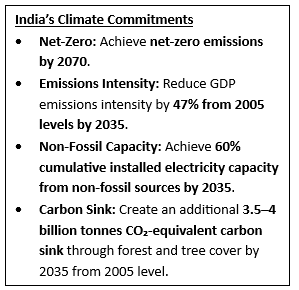
  • Climate Mitigation: Forests and tree cover serve as important carbon sinks, making GIM relevant to India’s efforts to enhance carbon sequestration and meet its climate commitments.
  • Ecosystem Restoration: Restoring degraded forests and landscapes can improve biodiversity, soil conservation, water regulation and other ecosystem services.
  • Climate Resilience: Healthy ecosystems can strengthen the resilience of landscapes and communities against droughts, floods, land degradation and other climate-related stresses.
  • Livelihood Security: Forest-dependent communities rely on forests for non-timber forest products and other ecosystem-based livelihoods, giving GIM an important socioeconomic dimension.  

Key Implementation Challenges

  • Outcome vs. plantation approach: Success needs to be assessed through survival, forest quality, biodiversity and ecosystem restoration, rather than merely the area planted or treated.
  • Funding and implementation capacity: Inadequate funding, delays in fund availability/utilisation and uneven implementation capacity can constrain the scale and continuity of interventions.
  • Monitoring and accountability: Weak outcome monitoring makes it difficult to assess survival rates, improvement in forest quality and long-term ecological benefits.
  • Fragmented implementation: Limited convergence among GIM, CAMPA, MGNREGS and other related programmes, along with initiatives operating in silos, can result in fragmented interventions and inefficient utilisation of resources.

Way Forward

  • Shift towards landscape restoration: Move beyond plantation targets towards native, site-specific ecological restoration, with greater emphasis on forest quality, biodiversity and ecosystem services.
  • Strengthen outcome-based monitoring: Establish measurable indicators for survival rates, forest-density improvement, biodiversity, ecosystem services and carbon sequestration, supported by GIS, remote sensing and ground verification.
  • Deepen community participation and convergence: Strengthen the role of Gram Sabhas, Joint Forest Management institutions and local communities, while improving convergence with programmes such as CAMPA and MGNREGS.
  • Improve financial and institutional capacity: Ensure timely release and effective utilisation of funds while strengthening State-level planning, implementation and inter-agency coordination.

Khan Global Studies App

The most trusted learning platform on your phone

With our training programs, learning online can be a very exciting experience. Take the next step toward achieving your professional and personal objectives.


Download on the App StoreGet it on Google Play
KGS learning dashboard and mobile application
logo
Khan Global Studies Pvt. Ltd. 5th Floor,
A13A, Graphix 1 Tower B, Sector 62,
Noida, Uttar Pradesh 201309

Course Related Query:

Ask Your DoubtsStore Related Query:[email protected]

Get Free Academic Counseling & Course Details

KGS best learning platform

About Khan Global Studies

We love learning. Through our innovative solutions, we encourage ourselves, our teams, and our Students to grow. We welcome and look for diverse perspectives and opinions because they enhance our decisions. We strive to understand the big picture and how we contribute to the company’s objectives. We approach challenges with optimism and harness the power of teamwork to accomplish our goals. These aren’t just pretty words to post on the office wall. This is who we are. It’s how we work. And it’s how we approach every interaction with each other and our Students.


What Makes Us Different

Come with an open mind, hungry to learn, and you’ll experience unmatched personal and professional growth, a world of different backgrounds and perspectives, and the freedom to be you—every day. We strive to build and sustain diverse teams and foster a culture of belonging. Creating an inclusive environment where every students feels welcome, appreciated, and heard gives us something to feel (really) good about.

©Copyright 2026 KhanGlobalStudies