Explore All Exams at KGS


All Exams
Explore All Exams at KGS

Khan Sir Courses
Geography I Polity I History | World Map I Indian Map I Economics I Biology

UPSC & State PSC
UPSC I BPSC I UP-PSC I MP-PSC

Judiciary
CLAT

State Exams
UP I Bihar I MP | Rajasthan

NEET | JEE | CUET
NEET | JEE | CUET

Defence Exams
NDA I CDS I CAPF I AFCAT I SSB I Agniveer

Police Exams
UP SI | Bihar SI | Delhi Police | UP Constable

SSC Exams
CGL I CPO I CHSL I MTS I SSC GD I Delhi Police

Foundation Courses
Physics I Chemistry I Biology I History I Geography I Polity I NCERT I Math I English | Map I Reasoning

Railway Exams
RRB | RPF

Teaching Exams
TET | Teaching | UGC

Banking Exams
SBI | RBI | IBPS

Engineering Exams
Civil | Electrical | Mechanical
UGC NET
UGC NET/JRF
Current Affairs provides you with the best compilation of the Daily Current Affairs taking place across the globe: National, International, Sports, Science and Technology, Banking, Economy, Agreement, Appointments, Ranks, and Report and General Studies
Current Affairs
SYLLABUS
GS-3: Conservation, Environmental Pollution and Degradation, Environmental Impact Assessment; Science and Technology—Developments and their Applications and Effects in Everyday Life; Indigenization of Technology.
Context: Carbon Capture, Utilisation and Storage (CCUS) featured among the emerging energy technologies discussed at the Emerging Science, Technology and Innovation Conclave (ESTIC-2026), held from 27–29 October 2026 at Bharat Mandapam, New Delhi.
More on the News
• ESTIC-2026: The second edition of the conclave was organised by the Council of Scientific and Industrial Research (CSIR) under the theme “Creative Minds, Catalyzing Science, Empowering Technologies”.
• India’s decarbonisation challenge: CCUS is gaining attention as a potential pathway to reduce emissions from hard-to-abate industrial sectors while supporting India's Net Zero target by 2070.
Understanding CCUS
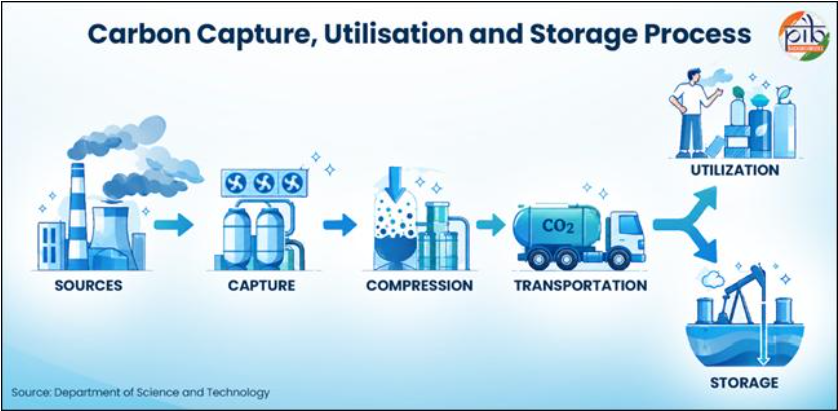
• About: CCUS involves capturing carbon dioxide (CO₂) from industrial sources or other emission streams before it enters the atmosphere, followed by its utilisation in useful products or permanent storage in geological formations.
• Key Stages:
• Major storage pathways: These include depleted oil and gas reservoirs, deep saline aquifers and suitable basalt formations.
• Carbon utilisation: Captured CO₂ can serve as a feedstock for building materials, chemicals, synthetic fuels, polymers and biological products. The climate benefits vary by application and depend on lifecycle emissions.
• CCUS hubs and clusters: Multiple industrial emitters can be connected to shared CO₂ transport and storage infrastructure, potentially reducing costs and enabling deployment at scale.
Need and Significance
• Addressing a major emissions challenge: Emissions from hard-to-abate industrial sectors and thermal power generation are expected to reach nearly 2,300 million tonnes per annum by 2030. CCUS offers a pathway to address emissions that are difficult to eliminate through electrification and renewable energy alone.
• Achieving Net Zero by 2070: CCUS can complement renewable energy, energy efficiency and industrial electrification, particularly where industrial processes require high temperatures or carbon-based inputs.
• Decarbonising essential industries: It can help reduce emissions from steel, cement, chemicals, refineries and fertilisers while allowing the continued production of essential industrial goods.
• Supporting low-carbon hydrogen and industrial innovation: Carbon capture can support hydrogen production from fossil fuels. Captured CO₂ can also be used in concrete, chemicals and synthetic fuels, subject to the emissions and lifecycle impacts of the complete production pathway.
Government Initiatives and Pilots
• Union Budget 2026–27: Proposed an outlay of ₹20,000 crore over five years to advance CCUS technologies in five sectors—power, steel, cement, refineries and chemicals—with a focus on improving readiness for end-use applications.
• CCUS R&D Roadmap, 2025: Launched by the Department of Science & Technology in December 2025, the roadmap provides strategic direction for research, funding, technology development and deployment, with a focus on commercial readiness.
• Demonstration infrastructure: In May 2026, IIT Bombay inaugurated India's first integrated CCUS field laboratory, capable of capturing up to 3 tonnes of CO₂ per day from industrial emissions and ambient air, while supporting utilisation and geological-storage research.
• NITI Aayog CCUS Policy Framework: Released in November 2022, the report examines CCUS as an emissions reduction strategy for deep decarbonisation of hard-to-abate sectors and outlines sector-specific policy interventions for its deployment.
Key Challenges and Concerns
• High costs and energy requirements: Capture, purification, compression, transport and storage require substantial investment and energy, while commercial viability varies by sector and technology.
• Storage uncertainty and infrastructure gaps: NITI Aayog estimates India's theoretical geological CO₂ storage capacity at 395–614 Gt. Actual deployment requires site-specific geological assessment, validation, transport networks and suitable storage infrastructure.
• Uncertain climate benefits of utilisation: CO₂ used in some products may be released back into the atmosphere after a short period. Its climate benefit must therefore be assessed over the product's lifecycle; enhanced oil recovery also warrants scrutiny of associated emissions.
• Long-term safety and accountability: Geological storage requires effective monitoring, leakage management and clear arrangements for long-term liability and environmental protection.
Way Forward
• Prioritise sectors and locations: Focus early deployment on hard-to-abate industries where emissions are difficult to eliminate, and map suitable storage sites near major emission sources.
• Develop shared CCUS hubs: Connect multiple industrial emitters to common transport and storage infrastructure to reduce costs and improve economies of scale. Regional industrial clusters being developed in the UK, Netherlands and Norway illustrate this approach.
• Link funding to measurable outcomes: Use public support to advance demonstration and commercial deployment, with clear milestones for capture efficiency, energy consumption, cost reduction and verified emissions avoided.
• Ensure CCUS complements direct mitigation: Continue prioritising renewable energy, energy efficiency and other feasible emissions-reduction measures. Evaluate utilisation projects through lifecycle assessment so that using captured CO₂ is not automatically treated as a net climate benefit.
Khan Global Studies App
With our training programs, learning online can be a very exciting experience. Take the next step toward achieving your professional and personal objectives.



Course Related Query:
Ask Your DoubtsStore Related Query:[email protected]NEET | JEE | CUET
NCERT Books
Resources
We love learning. Through our innovative solutions, we encourage ourselves, our teams, and our Students to grow. We welcome and look for diverse perspectives and opinions because they enhance our decisions. We strive to understand the big picture and how we contribute to the company’s objectives. We approach challenges with optimism and harness the power of teamwork to accomplish our goals. These aren’t just pretty words to post on the office wall. This is who we are. It’s how we work. And it’s how we approach every interaction with each other and our Students.
Come with an open mind, hungry to learn, and you’ll experience unmatched personal and professional growth, a world of different backgrounds and perspectives, and the freedom to be you—every day. We strive to build and sustain diverse teams and foster a culture of belonging. Creating an inclusive environment where every students feels welcome, appreciated, and heard gives us something to feel (really) good about.