You're all caught up—no notifications available.
Explore All Exams at KGS


All Exams
Explore All Exams at KGS

Khan Sir Courses
Geography I Polity I History | World Map I Indian Map I Economics I Biology

UPSC & State PSC
UPSC I BPSC I UP-PSC I MP-PSC

State Exams
UP I Bihar I MP | Rajasthan

NEET | JEE | CUET
NEET | JEE | CUET

Defence Exams
NDA I CDS I CAPF I AFCAT I SSB I Agniveer

Police Exams
UP SI | Bihar SI | Delhi Police | UP Constable

SSC Exams
CGL I CPO I CHSL I MTS I SSC GD I Delhi Police

Foundation Courses
Physics I Chemistry I Biology I History I Geography I Polity I NCERT I Math I English | Map I Reasoning

Railway Exams
RRB | RPF

Teaching Exams
TET | Teaching | UGC

Banking Exams
SBI | RBI | IBPS

Engineering Exams
Civil | Electrical | Mechanical
UGC NET
UGC NET/JRF
Current Affairs provides you with the best compilation of the Daily Current Affairs taking place across the globe: National, International, Sports, Science and Technology, Banking, Economy, Agreement, Appointments, Ranks, and Report and General Studies

SYLLABUS
GS-3: Indian Economy and issues relating to planning, mobilization of resources, growth, development and employment.
Context: India's wholesale price inflation rose to 9.68% in May 2026 under the newly revised Wholesale Price Index (WPI) series with base year 2022-23, mainly driven by sharp increases in energy prices.
More on the News
• Alongside the revised WPI, the government introduced the Output Producer Price Index (OPPI), Trial Input Producer Price Index (IPPI), and Service Producer Price Indices (Service PPIs) for selected sectors.
• The move aims to align India's producer-price measurement framework with international best practices and IMF recommendations.
• The government has announced that WPI will continue alongside PPIs for five years before being phased out.
Key Highlights of the Findings
• WPI inflation increased to 9.68% in May 2026, up from 8.26% in April 2026.
• Fuel and Power inflation surged to 30.33%, emerging as the biggest contributor to wholesale inflation.
• Inflation in Crude Petroleum & Natural Gas rose to 61.51%, while Mineral Oils recorded 49.82% inflation.
• Manufactured Products inflation accelerated to 7.48% from 6.68% in April.
• Primary Articles inflation increased to 4.99% from 3.78%.
• The WPI Food Index rose by 4.49%, compared with 3.11% in April.
• Major drivers of inflation were Mineral Oils, Crude Petroleum & Natural Gas, Chemicals & Chemical Products, and Basic Metals.
About the Wholesale Price Index (WPI)
• WPI measures the average change in prices of goods traded at the wholesale/producer level before they reach consumers.
• It is compiled and released by the Office of the Economic Adviser (OEA), Department for Promotion of Industry and Internal Trade (DPIIT), Ministry of Commerce and Industry.
• The revised WPI series uses 2022-23 as the base year, replacing the 2011-12 series.
• It is released on a monthly basis, generally on the 14th of the following month (or next working day).
• The new basket covers 957 commodities, up from 697 commodities in the previous series.
• The index is divided into three major groups:
• Manufactured Products carry the highest weight in the index basket.
• Solar Power, Wind Power, and Nuclear Electricity have been included in the Electricity group.
• Crude Petroleum and Natural Gas have been shifted from the Primary Articles group to the Fuel and Power group for better tracking of energy prices.
• The new series uses Gross Value of Output (GVO) for assigning weights, replacing the earlier Net Traded Value approach.
• The elementary indices are now compiled using the short-term formulation method, replacing the long-term formulation method.
• Missing price observations are estimated through Targeted Mean Imputation, replacing the earlier Carry Forward Method.
• A WPI Food Index is also compiled by combining:
• WPI covers only goods and does not include services.
About the Output Producer Price Index (OPPI)
• OPPI measures changes in prices received by producers for goods sold at the factory gate or first point of sale.
• It is compiled on a monthly basis with 2022-23 as the base year.
• Weights are derived from the Supply Table of the National Accounts Supply and Use Table (SUT).
• The All Commodities OPPI stood at 109.6 in May 2026, compared with 108.6 in April 2026.
• Major sectors covered include:
• OPPI provides a more direct measure of producer-level inflation than WPI.
• OPPI is compiled using Basic Prices (factory-gate prices).
About the Trial Input Producer Price Index (IPPI)
• IPPI measures changes in prices paid by industries for inputs used in the production process.
• It is currently being published on a trial/experimental basis for the manufacturing sector.
• Weights are derived from the Use Table of the National Accounts Supply and Use Table (SUT).
• Unlike WPI and OPPI, IPPI is compiled using Purchaser's Prices, reflecting actual input costs faced by industries.
• The Manufacturing Sector IPPI stood at 104.9 in May 2026.
About the Service Producer Price Index (Service PPI)
• Service PPI measures changes in prices received by service providers.
• It is compiled on a quarterly basis and released with a lag of 55 days after the end of the reference quarter.
• Service PPI is compiled using Basic Prices.
• In the first phase, Service PPIs have been introduced for seven sectors:
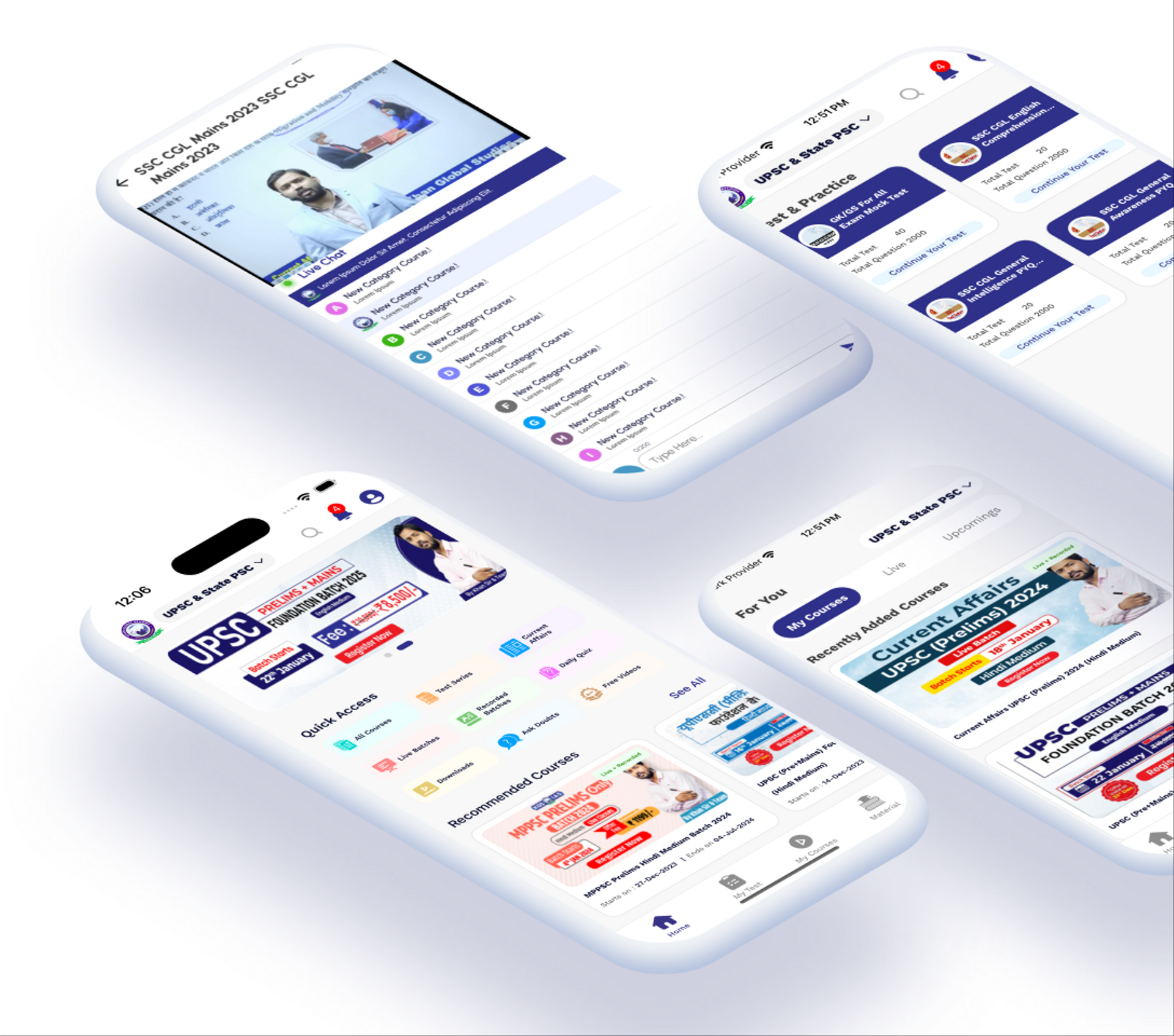
The most trusted learning platform on your phone
With our training programs, learning online can be a very exciting experience! Take the next step toward achieving your professional and personal objectives



Course Related Query:
Ask Your DoubtsStore Related Query:[email protected]NEET | JEE | CUET
NCERT Books
Resources
We love learning. Through our innovative solutions, we encourage ourselves, our teams, and our Students to grow. We welcome and look for diverse perspectives and opinions because they enhance our decisions. We strive to understand the big picture and how we contribute to the company’s objectives. We approach challenges with optimism and harness the power of teamwork to accomplish our goals. These aren’t just pretty words to post on the office wall. This is who we are. It’s how we work. And it’s how we approach every interaction with each other and our Students.
Come with an open mind, hungry to learn, and you’ll experience unmatched personal and professional growth, a world of different backgrounds and perspectives, and the freedom to be you—every day. We strive to build and sustain diverse teams and foster a culture of belonging. Creating an inclusive environment where every students feels welcome, appreciated, and heard gives us something to feel (really) good about.
Get Free academic Counseling & Course Details