Explore All Exams at KGS


All Exams
Explore All Exams at KGS

Khan Sir Courses
Geography I Polity I History | World Map I Indian Map I Economics I Biology

UPSC & State PSC
UPSC I BPSC I UP-PSC I MP-PSC

State Exams
UP I Bihar I MP | Rajasthan

NEET | JEE | CUET
NEET | JEE | CUET

Defence Exams
NDA I CDS I CAPF I AFCAT I SSB I Agniveer

Police Exams
UP SI | Bihar SI | Delhi Police | UP Constable

SSC Exams
CGL I CPO I CHSL I MTS I SSC GD I Delhi Police

Foundation Courses
Physics I Chemistry I Biology I History I Geography I Polity I NCERT I Math I English | Map I Reasoning

Railway Exams
RRB | RPF

Teaching Exams
TET | Teaching | UGC

Banking Exams
SBI | RBI | IBPS

Engineering Exams
Civil | Electrical | Mechanical
UGC NET
UGC NET/JRF
Current Affairs provides you with the best compilation of the Daily Current Affairs taking place across the globe: National, International, Sports, Science and Technology, Banking, Economy, Agreement, Appointments, Ranks, and Report and General Studies

Current Affairs
SYLLABUS
GS-2: Bilateral, Regional and Global Groupings and Agreements involving India and/or affecting India’s interests; Important International Institutions, agencies and fora – their Structure, Mandate.
Context: The Gaza Board of Peace announced an agreement with Hamas on its phased disarmament, marking the first major implementation milestone under the 20-point Gaza Peace Plan.
Background of the 20-Point Gaza Peace Plan
• The 20-point Gaza Peace Plan, unveiled by US President Donald Trump in 2025, seeks to end the Israel–Hamas conflict through a phased political, security and reconstruction roadmap.
• Phase I focuses on a ceasefire, hostage exchange and limited withdrawal of Israeli forces.
• Phase II envisages Hamas' disarmament, transfer of governance to a technocratic Palestinian administration, deployment of an International Stabilization Force (ISF) and reconstruction of Gaza.
• The present agreement marks the beginning of the implementation of Phase II.
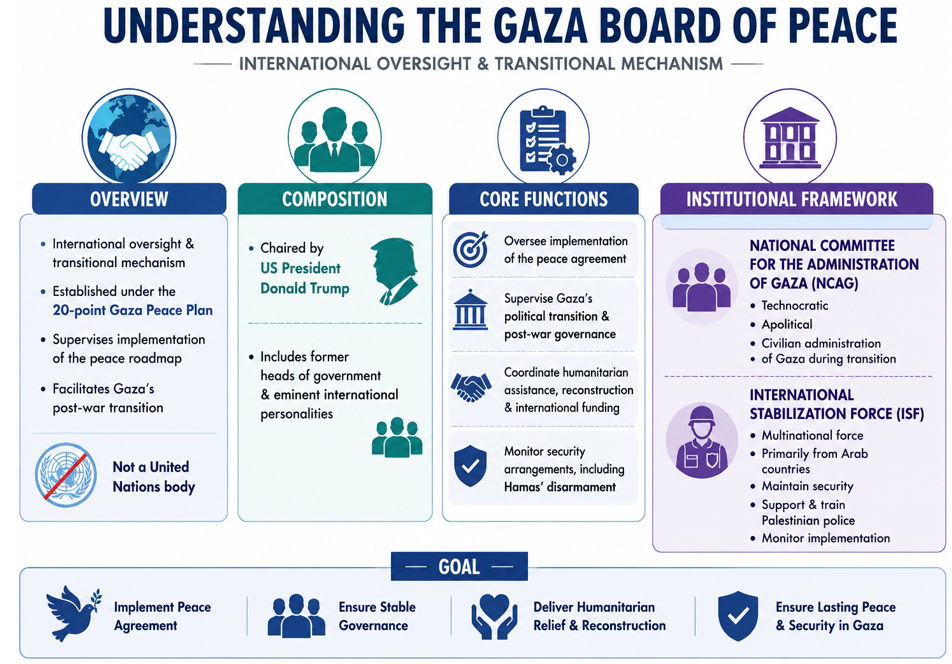
Key Highlights of the Agreement
• Phased Disarmament: Hamas agreed to a framework for the phased disarmament of its military wing under an internationally supervised mechanism, subject to the agreed implementation roadmap.
• Political Transition: Gaza's administration will be transferred to the National Committee for the Administration of Gaza (NCAG), a technocratic and apolitical Palestinian body, ending Hamas' governing role.
• International Security Mechanism: An International Stabilization Force (ISF), comprising troops from Arab countries, is proposed to maintain security, train Palestinian police and oversee implementation of the agreement.
• Implementation Remains Conditional: While the agreement represents a diplomatic breakthrough, differences persist over the sequencing of disarmament, Israeli military withdrawal, hostage release and long-term security guarantees.
Significance of the Agreement
• First Major Implementation Breakthrough: Represents the first concrete political milestone under the 20-point Gaza Peace Plan, moving the peace process from negotiations towards implementation.
• Facilitates Political Transition: Opens the possibility of replacing Hamas' armed governance with a technocratic Palestinian administration, laying the foundation for institutional reforms in Gaza.
• Enables Humanitarian Recovery: Creates conditions for expanding humanitarian assistance, reconstruction of critical infrastructure and revival of Gaza's economy.
• Revives Diplomatic Process: If implemented successfully, it could reduce regional tensions and create fresh momentum towards a negotiated Two-State Solution.
Challenges/Concerns
• Sequencing Dispute: Hamas seeks guarantees of a permanent ceasefire and complete Israeli withdrawal before full disarmament, while Israel insists on verified disarmament before completing troop withdrawal.
• Verification & Enforcement: Monitoring weapons stockpiles, tunnel networks and compliance with disarmament commitments remains a major operational challenge.
• Post-Conflict Governance: The proposed NCAG must gain legitimacy among Palestinians while ensuring effective coordination with Israel and international stakeholders.
• Wider Political Deadlock: The agreement focuses on Gaza, but unresolved issues relating to the West Bank, Jerusalem, Palestinian political unity and final-status negotiations continue to impede a durable peace.
Way Forward
• Implement a Phased & Verifiable Roadmap: Ensure that disarmament, hostage release, Israeli withdrawal and ceasefire commitments proceed through transparent, internationally verified milestones.
• Strengthen Inclusive Palestinian Governance: Empower the NCAG through broad Palestinian participation and sustained international political and financial support.
• Mobilise Coordinated International Support: Ensure sustained humanitarian assistance, reconstruction financing and diplomatic engagement through the UN, Arab States and other international partners.
• Revive the Political Process: Build on the present agreement to resume negotiations towards a Two-State Solution, enabling Israel and an independent, sovereign Palestine to coexist peacefully in accordance with relevant UN resolutions.
Khan Global Studies App
With our training programs, learning online can be a very exciting experience. Take the next step toward achieving your professional and personal objectives.


Course Related Query:
Ask Your DoubtsStore Related Query:[email protected]NEET | JEE | CUET
NCERT Books
Resources
We love learning. Through our innovative solutions, we encourage ourselves, our teams, and our Students to grow. We welcome and look for diverse perspectives and opinions because they enhance our decisions. We strive to understand the big picture and how we contribute to the company’s objectives. We approach challenges with optimism and harness the power of teamwork to accomplish our goals. These aren’t just pretty words to post on the office wall. This is who we are. It’s how we work. And it’s how we approach every interaction with each other and our Students.
Come with an open mind, hungry to learn, and you’ll experience unmatched personal and professional growth, a world of different backgrounds and perspectives, and the freedom to be you—every day. We strive to build and sustain diverse teams and foster a culture of belonging. Creating an inclusive environment where every students feels welcome, appreciated, and heard gives us something to feel (really) good about.