KGS

All Exams

Explore All Exams at KGS

All Exams
Current Affairs made simple.

Current Affairs provides you with the best compilation of the Daily Current Affairs taking place across the globe: National, International, Sports, Science and Technology, Banking, Economy, Agreement, Appointments, Ranks, and Report and General Studies

Current Affairs

Global Hunger Index 2026

SYLLABUS

GS-2: Issues relating to poverty and hunger; Issues relating to development and management of Social Sector/Services relating to Health, Education, Human Resources.

Context: The Global Hunger Index (GHI) 2026, published under the theme “No Security Without Food Security”, places India at 100th among 122 countries, with a score of 24.1, categorised as serious hunger.

About the Global Hunger Index
  • Purpose and publishers: The GHI is a peer-reviewed annual publication that measures and tracks hunger at global, regional and national levels. It is jointly published by Welthungerhilfe (WHH), the Institute for International Law of Peace and Armed Conflict (IFHV), and Helvetas.
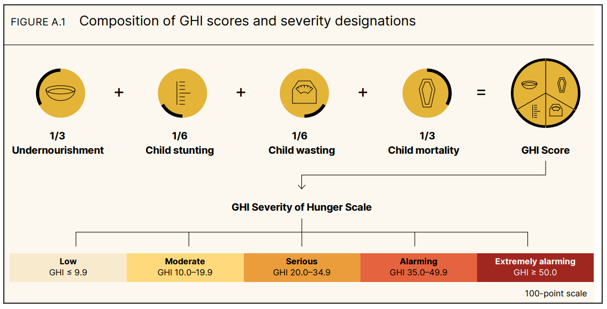
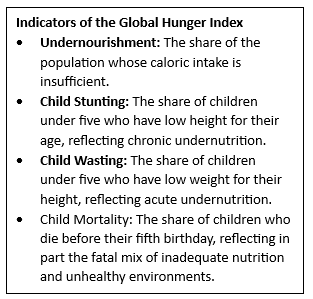
  • Four indicators: The index combines undernourishment, child stunting, child wasting and under-five mortality.
  • Scoring: The GHI uses a 0–100 scale, where 0 represents no hunger, and 100 represents the worst possible hunger situation. Its five severity categories are low, moderate, serious, alarming and extremely alarming.

Key Findings of GHI 2026

Global and Regional Findings

  • Global hunger has worsened: The global GHI score rose from 17.6 in 2018 to 18.1 in 2026, interrupting the decline recorded since 2000. The report examines the effects of overlapping conflicts, climate extremes and economic shocks on food and nutrition security.
  • Africa South of the Sahara faces the highest regional hunger level: Its GHI score of 27.5 is the highest among regions assessed, followed by South Asia at 23.5. Both regions fall in the serious category.
  • Countries facing the most severe hunger: Somalia has the highest GHI score in the 2026 report, followed by the Democratic Republic of the Congo, Chad and Madagascar. Eight countries have alarming hunger levels, while 36 countries are classified in the serious category.
  • Progress remains uneven: Compared with 2018, GHI scores increased in Africa South of the Sahara and West Asia and North Africa, remained unchanged in Europe and Central Asia, and declined by less than one point in Latin America and the Caribbean and East and Southeast Asia.
  • Food security and wider stability: The report highlights how conflict, disrupted food and fertiliser markets, climate shocks and economic pressures can undermine food security. It calls for resilient food systems, secure livelihoods, social protection, climate adaptation and access to essential resources such as water.

India’s Performance

  • Overall performance: India scored 24.1 and ranked 100th among 122 countries, placing it in the serious hunger category. Ethiopia shares the same rank and score.
  • Component indicators: India’s undernourishment rate is 9.8%, child stunting is 29.3%, child wasting is 19.0%, and under-five mortality is 2.7%.
  • Progress in child nutrition: Child stunting declined from 50.0% in 2000 to 29.3% in 2026, a reduction of 20.7 percentage points. India’s GHI score also improved from 25.8 in 2018 to 24.1 in 2026.
  • Mixed progress: Despite improvements in undernourishment and stunting, child wasting remains high at 19.0%, the highest rate in South Asia. Child stunting has moved from the very high to the high category.
  • Regional Comparison: India performs worse than Sri Lanka (53rd; 10.2), Nepal (72nd; 14.5) and Bangladesh (84th; 19.2), but better than Pakistan (106th; 25.5) and Afghanistan (108th; 28.6).

Key Concerns for India

  • Persistent child undernutrition: The high prevalence of child wasting and stunting remains a major concern despite improvements in the overall GHI score.
  • Uneven progress: The contrast between declining undernourishment and rising child wasting indicates that improvements in food access do not automatically translate into better nutritional outcomes.
  • Multidimensional determinants: Hunger is influenced by access to diverse and affordable diets, maternal and child healthcare, sanitation and secure livelihoods.
  • Vulnerability to external shocks: The report highlights the risks posed by climate extremes, food-price pressures and disruptions to food systems, including the prospect of below-normal monsoon rainfall across India’s Monsoon Core Zone in 2026.

Government Initiatives to Address Hunger and Malnutrition

  • Mission Saksham Anganwadi and POSHAN 2.0: Provides supplementary nutrition and integrated Anganwadi services for children, pregnant women and lactating mothers, alongside nutrition education and behaviour-change interventions.
  • PM POSHAN: Provides hot cooked meals to eligible children in government and government-aided schools to improve nutritional status and support school attendance and retention.
  • National Food Security Act (NFSA), 2013: Establishes a rights-based framework for food security, including subsidised foodgrains for eligible households through the Targeted Public Distribution System and nutritional support for women and children through designated schemes.
  • Anaemia Mukt Bharat: Addresses anaemia through iron and folic acid supplementation, community outreach and monitoring under the Ministry of Health and Family Welfare.

Way Forward

  • Prioritise maternal and early-childhood nutrition: Strengthen maternal nutrition, breastfeeding, complementary feeding, growth monitoring and early identification of undernutrition.
  • Improve programme delivery and convergence: Coordinate nutrition, healthcare and food-security interventions, supported by timely monitoring and targeted action for vulnerable groups.
  • Address underlying determinants: Improve access to diverse and affordable diets, healthcare, safe drinking water and sanitation.
  • Build resilient food systems: Strengthen social protection, secure livelihoods and climate adaptation to protect vulnerable households from economic and environmental shocks.

Khan Global Studies App

The most trusted learning platform on your phone

With our training programs, learning online can be a very exciting experience. Take the next step toward achieving your professional and personal objectives.


Download on the App StoreGet it on Google Play
KGS learning dashboard and mobile application
logo
Khan Global Studies Pvt. Ltd. 5th Floor,
A13A, Graphix 1 Tower B, Sector 62,
Noida, Uttar Pradesh 201309

Course Related Query:

Ask Your DoubtsStore Related Query:[email protected]

Get Free Academic Counseling & Course Details

KGS best learning platform

About Khan Global Studies

We love learning. Through our innovative solutions, we encourage ourselves, our teams, and our Students to grow. We welcome and look for diverse perspectives and opinions because they enhance our decisions. We strive to understand the big picture and how we contribute to the company’s objectives. We approach challenges with optimism and harness the power of teamwork to accomplish our goals. These aren’t just pretty words to post on the office wall. This is who we are. It’s how we work. And it’s how we approach every interaction with each other and our Students.


What Makes Us Different

Come with an open mind, hungry to learn, and you’ll experience unmatched personal and professional growth, a world of different backgrounds and perspectives, and the freedom to be you—every day. We strive to build and sustain diverse teams and foster a culture of belonging. Creating an inclusive environment where every students feels welcome, appreciated, and heard gives us something to feel (really) good about.

©Copyright 2026 KhanGlobalStudies