You're all caught up—no notifications available.
Explore All Exams at KGS


All Exams
Explore All Exams at KGS

Khan Sir Courses
Geography I Polity I History | World Map I Indian Map I Economics I Biology

UPSC & State PSC
UPSC I BPSC I UP-PSC I MP-PSC

State Exams
UP I Bihar I MP | Rajasthan

NEET | JEE | CUET
NEET | JEE | CUET

Defence Exams
NDA I CDS I CAPF I AFCAT I SSB I Agniveer

Police Exams
UP SI | Bihar SI | Delhi Police | UP Constable

SSC Exams
CGL I CPO I CHSL I MTS I SSC GD I Delhi Police

Foundation Courses
Physics I Chemistry I Biology I History I Geography I Polity I NCERT I Math I English | Map I Reasoning

Railway Exams
RRB | RPF

Teaching Exams
TET | Teaching | UGC

Banking Exams
SBI | RBI | IBPS

Engineering Exams
Civil | Electrical | Mechanical
UGC NET
UGC NET/JRF
Current Affairs provides you with the best compilation of the Daily Current Affairs taking place across the globe: National, International, Sports, Science and Technology, Banking, Economy, Agreement, Appointments, Ranks, and Report and General Studies
SYLLABUS
GS-3: Conservation, Environmental Pollution and Degradation, Environmental Impact Assessment.
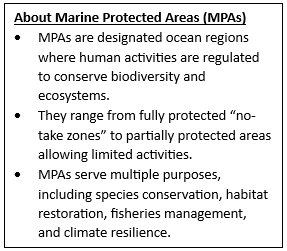
Context: As per the latest updates from the United Nations Environment Programme (UNEP), the world has reached a major conservation milestone, with 10.01% of the global ocean now officially designated as protected and conserved areas.
More on the News
• This milestone marks a rise from 8.6% in 2024, meaning roughly 5 million sq km of ocean was added to the protection network in just two years.
• However, the milestone comes six years after the original target under the Aichi Biodiversity Targets, where countries agreed to protect 10% of the ocean by 2020.
• The milestone is closely linked to the broader global goal under the Kunming–Montreal Global Biodiversity Framework, which calls for protecting 30% of land and sea by 2030 (“30×30 target”).
Key Highlights of the Latest Update
• Global ocean protection has crossed the 10% threshold for the first time, marking a significant milestone in marine conservation efforts.
• The increase in protected areas over the past two years is substantial, covering an area larger than the European Union, indicating accelerated but still insufficient progress.
• However, effective protection remains limited, with only a small proportion of these areas being strictly or fully protected, raising concerns about the quality and enforcement of Marine Protected Areas (MPAs).
• Progress is highly uneven, with most gains concentrated within national jurisdictions, while protection in areas beyond national jurisdiction (high seas) remains minimal.
• To meet the 30×30 target by 2030, global ocean protection must expand significantly—by an area roughly equivalent to the Indian Ocean, highlighting the scale of effort still required.
Significance of Ocean Protection
• Ecological Importance: Oceans host immense biodiversity, including coral reefs, deep-sea ecosystems, and migratory species critical for ecological balance.
• Climate Regulation: Marine ecosystems act as major carbon sinks (blue carbon), helping mitigate climate change and regulate global temperatures.
• Economic Value: Oceans support fisheries, tourism, and livelihoods for millions, forming a key pillar of the global blue economy.
• Disaster Resilience: Healthy marine ecosystems such as mangroves and coral reefs provide natural protection against storms and coastal erosion.
Challenges and Concerns
• Gap to 30×30 Target: Despite reaching ~10% protection, the current pace is too slow, and achieving 30% by 2030 will require a rapid and large-scale expansion of well-managed MPAs.
• “Paper Parks” Problem: Many MPAs lack effective enforcement and monitoring, existing only on paper and failing to prevent harmful activities, thereby limiting real conservation impact.
• Limited High Seas Governance: Protection in areas beyond national jurisdiction remains minimal due to weak legal frameworks and coordination challenges, reducing overall global effectiveness.
• Funding and Capacity Constraints: Developing countries often face financial and technical limitations, hindering proper management, monitoring, and enforcement of protected areas.
• Conflict of Interests: Conservation efforts frequently clash with economic activities like fishing, shipping, and mining, creating policy trade-offs and slowing implementation.
Global Initiatives and Agreements
• Kunming-Montreal Global Biodiversity Framework (2022): It sets the “30×30 target”, committing countries to protect 30% of global land and oceans by 2030, forming the central guiding framework for biodiversity conservation.
• BBNJ Agreement (High Seas Treaty): It provides a legal framework for conserving biodiversity in areas beyond national jurisdiction, addressing gaps in governance of the high seas.
• Protected Planet Initiative: Led by the UNEP and International Union for Conservation of Nature (IUCN), it tracks global progress on protected areas and supports data-driven conservation planning.
• UN Sustainable Development Goal 14 (Life Below Water): It aims to ensure the conservation and sustainable use of oceans and marine resources, aligning global efforts with broader sustainable development objectives.
SOURCES
Down To Earth
Oceangraphi
IUCN
The most trusted learning platform on your phone
With our training programs, learning online can be a very exciting experience! Take the next step toward achieving your professional and personal objectives


Course Related Query:
Ask Your DoubtsStore Related Query:[email protected]NCERT Books
Resources
We love learning. Through our innovative solutions, we encourage ourselves, our teams, and our Students to grow. We welcome and look for diverse perspectives and opinions because they enhance our decisions. We strive to understand the big picture and how we contribute to the company’s objectives. We approach challenges with optimism and harness the power of teamwork to accomplish our goals. These aren’t just pretty words to post on the office wall. This is who we are. It’s how we work. And it’s how we approach every interaction with each other and our Students.
Come with an open mind, hungry to learn, and you’ll experience unmatched personal and professional growth, a world of different backgrounds and perspectives, and the freedom to be you—every day. We strive to build and sustain diverse teams and foster a culture of belonging. Creating an inclusive environment where every students feels welcome, appreciated, and heard gives us something to feel (really) good about.
Get Free academic Counseling & Course Details