Explore All Exams at KGS


All Exams
Explore All Exams at KGS

Khan Sir Courses
Geography I Polity I History | World Map I Indian Map I Economics I Biology

UPSC & State PSC
UPSC I BPSC I UP-PSC I MP-PSC

Judiciary
CLAT

State Exams
UP I Bihar I MP | Rajasthan

NEET | JEE | CUET
NEET | JEE | CUET

Defence Exams
NDA I CDS I CAPF I AFCAT I SSB I Agniveer

Police Exams
UP SI | Bihar SI | Delhi Police | UP Constable

SSC Exams
CGL I CPO I CHSL I MTS I SSC GD I Delhi Police

Foundation Courses
Physics I Chemistry I Biology I History I Geography I Polity I NCERT I Math I English | Map I Reasoning

Railway Exams
RRB | RPF

Teaching Exams
TET | Teaching | UGC

Banking Exams
SBI | RBI | IBPS

Engineering Exams
Civil | Electrical | Mechanical
UGC NET
UGC NET/JRF
Current Affairs provides you with the best compilation of the Daily Current Affairs taking place across the globe: National, International, Sports, Science and Technology, Banking, Economy, Agreement, Appointments, Ranks, and Report and General Studies
Current Affairs
SYLLABUS
GS-2: Important International Institutions, agencies and fora - their Structure, Mandate.
Context: The Global Risks Report 2026, prepared by the World Economic Forum (WEF), is the 21st edition of the annual report, marking the second half of a turbulent decade.
More on the News:
• The report analyses global risks through three timeframes to support decision makers in balancing current crises and longer-term priorities.
Key findings of the Report
• A new “Age of competition”: As global risks continue to spiral in scale, interconnectivity and velocity, 2026 marks an age of competition because of:-
• Retreating Multilateralism: Declining trust, diminishing transparency and respect for the rule of law, along with heightened protectionism, are threatening longstanding international relations, trade and investment and increasing the propensity for conflict.
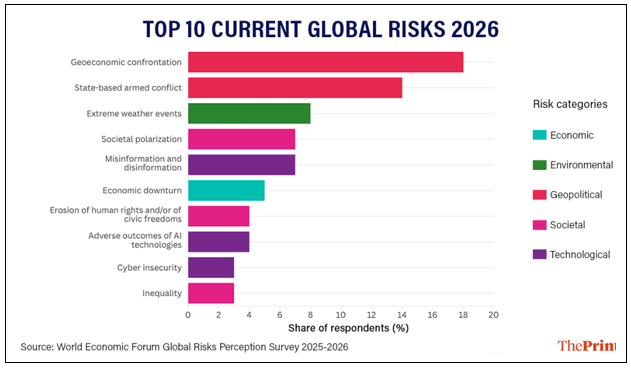
• Top global risk in 2026
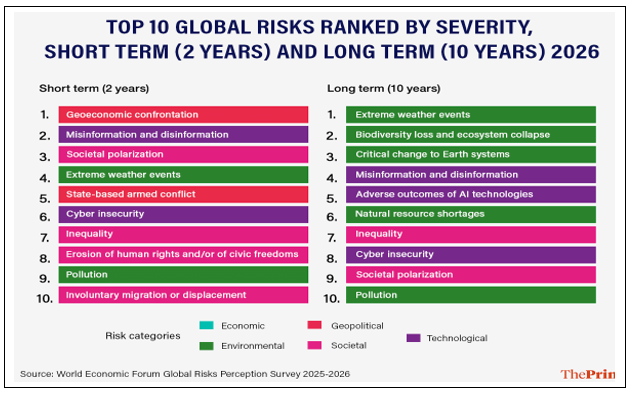
• Intensifying Economic risks: Economic risks that includes Economic downturn, Geoeconomic confrontation, Asset bubble burst and Inflation, show the largest increases in ranking over the next two years, albeit from relatively low rankings last year.
• Unchecked Technological risks: Misinformation and disinformation, Cyber insecurity, and Adverse outcomes of frontier technologies like AI, leading to new risks across domains, from labour markets to information integrity to autonomous weapons systems.
• Societies are on the edge:
• Deprioritized Environmental concerns: Environmental risks like Extreme weather events, Pollution, Biodiversity loss and ecosystem collapse declined in severity score for the two-year time horizon compared with last year’s findings, reflecting an absolute shift away from concerns about the environment.
India-Specific Findings in the Report
• Top five risks as identified by the Executive Opinion Survey (EOS) 2025 include:
• Natural resources in Trade: India is increasingly using natural resources as leverage in trade and strategic negotiations.
• Potential Geopolitical Flashpoints:
• Misinformation in Democracy: Recent elections in the United States, Ireland, the Netherlands, Pakistan, Japan, India and Argentina have all had to contend with such fabricated content on social media, depicting fictional events or discrediting political candidates, blurring the line between fact and fiction.
Key recommendations in the report
• Multipolarity with Multilateral: Strengthen multilateral frameworks and rebuild trust-based cooperation to manage global risks.
• Counter societal polarization: Strengthen media literacy, fact-checking frameworks, and transparent communication strategies to address the spread of misinformation and Deepfakes that undermine democratic processes and trust.
• Tech Governance: upgrade cyberdefenses, create adaptive rules for AI, and safeguard critical infrastructure.
• Bridge Social Protection Gaps: promote inclusive growth, Equity, social safety nets, and equitable access to services.
Khan Global Studies App
With our training programs, learning online can be a very exciting experience. Take the next step toward achieving your professional and personal objectives.


Course Related Query:
Ask Your DoubtsStore Related Query:[email protected]NEET | JEE | CUET
NCERT Books
Resources
We love learning. Through our innovative solutions, we encourage ourselves, our teams, and our Students to grow. We welcome and look for diverse perspectives and opinions because they enhance our decisions. We strive to understand the big picture and how we contribute to the company’s objectives. We approach challenges with optimism and harness the power of teamwork to accomplish our goals. These aren’t just pretty words to post on the office wall. This is who we are. It’s how we work. And it’s how we approach every interaction with each other and our Students.
Come with an open mind, hungry to learn, and you’ll experience unmatched personal and professional growth, a world of different backgrounds and perspectives, and the freedom to be you—every day. We strive to build and sustain diverse teams and foster a culture of belonging. Creating an inclusive environment where every students feels welcome, appreciated, and heard gives us something to feel (really) good about.