You're all caught up—no notifications available.
Explore All Exams at KGS


All Exams
Explore All Exams at KGS

Khan Sir Courses
Geography I Polity I History | World Map I Indian Map I Economics I Biology

UPSC & State PSC
UPSC I BPSC I UP-PSC I MP-PSC

State Exams
UP I Bihar I MP | Rajasthan

NEET | JEE | CUET | Boards
NEET | JEE | CUET | Boards

Defence Exams
NDA I CDS I CAPF I AFCAT I SSB I Agniveer

Police Exams
UP SI | Bihar SI | Delhi Police | UP Constable

SSC Exams
CGL I CPO I CHSL I MTS I SSC GD I Delhi Police

Foundation Courses
Physics I Chemistry I Biology I History I Geography I Polity I NCERT I Math I English | Map I Reasoning

Railway Exams
RRB | RPF

Teaching Exams
TET | Teaching | UGC

Banking Exams
SBI | RBI | IBPS

Engineering Exams
Civil | Electrical | Mechanical
UGC NET
UGC NET/JRF
Current Affairs provides you with the best compilation of the Daily Current Affairs taking place across the globe: National, International, Sports, Science and Technology, Banking, Economy, Agreement, Appointments, Ranks, and Report and General Studies

SYLLABUS
GS-2: Bilateral Agreements involving India and/or affecting India’s interests.
GS-3: Indian Economy and issues relating to Planning, Mobilization of Resources, Growth, Development and Employment.
Context: Recently, India and the Gulf Cooperation Council (GCC) formally launched negotiations for a comprehensive Free Trade Agreement (FTA) with the signing of a Joint Statement in New Delhi.
More on the News
• The Joint Statement was signed by Union Minister of Commerce and Industry Piyush Goyal and GCC Secretary General Jasem Mohamed Albudaiwi.
• The Joint Statement follows the signing of the Terms of Reference (ToR) earlier in February 2026, which sets the framework for negotiations.
• Negotiations will cover goods, services, investments, rules of origin, and dispute settlement, building on prior bilateral FTAs like India-UAE (2022).
• The move comes amid global economic uncertainties and supply-chain realignments, reflecting India’s push to deepen strategic trade partnerships in West Asia.
India–GCC Trading Relations
• The GCC is India’s largest trading partner bloc, with bilateral trade reaching approximately USD 178.6 billion in FY 2024–25, accounting for 15.42% of India’s global trade.
• Key exports from India to GCC include engineering goods, rice, textiles, machinery, gems and jewellery, while key sectors of imports from GCC primarily comprise crude oil, LNG, petrochemicals, and precious metals such as gold.
• In the last five years, India’s trade with the GCC has expanded steadily, registering an annual average growth rate of 15.3%.
• The GCC region is also a significant source of FDI for India, with cumulative investments exceeding USD 31.14 billion as of September 2025.
• Nearly 10 million Indians reside in GCC countries, forming one of the largest overseas Indian communities globally and strengthening remittance flows and people-to-people ties.
Significance of the Proposed FTA
• Energy Transition & Strategic Stability: Anchors long-term hydrocarbon supplies while expanding cooperation in grid interconnections and petrochemicals, thus supporting India’s energy security during its transition phase.
• Export Expansion & MSME Integration: Tariff rationalisation and streamlined standards can widen market access for Indian MSMEs in sectors like pharmaceuticals, engineering goods, food products, textiles, and digital services, aiding export diversification.
• Investment Flows & Infrastructure Financing: Deepens engagement with GCC sovereign wealth funds and institutional investors, catalysing capital inflows into infrastructure, logistics, manufacturing clusters, and emerging sectors.
• Supply Chain & Logistics Connectivity: Integrates India into West Asia–centric trade corridors linking Asia, Europe, and Africa, enhancing supply chain resilience and reducing trade transaction costs.
• Strategic & Geoeconomic Convergence: Aligns with GCC economic diversification agendas (e.g., Vision 2030 frameworks) and India’s Viksit Bharat ambitions, potentially elevating bilateral trade toward the USD 200+ billion trajectory over the decade.
About the Gulf Cooperation Council (GCC)
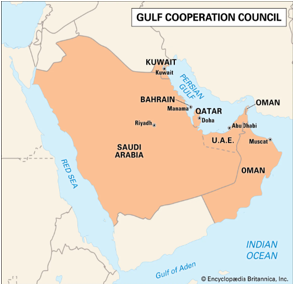
• Established in 1981, the GCC is a regional intergovernmental political and economic union comprising six member states, namely, Saudi Arabia, the United Arab Emirates, Qatar, Kuwait, Oman, and Bahrain.
• Formed in the background of heightened regional instability, particularly after the 1979 Iranian Revolution and the Iran–Iraq War (1980–1988), it aims to strengthen collective security and regional cooperation among Gulf states.
• The GCC has a combined GDP of approximately USD 2.3 trillion and a population of around 61.5 million.
• The GCC’s highest authority is the Supreme Council, comprising the Heads of State of member countries. The presidency rotates annually among members in alphabetical order.
• Its Secretariat is headquartered in Riyadh, Saudi Arabia.
The most trusted learning platform on your phone
With our training programs, learning online can be a very exciting experience! Take the next step toward achieving your professional and personal objectives


Course Related Query:
Ask Your DoubtsStore Related Query:[email protected]NCERT Books
Resources
We love learning. Through our innovative solutions, we encourage ourselves, our teams, and our Students to grow. We welcome and look for diverse perspectives and opinions because they enhance our decisions. We strive to understand the big picture and how we contribute to the company’s objectives. We approach challenges with optimism and harness the power of teamwork to accomplish our goals. These aren’t just pretty words to post on the office wall. This is who we are. It’s how we work. And it’s how we approach every interaction with each other and our Students.
Come with an open mind, hungry to learn, and you’ll experience unmatched personal and professional growth, a world of different backgrounds and perspectives, and the freedom to be you—every day. We strive to build and sustain diverse teams and foster a culture of belonging. Creating an inclusive environment where every students feels welcome, appreciated, and heard gives us something to feel (really) good about.
Get Free academic Counseling & Course Details