logo

All Exams

Notifications

All Exams

Explore All Exams at KGS

All Exams
Home>Current Affairs>India Rejects Hague Arbitration Ruling on Indus Waters Treaty
Current Affairs made simple.

Current Affairs provides you with the best compilation of the Daily Current Affairs taking place across the globe: National, International, Sports, Science and Technology, Banking, Economy, Agreement, Appointments, Ranks, and Report and General Studies

banner-image

India Rejects Hague Arbitration Ruling on Indus Waters Treaty

SYLLABUS: 

GS-2: India and its neighborhood relations and Bilateral, regional, and global grouping and agreements involving India and/or affecting India’s interests.

Context: India rejected an award issued by the Court of Arbitration (CoA) at The Hague concerning maximum pondage at Indian hydroelectric projects on the Indus River system, reiterating that it does not recognise the tribunal as legitimately constituted.

More on the News

  • The Ministry of External Affairs termed the CoA an “illegally constituted” body and declared all its proceedings, awards, and decisions as “null and void”.
  • The five-member CoA, constituted in January 2023 at Pakistan’s request, is examining disputes related to the design of India’s Kishenganga and Ratle hydroelectric projects on the Indus River system.
  • India has refused to participate in the arbitration process, arguing that the disputes are technical in nature and fall within the jurisdiction of the Neutral Expert mechanism provided under the Treaty.
  • In its August 2025 Award on Issues of General Interpretation, the CoA reportedly ruled largely in Pakistan’s favour by restricting India’s calculation of permissible pondage and limiting design flexibility for run-of-river projects.
  • India placed the IWT in abeyance in April 2025 after the Pahalgam terror attack in Jammu and Kashmir, marking a major shift in its approach towards the Treaty.

About the Indus Waters Treaty (IWT)

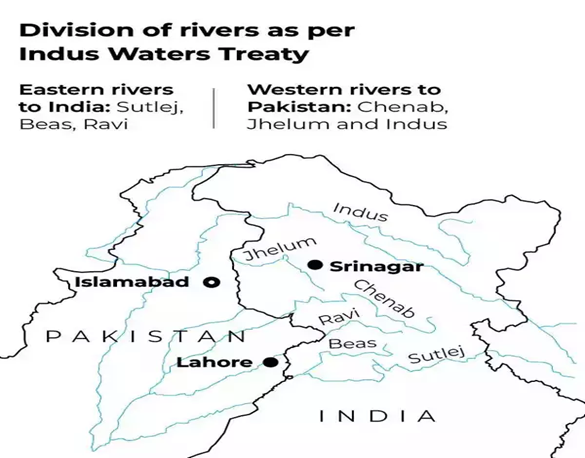
  • It is a landmark transboundary water-sharing agreement signed between India and Pakistan in September 1960,facilitated by the World Bank, to manage the distribution of water from the Indus River System, which consists of six rivers: Indus, Jhelum, Chenab, Ravi, Beas, and Sutlej.
  • These rivers originate from Tibet and flow through the Himalayan ranges into India and Pakistan, which makes Pakistan as the lower riparian state.

Key Provisions of the Treaty

  • Water Allocation:
    • Eastern Rivers (Ravi, Beas, Sutlej): Allocated to India for unrestricted use.
    • Western Rivers (Indus, Chenab, Jhelum): Allocated to Pakistan for unrestricted use, with some exceptions for India’s non-consumptive agricultural and domestic needs.
  • India’s Rights and Restrictions:
    • According to Article III (1) of the IWT, “India is under obligation to let flow” waters of the Western Rivers to Pakistan.
    • India is also permitted to build "run of the river" hydropower projects, which do not require live storage of water. However, it must share project details with Pakistan, which has 3 months to raise objections.
  • Article IX of the Treatyestablishes a three-step Dispute Resolution Mechanism:
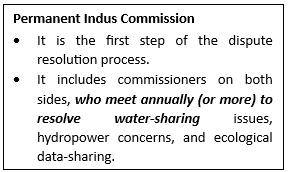
    • Permanent Indus Commission: First level, where representatives from both countries discuss and attempt to resolve disputes.
    • Neutral Expert: If technical differences or unresolved questions remain, either country can request the World Bank to appoint a Neutral Expert (NE)to make a decision.
    • Court of Arbitration: If either party disagrees with the NE’s decision or if there are disputes about the treaty's interpretation, the issue can be referred to a Court of Arbitration.
  • According to the treaty, neither India nor Pakistan can unilaterally withdraw from the agreement, but Article XII allows for modifications to the treaty provisions only through a “duly ratified treaty” that both governments must mutually agree upon, essentially meaning any changes require the consent of both parties involved.

Significance of the Treaty

  • The IWT is regarded as one of the world’s most durable international water-sharing agreements, having survived wars, military standoffs, and prolonged diplomatic tensions between India and Pakistan.
  • It has often been cited globally as a successful example of conflict management and cooperation over shared water resources despite hostile political relations.
  • The Treaty also reflects the principle that transboundary rivers should be governed through legal and institutional mechanisms rather than unilateral actions.
footer image

The most trusted learning platform on your phone

With our training programs, learning online can be a very exciting experience! Take the next step toward achieving your professional and personal objectives

app-storeplay-store
logo
Khan Global Studies Pvt. Ltd. 5th Floor,
A13A, Graphix 1 Tower B, Sector 62,
Noida, Uttar Pradesh 201309

Course Related Query:

Ask Your DoubtsStore Related Query:[email protected]

Get Free Academic Counseling & Course Details

KGS best learning platform

About Khan Global Studies

We love learning. Through our innovative solutions, we encourage ourselves, our teams, and our Students to grow. We welcome and look for diverse perspectives and opinions because they enhance our decisions. We strive to understand the big picture and how we contribute to the company’s objectives. We approach challenges with optimism and harness the power of teamwork to accomplish our goals. These aren’t just pretty words to post on the office wall. This is who we are. It’s how we work. And it’s how we approach every interaction with each other and our Students.


What Makes Us Different

Come with an open mind, hungry to learn, and you’ll experience unmatched personal and professional growth, a world of different backgrounds and perspectives, and the freedom to be you—every day. We strive to build and sustain diverse teams and foster a culture of belonging. Creating an inclusive environment where every students feels welcome, appreciated, and heard gives us something to feel (really) good about.


Copyright 2026 KhanGlobalStudies

Have a question?

Get Free academic Counseling & Course Details

floatButton
India Rejects Hague Arbitration Ruling on Indus Waters Treaty | Current Affairs