Explore All Exams at KGS


All Exams
Explore All Exams at KGS

Khan Sir Courses
Geography I Polity I History | World Map I Indian Map I Economics I Biology

UPSC & State PSC
UPSC I BPSC I UP-PSC I MP-PSC

Judiciary
CLAT

State Exams
UP I Bihar I MP | Rajasthan

NEET | JEE | CUET
NEET | JEE | CUET

Defence Exams
NDA I CDS I CAPF I AFCAT I SSB I Agniveer

Police Exams
UP SI | Bihar SI | Delhi Police | UP Constable

SSC Exams
CGL I CPO I CHSL I MTS I SSC GD I Delhi Police

Foundation Courses
Physics I Chemistry I Biology I History I Geography I Polity I NCERT I Math I English | Map I Reasoning

Railway Exams
RRB | RPF

Teaching Exams
TET | Teaching | UGC

Banking Exams
SBI | RBI | IBPS

Engineering Exams
Civil | Electrical | Mechanical
UGC NET
UGC NET/JRF
Current Affairs provides you with the best compilation of the Daily Current Affairs taking place across the globe: National, International, Sports, Science and Technology, Banking, Economy, Agreement, Appointments, Ranks, and Report and General Studies
Current Affairs
SYLLABUS
GS-3: Science and Technology- developments and their applications and effects in everyday life; Awareness in the fields bio-technology and issues relating to intellectual property rights.
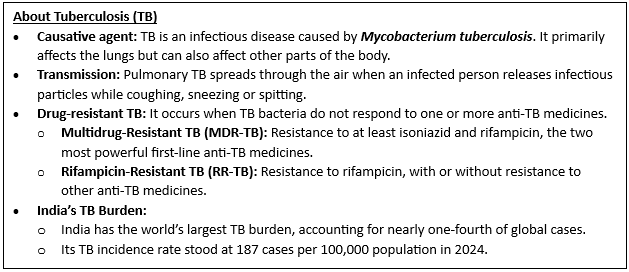
Context: The Indian Patent Office has rejected a patent application by the US-based TB Alliance for the BPaL drug combination used to treat drug-resistant tuberculosis (DR-TB), removing one potential barrier to generic competition and raising the prospect of more affordable treatment.
More on the News
• Patent application: TB Alliance, a US-based non-profit, sought a patent for the BPaL combination of bedaquiline, pretomanid and linezolid for treating drug-resistant TB.
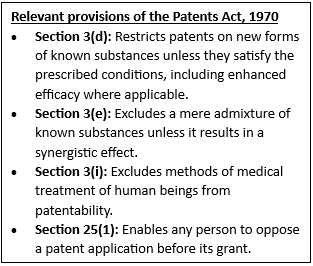
• Pre-grant opposition: The application faced two pre-grant oppositions under Section 25(1) of the Patents Act, 1970, led by patient groups and public-health organisations.
• Grounds of opposition: Opponents argued that the combination of existing medicines had already been disclosed in earlier research and clinical trials, and did not involve sufficient novelty or inventive step.
• Patent Office decision: The application was rejected under Section 15 for failing to meet patentability requirements, including novelty, inventive step and sufficient disclosure.
Understanding the BPaL Regimen
• Composition: BPaL combines three medicines:
• Shorter treatment: BPaL is a six-month, all-oral regimen recommended by the World Health Organization (WHO) for eligible patients with certain forms of DR-TB. It offers an alternative to older treatment courses that could last 18–24 months and sometimes involved painful injections.
• BPaLM regimen: BPaLM adds moxifloxacin (M) to the three BPaL medicines. India’s National Tuberculosis Elimination Programme (NTEP) has adopted this six-month regimen for eligible patients with multidrug- or rifampicin-resistant TB.
• Treatment outcomes: The BPaLM regimen has recorded a treatment success rate of 89%, compared with 52–75% for standard regimens. More than 15,000 patients have started BPaLM treatment under India’s national TB programme.
• International patent position: TB Alliance reportedly holds patents covering the BPaL combination in 11 countries, including South Africa, Indonesia and the Russian Federation. These patents are due to expire in 2036.
Significance of the Decision
• Scope for generic competition: The rejection removes the potential patent barrier arising from this particular application, allowing other manufacturers to explore producing the BPaL combination in India, subject to applicable regulatory requirements.
• Potential reduction in public expenditure: DR-TB medicines are provided free to eligible patients through the public health system. Therefore, lower procurement prices could benefit the government directly and help it cover more patients with the same budget.
• Building on earlier generic competition: Following the rejection of a secondary patent on bedaquiline in 2023, generic competition contributed to a reduction in the reported cost of a six-month BPaLM course from US$588 in 2022 to US$284.
• Curbing evergreening: The decision reinforces scrutiny of secondary patents on existing medicines and combinations. It highlights the role of India’s patentability standards in preventing extensions of market exclusivity without a sufficiently novel and inventive contribution.
Challenges and Limitations
• No automatic price reduction: Patent rejection does not itself determine medicine prices or guarantee the immediate availability of generic alternatives. The actual benefit will depend on the entry of quality-assured manufacturers and competitive procurement.
• Regulatory approval remains necessary: Patent rejection is distinct from drug regulatory approval. CDSCO has approved bedaquiline and pretomanid for use under NTEP; manufacturers must still comply with applicable regulatory requirements before marketing their products.
• Public procurement and supply constraints: Even if more manufacturers enter the market, timely government procurement and uninterrupted supplies will be essential to ensure that eligible patients receive treatment without delays.
• Costs beyond medicines: Patients may continue to incur expenses on travel, investigations outside the public programme, nutrition and loss of income. Lower medicine prices alone cannot eliminate these financial and social barriers.
Way Ahead
• Scale up access to shorter regimens: NTEP should ensure that all medically eligible patients with rifampicin-resistant and multidrug-resistant TB are assessed for BPaL/BPaLM treatment in accordance with national protocols.
• Promote quality-assured generic manufacturing: Encourage more manufacturers to enter the market while maintaining stringent checks on the quality, safety and efficacy of generic formulations.
• Strengthen procurement and supply chains: Government procurement agencies should use competitive purchasing to secure affordable prices and ensure uninterrupted availability across treatment centres.
• Provide comprehensive patient support: Integrate shorter treatment regimens with timely diagnosis, drug-safety monitoring, nutritional assistance and adherence support to address the wider barriers faced by DR-TB patients.
Khan Global Studies App
With our training programs, learning online can be a very exciting experience. Take the next step toward achieving your professional and personal objectives.



Course Related Query:
Ask Your DoubtsStore Related Query:[email protected]NEET | JEE | CUET
NCERT Books
Resources
We love learning. Through our innovative solutions, we encourage ourselves, our teams, and our Students to grow. We welcome and look for diverse perspectives and opinions because they enhance our decisions. We strive to understand the big picture and how we contribute to the company’s objectives. We approach challenges with optimism and harness the power of teamwork to accomplish our goals. These aren’t just pretty words to post on the office wall. This is who we are. It’s how we work. And it’s how we approach every interaction with each other and our Students.
Come with an open mind, hungry to learn, and you’ll experience unmatched personal and professional growth, a world of different backgrounds and perspectives, and the freedom to be you—every day. We strive to build and sustain diverse teams and foster a culture of belonging. Creating an inclusive environment where every students feels welcome, appreciated, and heard gives us something to feel (really) good about.