You're all caught up—no notifications available.
Explore All Exams at KGS


All Exams
Explore All Exams at KGS

Khan Sir Courses
Geography I Polity I History | World Map I Indian Map I Economics I Biology

UPSC & State PSC
UPSC I BPSC I UP-PSC I MP-PSC

State Exams
UP I Bihar I MP | Rajasthan

NEET | JEE | CUET
NEET | JEE | CUET

Defence Exams
NDA I CDS I CAPF I AFCAT I SSB I Agniveer

Police Exams
UP SI | Bihar SI | Delhi Police | UP Constable

SSC Exams
CGL I CPO I CHSL I MTS I SSC GD I Delhi Police

Foundation Courses
Physics I Chemistry I Biology I History I Geography I Polity I NCERT I Math I English | Map I Reasoning

Railway Exams
RRB | RPF

Teaching Exams
TET | Teaching | UGC

Banking Exams
SBI | RBI | IBPS

Engineering Exams
Civil | Electrical | Mechanical
UGC NET
UGC NET/JRF
Current Affairs provides you with the best compilation of the Daily Current Affairs taking place across the globe: National, International, Sports, Science and Technology, Banking, Economy, Agreement, Appointments, Ranks, and Report and General Studies

SYLLABUS
GS-2: Issues relating to development and management of Social Sector/Services relating to Health.
Context: Ahead of World Cancer Day 2026, the Union Health Minister released India’s first national “Lung Cancer Treatment and Palliation: Evidence-Based Guidelines” in New Delhi, marking a major step towards standardized lung cancer care.
About the Guidelines
• Developed by national oncology experts under the Department of Health Research (DHR) and the Directorate General of Health Services (DGHS).
• The guidelines aim to provide a standardized, evidence-based framework for the diagnosis, treatment, and palliative care.
• Designed to ensure high-quality, accessible, and patient-centric care.
Key Features of the Guidelines
• The Guidelines comprise 15 evidence-based recommendations addressing both treatment and palliative care for lung cancer.
• The recommendations are based on systematic evidence synthesis and adapted to Indian healthcare realities.
• The guidelines aim to reduce variations in clinical practices across public and private healthcare systems.
• The guidelines have been made publicly accessible through the Department of Health Research website, enhancing transparency and adoption.
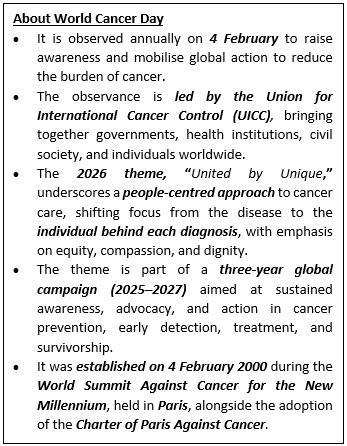
Summary of 15 Evidence-Based Recommendations
• Prehabilitation is recommended for patients planned to undergo lung cancer surgery.
• Mediastinal lymph node dissection is recommended over mediastinal lymph node sampling in operable lung cancer.
• Radical local treatment of both primary and metastatic sites is recommended over systemic therapy alone in patients with oligometastatic disease.
• Prophylactic Cranial Irradiation (PCI) is recommended over no PCI for patients with small-cell lung cancer.
• Either early or late integration of thoracic radiotherapy with chemotherapy is recommended for patients with limited-stage small cell lung cancer.
• Routine use of postoperative radiotherapy is not recommended following complete surgical resection.
• Stereotactic Body Radiation Therapy (SBRT) is not recommended over lobectomy or segmentectomy, except in selected patients who are medically unfit or unwilling to undergo surgery.
• Adjuvant tyrosine kinase inhibitor (TKI) therapy is recommended over chemotherapy alone in eligible patients.
• Second- and third-generation tyrosine kinase inhibitors are recommended over first-generation TKIs in appropriate clinical settings.
• Immunotherapy, either alone or in combination with other agents, is recommended over chemotherapy alone in suitable patients.
• Either neoadjuvant therapy followed by surgery or upfront surgery followed by adjuvant therapy is recommended, based on clinical judgment and patient factors.
• Lower-dose pembrolizumab (100 mg) may be considered on an individualized basis when standard dosing is not feasible.
• Early integration of palliative care with standard oncological care is recommended as compared to standard oncological care alone for patients with lung cancer.
• Multi-modal treatment is recommended as compared to drug therapy alone for the treatment of dyspnoea in patients with advanced lung cancer.
• A multimodal approach of treatment is recommended over Psychotherapeutic Care alone for patients with lung cancer.
Significance for India’s Healthcare System
• The guidelines strengthen early diagnosis and promote uniform treatment pathways for lung cancer patients.
• The emphasis on palliative care supports holistic and patient-centric management, especially for advanced-stage cases.
• The framework enhances credibility, consistency, and evidence-based clinical decision-making.
• The initiative reflects India’s shift towards indigenous, context-specific healthcare solutions rather than blind replication of global models.
Source:
News on Air
PIB

16th Finance Commission Report
Solid Fuel Ducted Ramjet (SFDR) Technology
Finance Commission Recommends Heatwaves and Lightning as National Disasters
India Releases Lung Cancer Treatment and Palliation Guidelines
SystemIndia’s Multi-Hazard Early Warning Decision Support System
India–Australia Economic Cooperation and Trade Agreement (Ind-Aus ECTA)
Defence Exports Touched an All-Time High in Financial Year 2025-26
Government Notifies Conditional Concessional Customs Duty for SEZ
Artemis II Mission
The most trusted learning platform on your phone
With our training programs, learning online can be a very exciting experience! Take the next step toward achieving your professional and personal objectives



Course Related Query:
Ask Your DoubtsStore Related Query:[email protected]NCERT Books
Resources
We love learning. Through our innovative solutions, we encourage ourselves, our teams, and our Students to grow. We welcome and look for diverse perspectives and opinions because they enhance our decisions. We strive to understand the big picture and how we contribute to the company’s objectives. We approach challenges with optimism and harness the power of teamwork to accomplish our goals. These aren’t just pretty words to post on the office wall. This is who we are. It’s how we work. And it’s how we approach every interaction with each other and our Students.
Come with an open mind, hungry to learn, and you’ll experience unmatched personal and professional growth, a world of different backgrounds and perspectives, and the freedom to be you—every day. We strive to build and sustain diverse teams and foster a culture of belonging. Creating an inclusive environment where every students feels welcome, appreciated, and heard gives us something to feel (really) good about.
Get Free academic Counseling & Course Details