You're all caught up—no notifications available.
Explore All Exams at KGS


All Exams
Explore All Exams at KGS

Khan Sir Courses
Geography I Polity I History | World Map I Indian Map I Economics I Biology

UPSC & State PSC
UPSC I BPSC I UP-PSC I MP-PSC

State Exams
UP I Bihar I MP | Rajasthan

NEET | JEE | CUET
NEET | JEE | CUET

Defence Exams
NDA I CDS I CAPF I AFCAT I SSB I Agniveer

Police Exams
UP SI | Bihar SI | Delhi Police | UP Constable

SSC Exams
CGL I CPO I CHSL I MTS I SSC GD I Delhi Police

Foundation Courses
Physics I Chemistry I Biology I History I Geography I Polity I NCERT I Math I English | Map I Reasoning

Railway Exams
RRB | RPF

Teaching Exams
TET | Teaching | UGC

Banking Exams
SBI | RBI | IBPS

Engineering Exams
Civil | Electrical | Mechanical
UGC NET
UGC NET/JRF
Current Affairs provides you with the best compilation of the Daily Current Affairs taking place across the globe: National, International, Sports, Science and Technology, Banking, Economy, Agreement, Appointments, Ranks, and Report and General Studies

SYLLABUS
GS-3: Indian Economy and issues relating to planning, mobilization of resources, growth, development and employment.
Context: Recently, the Government of India has retained the inflation target of 4% (±2%) for another five years (2026–2031), reaffirming its commitment to macroeconomic stability under the Flexible Inflation Targeting (FIT) framework.
More on the News
• The inflation target has been officially notified by the Government, in consultation with the Reserve Bank of India, for the period April 1, 2026, to March 31, 2031, under Section 45ZA of the RBI Act, 1934.
• This marks the second consecutive extension of the same target, first introduced in 2016 and renewed in 2021, reflecting strong policy continuity.
• Recent data show that inflation remains broadly under control, with headline CPI inflation at 3.21% in February 2026, supported by moderating food prices and stable macroeconomic conditions.
About the Inflation Targeting in India
• Inflation targeting is defined as a framework for policy decisions in which the central bank makes an explicit commitment to conduct policy to meet a publicly announced numerical inflation target within a particular time frame.
• Monetary Policy Framework Agreement:
o The Government of India and Reserve Bank of India signed a Monetary Policy Framework Agreement in February 2015 to primarily maintain price stability, while keeping in mind the objective of growth.
o The government set the inflation target in consultation with RBI with the possibility of revisiting it after five years.
• Statutory Adoption of Flexible inflation targeting (FIT):
o In May 2016, the RBI Act, 1934, was amended to provide a statutory basis for the implementation of the Flexible Inflation Targeting (FIT) framework in India, marking a major shift towards a rule-based monetary policy regime.
o Under FIT, RBI targets Consumer Price Index (CPI) inflation (headline inflation) to be maintained at 4% with a tolerance band of ±2 percentage points (i.e., the target range is 2% to 6%).
o If inflation exceeds 6% or drops below 2% for three consecutive quarters, it is deemed a failure to meet the target.
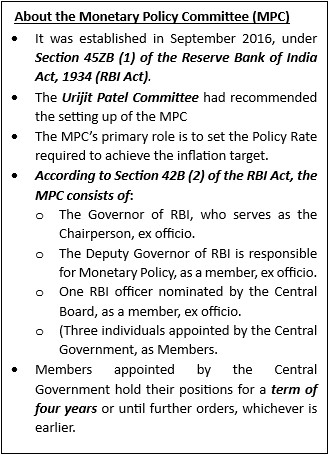
o The Monetary Policy Committee (MPC) determines the policy repo rate to achieve this inflation target and operationalises the FIT framework.
• Global Experience with Inflation Targeting:
o Inflation targeting as a monetary policy framework was first introduced by New Zealand in 1990.
o It has become the most widely adopted monetary policy framework globally, with both advanced and emerging economies using it to anchor inflation expectations and enhance policy credibility.
Performance of the Flexible Inflation Targeting (FIT) Framework
• Inflation Outcomes: Average inflation declined from ~6.8% in the pre-FIT period to ~4.9% in the post-FIT period, with inflation remaining largely range-bound and stable.
• Phases of Performance: During 2016–2019, inflation remained low and stable at around ~4%, during 2020–2022, inflation was elevated due to global shocks, and post-2022 inflation returned to alignment with the target.
• Hump-Shaped Inflation Pattern: The inflation trajectory exhibited a hump-shaped pattern, with initial and recent years aligned with the target while the middle years were tilted toward the upper tolerance band.
• Threshold Effect: Inflation beyond ~6% leads to a sharp decline in growth, thereby confirming the appropriateness of the current tolerance band.
Significance of Inflation Control
• Economic Importance: High inflation acts as a regressive tax that hurts the poor more, reduces savings, and misallocates investments, while stable inflation ensures predictability and supports long-term growth.
• Headline vs Core Debate: Headline inflation is preferred over core due to the high weight of food in the CPI basket and its second-round effects on wages and demand.
• Theoretical Insights: Milton Friedman stated that inflation is always and everywhere a monetary phenomenon driven by money supply expansion; the Phillips Curve suggests only a short-run trade-off between inflation and growth, with no long-run trade-off.
• Optimal Inflation Level: Empirical estimates place the optimal inflation level at ~4% (precisely 3.98%), providing limited justification for increasing the target above 4%.
• Policy Interlinkages: Effective inflation control relies on monetary discipline through the Flexible Inflation Targeting (FIT) framework and fiscal discipline via the Fiscal Responsibility and Budget Management (FRBM) Act of 2003, as weakness in one can undermine the other
The most trusted learning platform on your phone
With our training programs, learning online can be a very exciting experience! Take the next step toward achieving your professional and personal objectives



Course Related Query:
Ask Your DoubtsStore Related Query:[email protected]NCERT Books
Resources
We love learning. Through our innovative solutions, we encourage ourselves, our teams, and our Students to grow. We welcome and look for diverse perspectives and opinions because they enhance our decisions. We strive to understand the big picture and how we contribute to the company’s objectives. We approach challenges with optimism and harness the power of teamwork to accomplish our goals. These aren’t just pretty words to post on the office wall. This is who we are. It’s how we work. And it’s how we approach every interaction with each other and our Students.
Come with an open mind, hungry to learn, and you’ll experience unmatched personal and professional growth, a world of different backgrounds and perspectives, and the freedom to be you—every day. We strive to build and sustain diverse teams and foster a culture of belonging. Creating an inclusive environment where every students feels welcome, appreciated, and heard gives us something to feel (really) good about.
Get Free academic Counseling & Course Details