Current Affairs provides you with the best compilation of the Daily Current Affairs taking place across the globe: National, International, Sports, Science and Technology, Banking, Economy, Agreement, Appointments, Ranks, and Report and General Studies
India–UK CETA to Enter into Force on July 15
SYLLABUS
GS-2:Bilateral, regional and global groupings and agreements involving India and/or affecting India’s interests; Effect of Policies and Politics of Developed and Developing Countries on India’s interests.
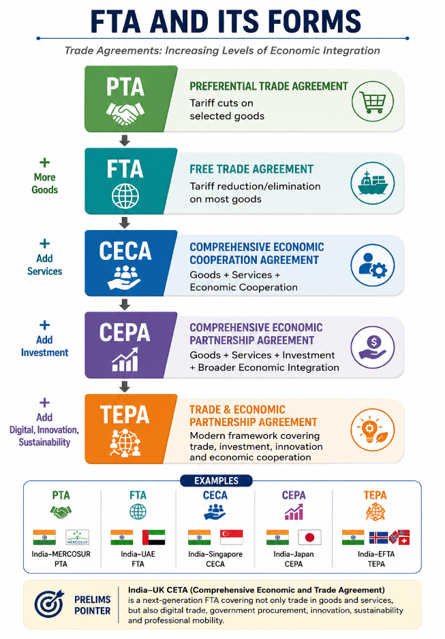
Context: The India–UK Comprehensive Economic and Trade Agreement (CETA) and the accompanying Double Contribution Convention (DCC) will enter into force on 15 July 2026, marking a major milestone in India’s economic diplomacy and deepening trade ties with one of its key strategic partners.
More on the News
The agreement was signed in July 2025 and has now completed all necessary domestic ratification procedures in both countries.
The FTA is the UK’s biggest and most economically significant bilateral trade agreement since Brexit (term for the UK leaving the European Union).
The foundation for the agreement was laid through the India–UK Enhanced Trade Partnership (2021) and the Roadmap 2030, which envisaged elevating bilateral ties to a Comprehensive Strategic Partnership and doubling bilateral trade to USD 100 billion by 2030.
The implementation marks a major milestone in the India–UK Comprehensive Strategic Partnership and operationalises one of India's most ambitious trade agreements with a major developed economy.
Key Features of the India–UK CETA
Trade in Goods
The UK will provide duty-free access to nearly 99% of India's exports, covering almost the entire trade value of Indian exports to the UK.
Major beneficiaries include textiles and apparel, leather and footwear, gems and jewellery, marine products, engineering goods, chemicals, auto components, processed foods, toys and sports goods.
India has opened 89.5% of its tariff lines, covering 91% of UK exports, while protecting sensitive sectors such as dairy products, cereals, millets, pulses, edible oils and several agricultural products.
Steel Trade Safeguard Understanding
India and the UK reached a mutually acceptable solution regarding the UK's steel safeguard measures, which had emerged as a key issue during the implementation process.
The arrangement ensures that around 85% of Indian steel exports remain outside the scope of the safeguard restrictions, supported through country-specific tariff-rate quotas and other protective mechanisms.
Services and Professional Mobility
The UK has provided one of its most comprehensive service packages, covering 137 sub-sectors across areas such as IT/ITeS, financial services, education, healthcare, professional services, telecommunications and consultancy.
The agreement facilitates mobility of business visitors, investors, intra-corporate transferees, contractual service suppliers and independent professionals.
A dedicated annual quota has been created for 1,800 Indian chefs, yoga instructors and classical musicians to work in the UK.
Double Contribution Convention (DCC)
The DCC exempts Indian professionals and their employers from making dual social-security contributions in the UK during temporary assignments for up to five years.
More than 75,000 Indian professionals and over 900 companies are expected to benefit, with estimated savings exceeding ₹4,000 crore.
Trade Facilitation and New Areas of Cooperation
The agreement simplifies Rules of Origin through exporter self-certification and reduced documentation requirements for small consignments, thereby facilitating participation by MSMEs and e-commerce businesses.
Significance of the Agreement
Boost to Labour-Intensive Exports: Duty-free access to the UK market for nearly 99% of Indian exports is expected to enhance the competitiveness of labour-intensive sectors such as textiles, leather, footwear, gems and jewellery, marine products, and processed foods.
Strengthening India's Services Advantage: Expanded market access across 137 service sub-sectors, coupled with enhanced mobility provisions and social-security exemptions under the DCC, will create new opportunities for Indian professionals and service providers.
Advancing India's Trade Strategy: The agreement reinforces India's strategy of pursuing comprehensive bilateral trade agreements with major economies and strengthens its position in global trade and supply chains.
Deepening India–UK Strategic Partnership: Beyond trade, CETA is expected to promote cooperation in investment, innovation, digital economy, clean energy, advanced manufacturing and resilient supply chains, thereby strengthening the broader India–UK Comprehensive Strategic Partnership.
Supporting Post-Brexit Economic Engagement: The agreement provides India with deeper access to a major developed market while helping the UK diversify its trade partnerships in the post-Brexit era.
Challenges and Concerns
Non-Tariff Barriers: Compliance with stringent UK standards relating to quality, sustainability, sanitary and phytosanitary measures may continue to pose challenges for Indian exporters.
Utilisation Gap: Experience from earlier FTAs suggests that many MSMEs may not fully utilise available benefits due to limited awareness of rules of origin, certification requirements and market opportunities.
Emerging Trade Regulations: Future measures relating to carbon emissions, sustainability standards and trade remedies could affect the competitiveness of certain Indian exports.
Domestic Sectoral Concerns: Careful monitoring will be required to ensure that tariff liberalisation does not adversely affect vulnerable domestic sectors while maintaining overall trade competitiveness.
Way Forward
Improve FTA Utilisation: Strengthen awareness, capacity-building and handholding support for MSMEs and exporters to effectively utilise market-access opportunities and Rules of Origin provisions.
Enhance Export Competitiveness: Invest in quality standards, technology upgradation, logistics efficiency and value addition to maximise gains in key sectors such as textiles, leather, gems and jewellery, engineering goods and marine products.
Address Emerging Trade Challenges: Proactively engage with the UK on sustainability standards, carbon-related trade measures and other non-tariff barriers to safeguard the interests of Indian exporters.
Deepen Economic Cooperation: Fast-track the proposed Bilateral Investment Treaty (BIT) and expand collaboration in innovation, clean energy, advanced manufacturing and resilient supply chains.
With our training programs, learning online can be a very exciting experience! Take the next step toward achieving your professional and personal objectives
We love learning. Through our innovative solutions, we encourage ourselves, our teams, and our Students to grow. We welcome and look for diverse perspectives and opinions because they enhance our decisions. We strive to understand the big picture and how we contribute to the company’s objectives. We approach challenges with optimism and harness the power of teamwork to accomplish our goals. These aren’t just pretty words to post on the office wall. This is who we are. It’s how we work. And it’s how we approach every interaction with each other and our Students.
What Makes Us Different
Come with an open mind, hungry to learn, and you’ll experience unmatched personal and professional growth, a world of different backgrounds and perspectives, and the freedom to be you—every day. We strive to build and sustain diverse teams and foster a culture of belonging. Creating an inclusive environment where every students feels welcome, appreciated, and heard gives us something to feel (really) good about.