Explore All Exams at KGS


All Exams
Explore All Exams at KGS

Khan Sir Courses
Geography I Polity I History | World Map I Indian Map I Economics I Biology

UPSC & State PSC
UPSC I BPSC I UP-PSC I MP-PSC

Judiciary
CLAT

State Exams
UP I Bihar I MP | Rajasthan

NEET | JEE | CUET
NEET | JEE | CUET

Defence Exams
NDA I CDS I CAPF I AFCAT I SSB I Agniveer

Police Exams
UP SI | Bihar SI | Delhi Police | UP Constable

SSC Exams
CGL I CPO I CHSL I MTS I SSC GD I Delhi Police

Foundation Courses
Physics I Chemistry I Biology I History I Geography I Polity I NCERT I Math I English | Map I Reasoning

Railway Exams
RRB | RPF

Teaching Exams
TET | Teaching | UGC

Banking Exams
SBI | RBI | IBPS

Engineering Exams
Civil | Electrical | Mechanical
UGC NET
UGC NET/JRF
Current Affairs provides you with the best compilation of the Daily Current Affairs taking place across the globe: National, International, Sports, Science and Technology, Banking, Economy, Agreement, Appointments, Ranks, and Report and General Studies
Current Affairs
SYLLABUS
GS-3: Achievements of Indians in science & technology; indigenization of technology and developing new technology.
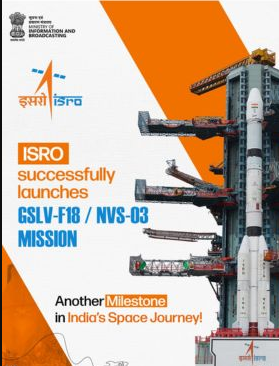
Context: The Indian Space Research Organisation (ISRO) successfully launched the NVS-03 navigation satellite aboard GSLV-F18 on October 30, 2026, to strengthen India's indigenous satellite navigation system, NavIC.
More on the News
• The GSLV-F18 lifted off from the Second Launch Pad at Satish Dhawan Space Centre (SDSC-SHAR), Sriharikota, at 11:51 PM IST.
• Approximately 18 minutes after liftoff, the 2,250-kg satellite was successfully injected into its intended Geosynchronous Transfer Orbit (GTO).
• It was the 20th flight of GSLV and achieved the shortest turnaround time of 56 days between two successive GSLV missions.
About the NVS-03 Satellite
• NVS-03 is the third satellite in ISRO's second-generation Navigation Satellite Series, developed to ensure continuity and improve the reliability of NavIC.
• It is the fourth satellite launched under the broader Indian Regional Navigation Satellite System (IRNSS) programme, according to the ISRO Chairman.
• Launch Vehicle: GSLV-F18.
• Satellite Weight: Approximately 2,250 kg.
• Mission Life: 12 years.
• Initial Orbit: Geosynchronous Transfer Orbit (GTO).
• Key Payloads:
• Following its injection into GTO, the satellite will undergo orbit-raising manoeuvres to reach its final operational orbit.
• Its solar panels have been deployed, and the satellite's initial health status was reported to be good.
How NVS-03 Helps NavIC
• Restores Minimum Operational Configuration: Brings the number of operational navigation satellites to four, the minimum required for basic standalone positioning services.
• Improves Navigation Reliability: Strengthens the continuity and availability of Positioning, Navigation and Timing (PNT) services.
• Introduces L1 Frequency: Improves compatibility with commonly used navigation chipsets in smartphones, vehicles and wearable devices.
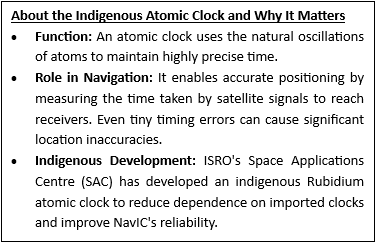
• Strengthens Indigenous Timing: Carries India's third indigenous atomic clock into orbit, while two indigenous clocks were already functioning in orbit.
• Supports Wider Applications: Enables navigation and tracking applications for trains, vehicles and shipping vessels, along with other civilian and strategic uses.
Significance of NavIC
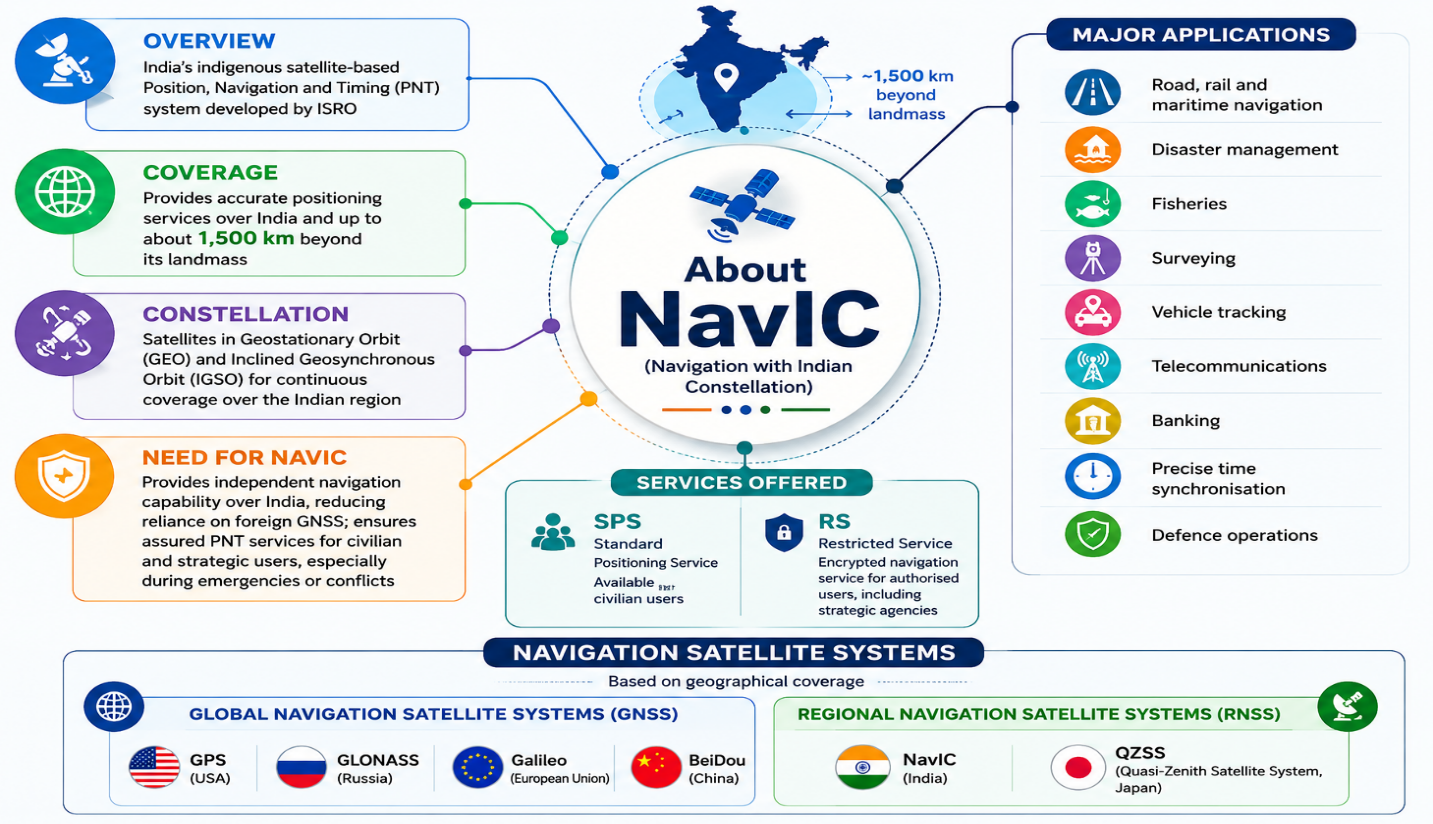
• Strategic Sovereignty: The 1999 Kargil War exposed India's dependence on foreign GPS information, highlighting the need for an indigenous navigation system.
• National Security: Provides independent navigation services to authorised defence users during conflicts and emergencies.
• Critical National Infrastructure: Supports train and vehicle tracking, fishing vessels, disaster response and dissemination of Indian Standard Time (IST).
• Technological Self-Reliance: Strengthens indigenous navigation capabilities and supports timing services for telecommunications, financial services and power grids, advancing Atmanirbhar Bharat.
Challenges of NavIC
• Atomic Clock Failures: Failures of imported atomic clocks in first-generation satellites have reduced the constellation's operational reliability.
• NVS-02 Mission Failure: In January 2025, NVS-02 failed to reach its final orbit due to a drive-signal failure in the oxidiser-line pyrotechnic valve.
• Limited Standalone Capability: The IRNSS-1F atomic clock stopped working on March 13, 2026, leaving only three satellites available for PNT services, below the four-satellite minimum.
• Limited Civilian Adoption: Limited integration of NavIC-compatible chipsets in smartphones and other consumer devices restricts wider adoption.
Way Forward
• Accelerate Constellation Replenishment: Expedite NVS-04 and NVS-05 launches to strengthen NavIC's satellite constellation.
• Strengthen Indigenous Technologies: Improve the reliability of indigenous atomic clocks, satellite payloads and onboard redundancy.
• Build a Resilient PNT Ecosystem: Promote multi-constellation GNSS interoperability while maintaining NavIC's independent capabilities.
• Expand Civilian Adoption: Promote L1-compatible NavIC receivers in smartphones, vehicles, drones and critical infrastructure.
Khan Global Studies App
With our training programs, learning online can be a very exciting experience. Take the next step toward achieving your professional and personal objectives.

Course Related Query:
Ask Your DoubtsStore Related Query:[email protected]NEET | JEE | CUET
NCERT Books
Resources
We love learning. Through our innovative solutions, we encourage ourselves, our teams, and our Students to grow. We welcome and look for diverse perspectives and opinions because they enhance our decisions. We strive to understand the big picture and how we contribute to the company’s objectives. We approach challenges with optimism and harness the power of teamwork to accomplish our goals. These aren’t just pretty words to post on the office wall. This is who we are. It’s how we work. And it’s how we approach every interaction with each other and our Students.
Come with an open mind, hungry to learn, and you’ll experience unmatched personal and professional growth, a world of different backgrounds and perspectives, and the freedom to be you—every day. We strive to build and sustain diverse teams and foster a culture of belonging. Creating an inclusive environment where every students feels welcome, appreciated, and heard gives us something to feel (really) good about.