You're all caught up—no notifications available.
Explore All Exams at KGS


All Exams
Explore All Exams at KGS

Khan Sir Courses
Geography I Polity I History | World Map I Indian Map I Economics I Biology

UPSC & State PSC
UPSC I BPSC I UP-PSC I MP-PSC

State Exams
UP I Bihar I MP | Rajasthan

NEET | JEE | CUET
NEET | JEE | CUET

Defence Exams
NDA I CDS I CAPF I AFCAT I SSB I Agniveer

Police Exams
UP SI | Bihar SI | Delhi Police | UP Constable

SSC Exams
CGL I CPO I CHSL I MTS I SSC GD I Delhi Police

Foundation Courses
Physics I Chemistry I Biology I History I Geography I Polity I NCERT I Math I English | Map I Reasoning

Railway Exams
RRB | RPF

Teaching Exams
TET | Teaching | UGC

Banking Exams
SBI | RBI | IBPS

Engineering Exams
Civil | Electrical | Mechanical
UGC NET
UGC NET/JRF
Current Affairs provides you with the best compilation of the Daily Current Affairs taking place across the globe: National, International, Sports, Science and Technology, Banking, Economy, Agreement, Appointments, Ranks, and Report and General Studies

SYLLABUS
GS 2: Indian Constitution- historical underpinnings, evolution, features, amendments, significant provisions and basic structure.
Context: Recently, Justice Yashwant Varma of the Allahabad High Court tendered his resignation to President Draupadi Murmu with immediate effect at a critical stage when Parliamentary removal proceedings were underway.
More on News:
• This marks the third instance in independent India where a High Court judge has resigned during impeachment related proceedings to avoid their conclusion.
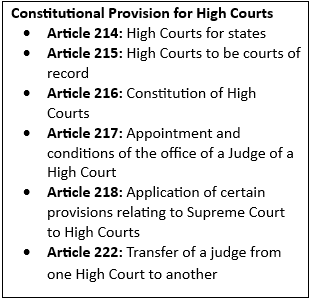
Constitutional Provision for High Courts
• Article 214: High Courts for states
• Article 215: High Courts to be courts of record
• Article 216: Constitution of High Courts
• Article 217: Appointment and conditions of the office of a Judge of a High Court
• Article 218: Application of certain provisions relating to Supreme Court to High Courts
• Article 222: Transfer of a judge from one High Court to another
• Each such resignation has exposed the same constitutional lacuna without prompting any legislative remedy so far.
• While the constitution does not use the word ‘impeachment’, it is colloquially used to refer to the proceedings under Article 124 (for the removal of a Supreme Court judge) and Article 218 (for the removal of a high court judge).
• Notable Impeachment Attempts in India:
• No judge in India has been successfully impeached since independence.
Backgound and Timeline
• Incident and initial developments: A firefighting operation at Justice Varma’s official residence in Delhi led to the discovery of sacks of charred cash while he was serving as a judge of the Delhi High Court.
• In-house inquiry by judiciary: Then Chief Justice of India Sanjiv Khanna set up a three member in house committee comprising Justice Sheel Nagu, Justice G S Sandhawalia and Justice Anu Sivaraman.
• Judicial and constitutional process: The Chief Justice of India recommended removal to the President and Prime Minister after he refused to resign.
• Parliamentary inquiry: A three member inquiry committee was constituted under the Judges Inquiry Act 1968 by Speaker Om Birla.
How a Sitting Judge Can Be Removed From Office?
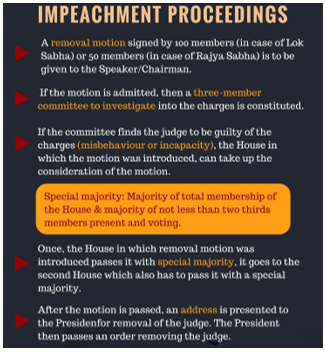
• The constitution provides that a judge can be removed only by an order of the president, based on a motion passed by both houses of parliament.
• The procedure for removal of judges is elaborated in the Judges Inquiry Act, 1968. The Act sets out the following steps for removal from office:
|
Stage |
Process |
|
Initiation of motion |
Impeachment motion may originate in either House of Parliament. Lok
Sabha requires 100 members’ signed notice to the Speaker. Rajya Sabha
requires 50 members’ signed notice to the Chairman. Speaker or
Chairman may examine material and decide to admit or refuse the motion. |
|
Inquiry committee formation |
If admitted, a three member committee is constituted by Speaker
or Chairman. It includes a Supreme Court judge, a Chief Justice of a
High Court, and a distinguished jurist. The committee frames charges and
conducts investigation. Judge is given a copy of charges and opportunity for
written defence. |
|
Report submission |
After investigation, the committee submits its report to the Speaker or
Chairman, who places it before the House of Parliament. |
|
Parliamentary consideration |
If report finds misbehaviour or incapacity, the motion is taken up for
debate in the House. |
|
Voting requirement |
Motion must be passed in each House by majority of total membership
and majority of at least two-thirds of members present and voting. After
approval in one House, it is sent to the other House. |
|
Final removal |
After approval by both Houses, the motion is sent to the President, who
issues the order for removal of the judge. |
Source:
The Hindu
Scobserver
PRS India

The most trusted learning platform on your phone
With our training programs, learning online can be a very exciting experience! Take the next step toward achieving your professional and personal objectives



Course Related Query:
Ask Your DoubtsStore Related Query:[email protected]NCERT Books
Resources
We love learning. Through our innovative solutions, we encourage ourselves, our teams, and our Students to grow. We welcome and look for diverse perspectives and opinions because they enhance our decisions. We strive to understand the big picture and how we contribute to the company’s objectives. We approach challenges with optimism and harness the power of teamwork to accomplish our goals. These aren’t just pretty words to post on the office wall. This is who we are. It’s how we work. And it’s how we approach every interaction with each other and our Students.
Come with an open mind, hungry to learn, and you’ll experience unmatched personal and professional growth, a world of different backgrounds and perspectives, and the freedom to be you—every day. We strive to build and sustain diverse teams and foster a culture of belonging. Creating an inclusive environment where every students feels welcome, appreciated, and heard gives us something to feel (really) good about.
Get Free academic Counseling & Course Details