Explore All Exams at KGS


All Exams
Explore All Exams at KGS

Khan Sir Courses
Geography I Polity I History | World Map I Indian Map I Economics I Biology

UPSC & State PSC
UPSC I BPSC I UP-PSC I MP-PSC

Judiciary
CLAT

State Exams
UP I Bihar I MP | Rajasthan

NEET | JEE | CUET
NEET | JEE | CUET

Defence Exams
NDA I CDS I CAPF I AFCAT I SSB I Agniveer

Police Exams
UP SI | Bihar SI | Delhi Police | UP Constable

SSC Exams
CGL I CPO I CHSL I MTS I SSC GD I Delhi Police

Foundation Courses
Physics I Chemistry I Biology I History I Geography I Polity I NCERT I Math I English | Map I Reasoning

Railway Exams
RRB | RPF

Teaching Exams
TET | Teaching | UGC

Banking Exams
SBI | RBI | IBPS

Engineering Exams
Civil | Electrical | Mechanical
UGC NET
UGC NET/JRF
Current Affairs provides you with the best compilation of the Daily Current Affairs taking place across the globe: National, International, Sports, Science and Technology, Banking, Economy, Agreement, Appointments, Ranks, and Report and General Studies
Current Affairs
SYLLABUS
GS-3: Issues related to direct and indirect farm subsidies and minimum support prices; Public Distribution System-objectives, functioning, limitations, revamping; issues of buffer stocks and food security; Technology missions; economics of animal-rearing.
Context: The Mission for Aatmanirbharta in Pulses completed one year on 11 October 2026, marking a year of efforts to strengthen domestic pulses production, reduce import dependence and enhance farmers’ incomes.
Key Features of the Mission for Aatmanirbharta in Pulses
• Production and Productivity Targets (by 2030–31): Increase pulses production from 242 to 350 lakh tonnes, cultivation area from 275 to 310 lakh hectares, and average productivity from 881 to 1,130 kg/ha.
• Seed Development and Distribution: Distribute 87.5 lakh free seed kits and 126 lakh quintals of certified seeds over six years.
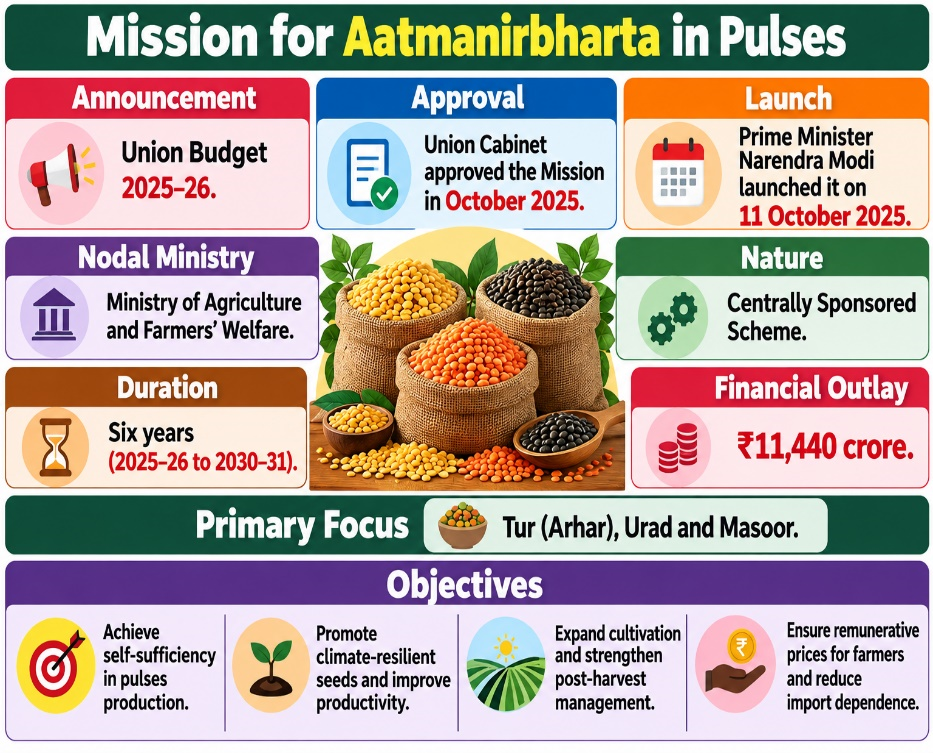
• Expansion of Cultivation: Expand pulses cultivation by 35 lakh hectares, targeting rice-fallow areas and other suitable lands.
• Assured Procurement and Price Support: Ensure procurement of 100% of Tur, Urad and Masoor offered by willing, registered farmers for four years (2025–26 to 2028–29) through NAFED and NCCF.
• Post-Harvest Infrastructure: Establish 1,000 pulse processing units (dal mills), with assistance of up to ₹25 lakh per eligible unit for processing and packaging infrastructure.
• Digital Monitoring and Implementation: Use a three-tier steering committee mechanism at national, State and district levels, with Krishi Mapper for geo-tagging, geo-fencing and tracking demonstrations.
Achievements of the Mission
• Growth in Domestic Production: Pulses production increased from 256.83 lakh tonnes in 2024–25 to 274.09 lakh tonnes in 2025–26.
• Reduction in Import Expenditure: The value of pulses imports declined by 31.52%, from ₹46,427.60 crore in 2024–25 to ₹31,793.59 crore in 2025–26, while pulses exports increased by 13.40%, from US$855 million to US$969.53 million.
• Progress in Procurement: According to the NCCF dashboard snapshot dated 17 June 2026, procurement reached 10.55 lakh tonnes across nine states, ₹7,047 crore was released directly to farmers as MSP payments, and 4.69 lakh farmers benefited out of 7.74 lakh registered farmers.
• Expansion of Processing Infrastructure: Of the 1,000 processing units envisaged, 528 were allocated to States and Union Territories in the first phase, while 18 of the 23 pulse-processing units approved under the relevant component of the Pradhan Mantri Kisan SAMPADA Yojana have been completed.
• Wider Seed Distribution: A total of 9.25 lakh free seed kits were distributed during Rabi 2025–26 to promote pulses cultivation, including in rice-fallow areas.
• Improved Price Support: For 2026–27, the Minimum Support Price (MSP) increased to ₹8,200 per quintal for Urad, ₹8,450 per quintal for Tur and ₹7,000 per quintal for Masoor compared with their respective 2024–25 rates.
Challenges and Areas for Improvement
• Persistent Demand–Supply Gap: Despite being the world’s largest producer of pulses, India continues to import pulses to meet domestic demand. Sustained production growth is essential to achieve self-sufficiency.
• Low Agricultural Productivity: Productivity remains below the Mission’s target of 1,130 kg per hectare. Yield gaps, limited adoption of improved varieties and regional variations constrain production.
• Climate and Market Uncertainties: Climate variability, pest attacks and price fluctuations can affect farmers’ output, profitability and willingness to expand pulses cultivation.
• Seed and Value-Chain Constraints: Timely access to quality seeds, adequate storage and processing facilities, and stronger private-sector participation in seed systems remain important for sustained growth.
Way Forward
• Strengthen Research and Seed Systems: Develop high-yielding, short-duration and climate-resilient varieties, and improve seed availability, certification, traceability and region-specific planning.
• Expand Sustainable Cultivation: Promote pulses in rice-fallow and rainfed areas, encourage intercropping and crop diversification, and strengthen farmer training through ICAR, Krishi Vigyan Kendras and State agricultural departments.
• Improve Market and Price Assurance: Ensure timely procurement and payments, strengthen local procurement centres and improve price monitoring to reduce farmers’ uncertainty.
• Build an Integrated Value Chain: Expand processing, storage and packaging, strengthen Farmer Producer Organisations, and explore pulses in public distribution and school meals to boost demand and nutritional security.
Khan Global Studies App
With our training programs, learning online can be a very exciting experience. Take the next step toward achieving your professional and personal objectives.



Course Related Query:
Ask Your DoubtsStore Related Query:[email protected]NEET | JEE | CUET
NCERT Books
Resources
We love learning. Through our innovative solutions, we encourage ourselves, our teams, and our Students to grow. We welcome and look for diverse perspectives and opinions because they enhance our decisions. We strive to understand the big picture and how we contribute to the company’s objectives. We approach challenges with optimism and harness the power of teamwork to accomplish our goals. These aren’t just pretty words to post on the office wall. This is who we are. It’s how we work. And it’s how we approach every interaction with each other and our Students.
Come with an open mind, hungry to learn, and you’ll experience unmatched personal and professional growth, a world of different backgrounds and perspectives, and the freedom to be you—every day. We strive to build and sustain diverse teams and foster a culture of belonging. Creating an inclusive environment where every students feels welcome, appreciated, and heard gives us something to feel (really) good about.