You're all caught up—no notifications available.
Explore All Exams at KGS


All Exams
Explore All Exams at KGS

Khan Sir Courses
Geography I Polity I History | World Map I Indian Map I Economics I Biology

UPSC & State PSC
UPSC I BPSC I UP-PSC I MP-PSC

State Exams
UP I Bihar I MP | Rajasthan

NEET | JEE | CUET
NEET | JEE | CUET

Defence Exams
NDA I CDS I CAPF I AFCAT I SSB I Agniveer

Police Exams
UP SI | Bihar SI | Delhi Police | UP Constable

SSC Exams
CGL I CPO I CHSL I MTS I SSC GD I Delhi Police

Foundation Courses
Physics I Chemistry I Biology I History I Geography I Polity I NCERT I Math I English | Map I Reasoning

Railway Exams
RRB | RPF

Teaching Exams
TET | Teaching | UGC

Banking Exams
SBI | RBI | IBPS

Engineering Exams
Civil | Electrical | Mechanical
UGC NET
UGC NET/JRF
Current Affairs provides you with the best compilation of the Daily Current Affairs taking place across the globe: National, International, Sports, Science and Technology, Banking, Economy, Agreement, Appointments, Ranks, and Report and General Studies

SYLLABUS
GS-2: Issues and Challenges Pertaining to the Federal Structure, Devolution of Powers and Finances up to Local Levels and Challenges Therein; Important Aspects of Governance, Transparency and Accountability.
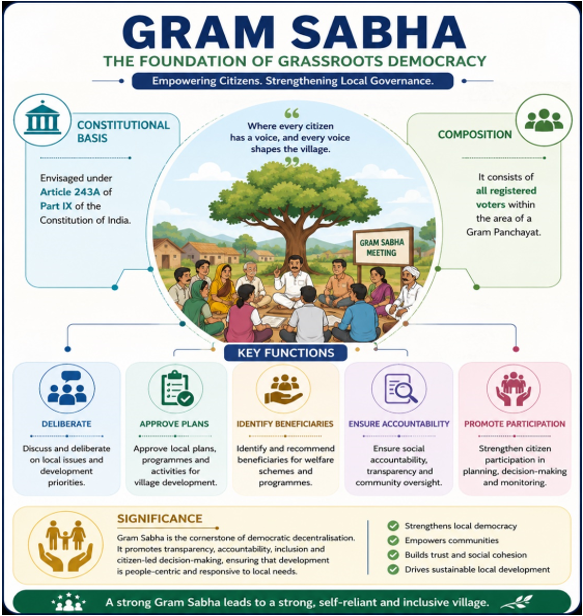
Context: The Ministry of Panchayati Raj recently released the National Study Report on Low Participation in Gram Sabha Across States and Union Territories, highlighting the key barriers affecting citizen participation and suggesting measures to strengthen grassroots democracy.
More on the News
• The study was conducted by the National Institute of Rural Development and Panchayati Raj (NIRDPR), Hyderabad, on the request of the Ministry of Panchayati Raj.
• It is one of the largest field-based assessments of Gram Sabha participation, covering 26 States/UTs, 213 districts, nearly 400 Gram Panchayats and around 7,800 respondents. The study also included 50 PESA Gram Panchayats and 130 Women-Friendly Gram Panchayats.
• The study examined factors influencing participation, inclusiveness, governance practices, communication systems, infrastructure, accessibility and citizen perceptions regarding Gram Sabha functioning.
Key Findings of the Report
• Multidimensional Nature of Low Participation: The study found that low participation in Gram Sabhas is multidimensional, shaped by socio-economic, institutional, governance and behavioural factors rather than any single cause.
• Livelihood and Time-Related Constraints
• Awareness and Procedural Literacy Deficit
• Participation Gaps among Social Groups: Migrant households (17.61%), youth (16.73%), elderly citizens (15.80%) and women (13.40%) were identified among the least represented groups in Gram Sabha processes.
• Emergence of “Gram Sabha Participation Fatigue”
Major Policy Recommendations
• National Gram Sabha Awareness and Mobilisation Mission: Launch a National Gram Sabha Awareness, Procedural Literacy and Mobilisation Mission to strengthen citizen awareness, procedural understanding and democratic participation.
• Strengthen Community Mobilisation: Institutionalise structured pre-Gram Sabha mobilisation through Ward Members, Self-Help Groups, frontline workers, youth groups and community institutions to ensure wider citizen outreach.
• Livelihood-Sensitive Scheduling: Schedule Gram Sabha meetings by considering agricultural cycles, local work patterns, migration realities and community preferences.
• Improve Transparency and Accountability: Institutionalise Action Taken Reports (ATRs), grievance-tracking systems, public review mechanisms and advance disclosure of agendas, beneficiary lists and budgets to build public trust.
• Leverage Technology and Convergence: Strengthen convergence between Panchayati Raj Institutions and line departments and use digital tools such as SMS alerts, WhatsApp groups, IVRS and eGramSwaraj-linked communication systems to enhance citizen engagement.
Significance of the Report
• Strengthening Participatory Democracy: The report provides an evidence-based roadmap for revitalising Gram Sabha as the foundation of grassroots democracy and citizen-led governance.
• Improving Accountability and Public Trust: Its recommendations seek to improve transparency, grievance redressal, responsiveness and visible governance outcomes, thereby strengthening citizens’ trust in local institutions.
• Advancing Inclusive Rural Governance: By addressing participation gaps among women, youth, migrants and vulnerable groups, the report promotes more inclusive and representative local governance.
• Enhancing Community-Led Development: Stronger Gram Sabhas can improve local planning, monitoring of public services and community ownership of development processes.

The most trusted learning platform on your phone
With our training programs, learning online can be a very exciting experience! Take the next step toward achieving your professional and personal objectives


Course Related Query:
Ask Your DoubtsStore Related Query:[email protected]NEET | JEE | CUET
NCERT Books
Resources
We love learning. Through our innovative solutions, we encourage ourselves, our teams, and our Students to grow. We welcome and look for diverse perspectives and opinions because they enhance our decisions. We strive to understand the big picture and how we contribute to the company’s objectives. We approach challenges with optimism and harness the power of teamwork to accomplish our goals. These aren’t just pretty words to post on the office wall. This is who we are. It’s how we work. And it’s how we approach every interaction with each other and our Students.
Come with an open mind, hungry to learn, and you’ll experience unmatched personal and professional growth, a world of different backgrounds and perspectives, and the freedom to be you—every day. We strive to build and sustain diverse teams and foster a culture of belonging. Creating an inclusive environment where every students feels welcome, appreciated, and heard gives us something to feel (really) good about.
Get Free academic Counseling & Course Details