You're all caught up—no notifications available.
Explore All Exams at KGS


All Exams
Explore All Exams at KGS

Khan Sir Courses
Geography I Polity I History | World Map I Indian Map I Economics I Biology

UPSC & State PSC
UPSC I BPSC I UP-PSC I MP-PSC

State Exams
UP I Bihar I MP | Rajasthan

NEET | JEE | CUET
NEET | JEE | CUET

Defence Exams
NDA I CDS I CAPF I AFCAT I SSB I Agniveer

Police Exams
UP SI | Bihar SI | Delhi Police | UP Constable

SSC Exams
CGL I CPO I CHSL I MTS I SSC GD I Delhi Police

Foundation Courses
Physics I Chemistry I Biology I History I Geography I Polity I NCERT I Math I English | Map I Reasoning

Railway Exams
RRB | RPF

Teaching Exams
TET | Teaching | UGC

Banking Exams
SBI | RBI | IBPS

Engineering Exams
Civil | Electrical | Mechanical
UGC NET
UGC NET/JRF
Current Affairs provides you with the best compilation of the Daily Current Affairs taking place across the globe: National, International, Sports, Science and Technology, Banking, Economy, Agreement, Appointments, Ranks, and Report and General Studies

PM-SHRI in Bengal, Kerala, and Tamil Nadu
Context: The Union Ministry of Education has issued a fresh reminder to West Bengal, Kerala, and Tamil Nadu regarding the pending implementation of the PM-SHRI scheme after the Assembly elections concluded in the three States.
About PM-SHRI Scheme
• Pradhan Mantri Schools for Rising India (PM-SHRI), launched in 2022, is a centrally sponsored scheme aimed at developing more than 14,500 existing schools across India as model institutions aligned with the vision of the National Education Policy (NEP) 2020.
• The scheme seeks to create inclusive, safe, technology-enabled, and learner-centric schools with modern infrastructure, experiential pedagogy, vocational education, green initiatives, and improved learning outcomes.
• PM-SHRI schools are expected to function as exemplar institutions showcasing the implementation of NEP 2020 through six key pillars:
• The scheme is being implemented from 2022–23 to 2026–27, after which States and Union Territories will be responsible for sustaining the standards achieved by these schools.
10th Indian Ocean Dialogue (IOD)
Context: India hosted the 10th edition of the Indian Ocean Dialogue (IOD-10) in New Delhi on 07–08 May 2026 under the theme "Indian Ocean Region in a Transforming World”.
Key Highlights of the 10th IOD
• The Dialogue was organised by the Ministry of External Affairs in collaboration with the Indian Council of World Affairs (ICWA) and the Indian Ocean Rim Association (IORA) Secretariat.
• The 10th edition assumed special significance as India currently holds the Chairship of IORA for the period 2025–27.
• India reiterated its commitment to a peaceful, stable, and prosperous Indian Ocean Region guided by its Vision MAHASAGAR (Mutual and Holistic Advancement for Security and Growth Across Regions), SAGAR doctrine, and Neighbourhood First policy.
About Indian Ocean Dialogue (IOD)
• The Indian Ocean Dialogue is a flagship Track 1.5 initiative of the Indian Ocean Rim Association (IORA), established following the 13th IORA Council of Ministers Meeting held in Perth, Australia, in 2013.
• It serves as an important platform bringing together policymakers, diplomats, scholars, think tanks, and strategic experts from IORA Member States and Dialogue Partners to deliberate on major strategic and developmental issues concerning the Indian Ocean Region (IOR).
• The Dialogue focuses on issues such as maritime security, Blue Economy, trade and connectivity, disaster resilience, climate change, sustainable development, and regional cooperation in the Indian Ocean Region.
About the Indian Ocean Rim Association (IORA)
• The Indian Ocean Rim Association (IORA) is an inter-governmental regional organisation established in 1997 to promote cooperation and sustainable development among countries bordering the Indian Ocean.
• Headquartered in Ebene, Mauritius, IORA currently comprises 23 Member States and 12 Dialogue Partners, representing a strategically significant region connecting Asia, Africa, and Australia.
Supreme Court Launches ‘One Case One Data’ and AI Chatbot ‘Su Sahay’
Context: Chief Justice of India Surya Kant announced the launch of the ‘One Case One Data’ initiative and the AI-powered chatbot ‘Su Sahay’ to strengthen judicial digital integration and improve public access to court services.
About the ‘One Case One Data’ Initiative and ‘Su Sahay’
• ‘One Case One Data’ aims to integrate judicial information from taluka courts, district courts, High Courts, and the Supreme Court into a unified digital system.
• The initiative seeks to create a comprehensive and interconnected judicial database across courts nationwide.
• It is expected to streamline and improve case management through better digital coordination and data integration.
• The initiative forms part of broader efforts to modernize judicial administration through technology-driven governance.
• ‘Su Sahay’ is an AI-powered chatbot integrated with the Supreme Court of India website to facilitate easier access to justice and court-related services.
• The chatbot will provide litigants and citizens with simple front-end guidance for accessing essential Supreme Court services and court-related information.
• ‘Su Sahay’ has been developed by the National Informatics Centre (NIC) in collaboration with the Supreme Court Registry.
Kimberley Process (KP) Intersessional Meeting 2026
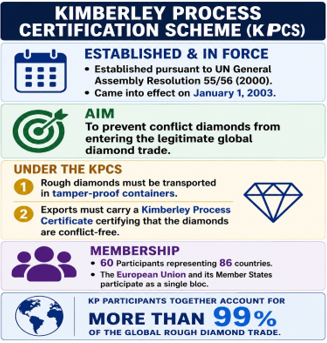
Context: India inaugurated the Kimberley Process (KP) Intersessional Meeting 2026 in Mumbai under its Chairship to discuss responsible and sustainable global diamond trade.
More on the News
• The four-day meeting is being held in Mumbai from May 11 to May 14, 2026, with participation from KP member countries, industry bodies and civil society organisations.
• Discussions are focused on monitoring and compliance mechanisms, artisanal and alluvial diamond production, trade statistics and strengthening transparency in the natural diamond value chain.
• KP
• India’s Chairship theme for 2026 is based on the “3Cs” — credibility, compliance, and consumer confidence — aimed at promoting responsibly sourced natural diamonds through intern
• ational collaboration.
About the Kimberley Process and India’s Role
• The Kimberley Process (KP) is a tripartite international initiative involving:
• Objective: To prevent the trade in “conflict diamonds”, which are rough diamonds used by rebel groups to finance armed conflicts against legitimate governments.
• India assumed the Chairship of the Kimberley Process on January 1, 2026.
• As one of the world’s leading diamond cutting and polishing centres, India plays an important role in promoting transparency, sustainability and responsible sourcing in the global diamond trade.
India–IFAD Launch Country Strategic Opportunities Programme (COSOP) 2026–2033 for Rural Prosperity
Context: The Government of India and the International Fund for Agricultural Development (IFAD) launched the new Country Strategic Opportunities Programme (COSOP) 2026–2033 to strengthen rural livelihoods, resilience, and sustainable development in line with India’s Viksit Bharat@2047 vision.
About the Country Strategic Opportunities Programme (COSOP) 2026–2033
• COSOP 2026–2033 is an eight-year strategic partnership framework between India and IFAD for rural development and agricultural transformation.
• It focuses on two major priorities:
1. Enhancing the social, economic, and climate resilience of rural communities.
2. Strengthening knowledge systems to scale successful rural development models within India and across the Global South.
• The programme gives special emphasis to grassroots institutions such as Self-Help Groups (SHGs), Farmer Producer Organisations (FPOs), and cooperatives as platforms linking finance, technology, infrastructure, and markets.
• The strategy aims to promote sustainable and market-oriented rural livelihoods instead of only poverty alleviation.
• COSOP also seeks to position India as a global knowledge leader by sharing successful models like inclusive rural finance, digital agriculture services, cooperative governance, and climate-resilient value chains with countries in Africa, Southeast Asia, and Latin America.
• Under the partnership, IFAD and the National Bank for Agriculture and Rural Development (NABARD) signed a strategic agreement to strengthen rural finance systems and support innovation in agriculture and allied sectors.
About the International Fund for Agricultural Development (IFAD)
• IFAD was established in 1977 in response to the global food crisis and is a specialized agency of the United Nations as well as an international financial institution.
• Its headquarters is located in Rome, Italy.
• India is a founding member of IFAD, and the organisation currently has 180 member states.
• IFAD aims to reduce rural poverty and hunger by investing in rural people, especially poor small-scale farmers and vulnerable communities.
• The organisation works to improve food security, increase rural incomes, strengthen climate resilience, promote sustainable agriculture, expand access to finance and technology, and support rural livelihoods through inclusive development programmes.
I4C–RBIH MoU to Strengthen AI-Driven Fight Against Cyber Financial Frauds
Context: The Indian Cyber Crime Coordination Centre (I4C) and the Reserve Bank Innovation Hub (RBIH) signed an MoU to strengthen coordination in combating cyber-enabled financial frauds and curbing mule accounts across India’s banking and digital payments ecosystem.
About the MoU
• The MoU focuses on fraud-risk intelligence sharing, analytical support, and operational coordination to strengthen proactive fraud detection and prevention mechanisms.
• Under the agreement, I4C will share intelligence related to suspected mule accounts through its Suspect Registry with AI-driven fraud detection systems such as MuleHunter.ai™ deployed across banks.
• RBIH will use these datasets to train and improve AI-based fraud-risk assessment models for early detection of suspicious financial transactions.
• The collaboration aims to enhance real-time fraud monitoring, reduce financial fraud losses, strengthen coordination between law enforcement agencies and financial institutions, and improve trust in India’s rapidly expanding digital payments ecosystem.
About the Indian Cyber Crime Coordination Centre (I4C)
• It is an initiative of the Ministry of Home Affairs (MHA) to tackle cybercrime in a coordinated and comprehensive manner across the country.
• The I4C scheme was approved on 5 October 2018 and was dedicated to the nation on 10 January 2020 by Union Home Minister Amit Shah.
• It works to improve coordination among Law Enforcement Agencies (LEAs), strengthen India’s cybercrime response architecture, and enhance citizen satisfaction in cybercrime grievance redressal.
• I4C operates key platforms such as the National Cybercrime Reporting Portal (NCRP) and maintains intelligence databases like the Suspect Registry. It was upgraded as an Attached Office of the MHA with effect from 1 July 2024.
About the Reserve Bank Innovation Hub (RBIH)
• Reserve Bank Innovation Hub is a wholly owned subsidiary of the Reserve Bank of India, established in March 2022 to promote innovation and digital transformation in India’s financial sector.
• Headquartered in Bengaluru, RBIH functions as a Section 8 company with an initial capital of ₹100 crore.
• It focuses on developing, prototyping, and scaling technology-driven solutions to promote financial inclusion, secure digital payments, and innovation in banking services.
• RBIH has been actively supporting AI-based fraud detection systems, including MuleHunter.ai™, to strengthen the resilience and security of India’s digital payments ecosystem.
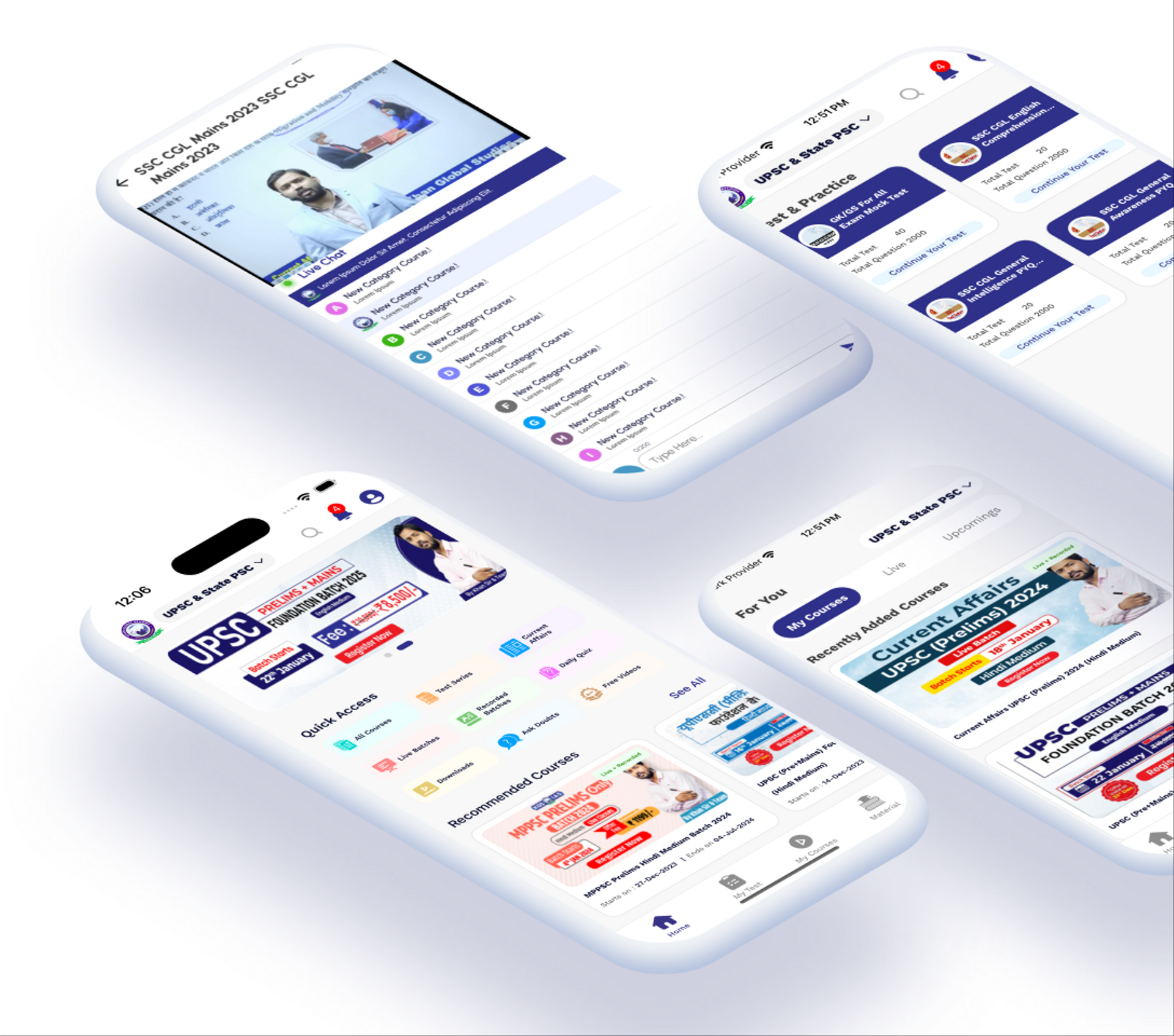
The most trusted learning platform on your phone
With our training programs, learning online can be a very exciting experience! Take the next step toward achieving your professional and personal objectives


Course Related Query:
Ask Your DoubtsStore Related Query:[email protected]NCERT Books
Resources
We love learning. Through our innovative solutions, we encourage ourselves, our teams, and our Students to grow. We welcome and look for diverse perspectives and opinions because they enhance our decisions. We strive to understand the big picture and how we contribute to the company’s objectives. We approach challenges with optimism and harness the power of teamwork to accomplish our goals. These aren’t just pretty words to post on the office wall. This is who we are. It’s how we work. And it’s how we approach every interaction with each other and our Students.
Come with an open mind, hungry to learn, and you’ll experience unmatched personal and professional growth, a world of different backgrounds and perspectives, and the freedom to be you—every day. We strive to build and sustain diverse teams and foster a culture of belonging. Creating an inclusive environment where every students feels welcome, appreciated, and heard gives us something to feel (really) good about.
Get Free academic Counseling & Course Details