Current Affairs provides you with the best compilation of the Daily Current Affairs taking place across the globe: National, International, Sports, Science and Technology, Banking, Economy, Agreement, Appointments, Ranks, and Report and General Studies
News in Short
Long-Range Anti-Ship Hypersonic Missile
Context: India publicly unveiled its first long-range hypersonic missile during a display of military power at the country’s 77th Republic Day parade at Kartavya Path in New Delhi.
More on the News
The Defence Research and Development Organisation (DRDO) tableau prominently featured the Long Range Anti-Ship Hypersonic Missile and naval technologies for combat submarines.
The display underscored India’s advances in indigenous missile development and underwater warfare systems.
It represents India’s entry into the elite club of hypersonic weapon-capable nations, particularly in anti-ship systems.
Key Highlights of the LR-AShM (Long Range Anti-Ship Hypersonic Missile)
The LR-AShM is India’s first publicly unveiled long-range hypersonic missile developed indigenously by DRDO.
It is designed primarily to meet the coastal battery requirements of the Indian Navy.
Speed: It follows a quasi-ballistic trajectory and achieves speeds up to Mach 10 with an average speed of around Mach 5.
Launcher: The missile is mounted on a mobile transporter-erector-launcher based on a 12×12 high-mobility vehicle.
Range: It is designed to carry multiple payload types and is reported to have a range exceeding 1,500 kilometres.
Precision Targeting: The missile is capable of engaging both static and moving maritime targets with high precision.
Trajectory: The missile performs multiple skip-glide manoeuvres during flight, making detection and interception difficult.
Sensors: It uses fully indigenous avionics and high-accuracy sensor packages for terminal guidance.
Propulsion: The system is powered by a two-stage solid propulsion rocket motor followed by an unpowered hypersonic glide phase.
Low Detectability: Due to low-altitude flight and high manoeuvrability, enemy radar systems struggle to track the missile.
Pixxel-led group wins India's first private national EO satellite project
Context: Recently, Bengaluru-based space tech company Pixxel formalised its agreement with the Indian National Space Promotion and Authorisation Centre (IN-SPACe) to build India’s Rs 1,200 crore national Earth Observation (EO) constellation.
More on the News
The project will be executed under a public-private partnership framework.
It is the first time a private consortium will own and operate a national EO satellite system for India.
An Earth Observation (EO) constellation is a coordinated group of satellites placed in specific orbits to continuously monitor the Earth’s surface, oceans, and atmosphere and collect data for scientific, economic, environmental, and security purposes.
Key Features of the Project
Pixxel will lead a consortium of four Indian space companies.
The Pixxel-led consortium includes Dhruva Space, PierSight and Satsure.
The consortium will design, build, own and operate the satellite constellation.
The constellation will be deployed over a five-year period.
A total of 12 satellites will be launched under the programme.
Satellite Capabilities
The constellation will include very high-resolution optical imaging satellites.
It will include multispectral imaging for land and vegetation analysis.
Synthetic Aperture Radar (SAR) satellites will enable all-weather and night-time observation.
Hyperspectral satellites will allow detailed detection of surface and atmospheric features.
Consortium Composition
Pixxel will provide advanced imaging satellite technology and overall programme leadership.
Dhruva Space will contribute satellite hardware and mission support capabilities.
PierSight will support maritime-focused observation and operations.
Satsure will provide analytics and value-added intelligence services.
PFRDA Constitutes SAARG Committee to Modernise NPS Investment Framework
Context: Recently, the Pension Fund Regulatory and Development Authority (PFRDA) has constituted a high-level committee, Strategic Asset Allocation and Risk Governance (SAARG), to review, recommend and modernise the investment framework under the National Pension System (NPS).
More on the News
The SAARG Committee comprisesnine members, which include experts from capital markets, asset management and securities law.
The Committee is chaired by Narayan Ramachandran, former country head and CEO of Morgan Stanley India.
The committee has nine months from its constitution date to submit its recommendations to PFRDA.
Mandate and Scope of SAARG
The committee will review existing NPS investment guidelines across government and non-government sectors.
It will benchmark India’s pension investment framework with leading global pension systems.
It will examine strategic asset allocation frameworks for long-term retirement objectives.
It will assess the introduction of new asset classes to improve diversification.
It will review performance measurement and accountability mechanisms for pension funds.
It will recommend stronger risk management and asset liability management practices.
National Pension System (NPS)
NPS is a government-backed, market-linked retirement savings scheme in India designed to help individuals build a corpus for their post-retirement life.
It is regulated by PFRDA, and is a low-cost, portable, and transparent system available to Indian citizens aged between 18 and 70.
16th National Voters’ Day
Context: India observed the 16th National Voters’ Day Celebrations on January 25, 2026.
About National Voters’ Day
Theme 2026: "My India, My Vote," with the tagline "Citizen at the Heart of Indian Democracy."
It celebrates democracy and empowers every citizen to take part in the electoral process.
The day marks the foundation of the Election Commission of India (ECI), which was established on January 25, 1950, under Article 324 of the Indian Constitution.
The voting age was reduced from 21 to 18 through the 61st Amendment in 1989.
The ‘right to vote’ was a statutory right conferred by Section 62 of the Representation of the People Act of 1951, but freedom of voting was a “species of the right to expression under Article 19(1)(a) of the Constitution.
About the Election Commission of India
The ECI is a pivotal constitutional authority responsible for the control, supervision, and conduct of elections in the world’s largest democracy.
It was established in 1950 and conducts elections to the Lok Sabha, Rajya Sabha, State Legislative Assemblies in India, and the offices of the President and Vice President.
The first general elections in independent India were held in 1951- 1952.
2nd Global Buddhist Summit
Context: The International Buddhist Confederation (IBC), in collaboration with the Union Ministry of Culture, Government of India, organised the 2nd Global Buddhist Summit (GBS) at Bharat Mandapam, New Delhi.
More on the News
Summit was held under the theme “Collective Wisdom, United Voice, and Mutual Coexistence.”
The theme seeks to reinforce the relevance of Buddhist philosophy in nurturing societal harmony and promoting constructive international engagement.
Representatives from countries such as Vietnam, Myanmar, Cambodia, Thailand, Bhutan, Japan, Nepal, the United States, and more joined discussions.
Discussions examined how the core values of the Buddha Dhamma can guide ethical leadership, promote social harmony, and support sustainable living amid rapid technological change, consumerism, and environmental degradation.
In addition to discussions, the Summit also features exhibitions on Sacred Relics and Cultural Engagement in Contemporary India and Virasat se Vishwa: India’s Buddha Dhamma Outreach.
A key highlight was the live demonstration of NORBU (Neural Operator for Responsible Buddhist Understanding), a language learning model based on the ChatGPT algorithm and trained on Buddhist texts.
Adopted by the IBC as its global patron and named “Kalyan Mitra” (Spiritual Friend), NORBU aims to connect tech-savvy youth with Buddhist teachings in multiple languages.
The 1st Global Buddhist Summit, held on 20–21 April 2023 in New Delhi, brought together over 170 delegates from 31 countries under the theme “Responses to Contemporary Challenges: Philosophy to Praxis.”
About the International Buddhist Confederation (IBC)
The International Buddhist Confederation (IBC) is a global Buddhist umbrella organisation headquartered in New Delhi under the aegis of the Ministry of Culture, Government of India.
Established in 2011 under the patronage of the supreme Buddhist religious hierarchy, the IBC has a global membership of over 300 monastic and lay organisations.
Matabari Tourism Circuit
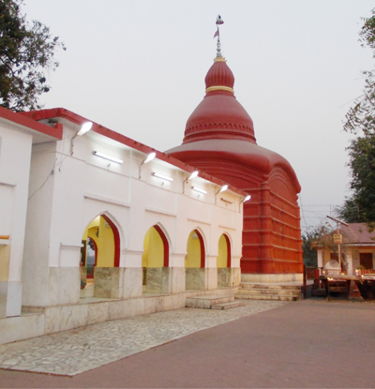
Context: Recently, the Union Minister for Development of North Eastern Region and Communications laid the foundation stone of the ₹450 crore ‘Matabari Tourism Circuit’ at Narkel Kunja, Dumbur Lake, Tripura.
More on the News
The project will include floating jetties, eco-friendly resorts, modern tourist facilities and immersive experiences rooted in local culture, giving the Dumbur region a distinct international tourism identity.
The new tourism circuit is expected to witness a significant rise in tourist footfall, improved facilities, and enhanced connectivity, benefiting both pilgrims and nature lovers alike.
About Matabari Temple
The Matabari Temple, dedicated to Goddess Tripura Sundari, is one of the 51 Shakti Peethas and attracts thousands of devotees annually.
Goddess Tripura Sundari is an avatar of the Goddess Parvathi, the consort of Lord Shiva.
Maharaja Dhanya Manikya constructed the temple in 1501 A.D.
The temple consists of a square-shaped sanctum designed in the model of a typical rural Bengal hut.
The temple is also known as Kurma Pith because its base resembles the hump of a tortoise, symbolising stability and endurance.
Inside the sanctum are two idols:
The main deity, Goddess Tripura Sundari, is a five-foot idol worshipped as the presiding mother.
A smaller idol, Chhoto-Ma (Goddess Chandi), once carried by Tripura kings to hunting expeditions and battlefields.
The temple is associated with the Matabari Peda, a sweet offered as prasad, which recently received the Geographical Indication (GI) tag.
Bactrian camels
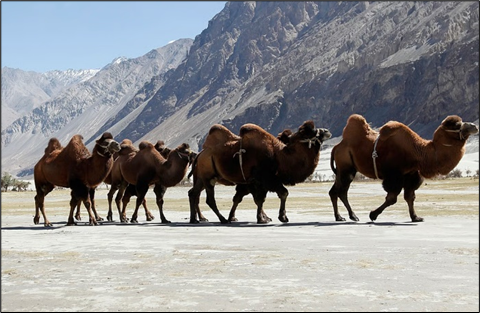
Context: Two Bactrian camels of Ladakh’s cold desert made a historic appearance at the Republic Day Parade as part of the ‘Animal Contingent’.
More on the News
They marched as part of the Animal Contingent along with Zanskar ponies and Army dogs.
The contingent comprised two Bactrian camels and four Zanskar ponies, symbolising a blend of tradition, resilience, and self-reliance within the Indian Army’s operational ecosystem.
Bactrian camels, also called Mundri camels locally, are native to Ladakh's high-altitude cold deserts.
Only about 365 of these rare camels remain in India, mostly in Nubra Valley.
They are uniquely adapted to survive extreme temperatures that drop as low as minus 30°C, thin air, strong UV radiation, and scarce vegetation, conditions where most machines fail.
Bactrian Camel (Camelus bactrianus)
Camelus bactrianus is the double-humped camel species adapted to cold arid and high-altitude environments.
The species derives its name from Bactria, an ancient region near the Hindu Kush mountains in Central Asia.
Bactrian camels are mainly found in Central Asian countries such as Mongolia, China, Kazakhstan, Turkmenistan and Uzbekistan.
Smaller populations exist in Afghanistan, Iran, Turkey, Pakistan and India.
In India, the species is found only in the cold desert region of Ladakh.
The IUCN has classified the wild Bactrian camel as critically endangered since 1998.
Habitat and Adaptations
The species inhabits rocky mountains, cold deserts, sand dunes and stony plains.
It is adapted to extreme temperatures ranging from minus 40 degrees Celsius in winter to 40 degrees Celsius in summer.
Bactrian camels can survive with very limited water and sparse vegetation.
They can meet part of their water requirement by eating snow during winter.
With our training programs, learning online can be a very exciting experience! Take the next step toward achieving your professional and personal objectives
We love learning. Through our innovative solutions, we encourage ourselves, our teams, and our Students to grow. We welcome and look for diverse perspectives and opinions because they enhance our decisions. We strive to understand the big picture and how we contribute to the company’s objectives. We approach challenges with optimism and harness the power of teamwork to accomplish our goals. These aren’t just pretty words to post on the office wall. This is who we are. It’s how we work. And it’s how we approach every interaction with each other and our Students.
What Makes Us Different
Come with an open mind, hungry to learn, and you’ll experience unmatched personal and professional growth, a world of different backgrounds and perspectives, and the freedom to be you—every day. We strive to build and sustain diverse teams and foster a culture of belonging. Creating an inclusive environment where every students feels welcome, appreciated, and heard gives us something to feel (really) good about.