Current Affairs provides you with the best compilation of the Daily Current Affairs taking place across the globe: National, International, Sports, Science and Technology, Banking, Economy, Agreement, Appointments, Ranks, and Report and General Studies
NEWS IN SHORT
Jan Vishwas (Amendment of Provisions) Bill, 2026
Context: Recently, the government introduced the Jan Vishwas (Amendment of Provisions) Bill, 2026, in the Lok Sabha.
Key Provisions of the Bill
The objective of the bill is to promote Ease of Doing Business and Ease of Living, while advancing a governance framework based on trust and proportionate regulation.
Decriminalisation of Offences: The Bill aims to decriminalise 717 provisions impacting ease of doing business, replacing criminal penalties for minor, technical, or procedural lapses with civil enforcement mechanisms.
Shift to Civil Enforcement Mechanism:
Imprisonment provisions are replaced with monetary penalties or warnings, introducing a proportionate regulatory framework in India.
It adopts graded enforcement, where first-time violations may attract only warnings, and penalties are aligned with the severity of the offence.
Efficient and Time-Bound Enforcement: It provides for the appointment of Adjudicating Officers and the establishment of Appellate Authorities to ensure speedy case disposal, reduce the burden on courts, and uphold the principles of natural justice.
Facilitating Ease of Doing Business and Ease of Living:
Simplification of Provisions: The Bill proposes 784 amendments of 79 Central Acts administered by 23 Ministries. It also proposes 67 amendments under the New Delhi Municipal Council Act, 1994 and the Motor Vehicles Act, 1988.
Trust-Based Governance: It ensures that citizens and businesses are not unduly penalised for minor non-compliance, improves compliance levels and fosters investment. It also reflects the government’s commitment to upholding principles of natural justice in governance.
Significance of the Bill
Boosts Ease of Doing Business by reducing fear of criminal penalties for minor lapses.
Promotes trust-based Governance by encouraging voluntary compliance over coercion.
Reduces court burden by enabling faster resolution through adjudicating mechanisms.
Ensures proportionate penalties by aligning punishment with the severity of offences.
Enhances investment climate by building investor confidence and economic growth.
TV Ratings Policy 2026
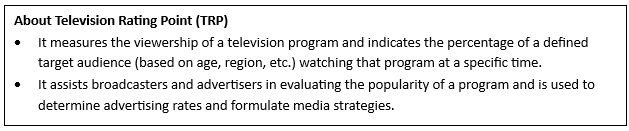
Context: Recently, the Ministry of Information & Broadcasting (MIB) released the TV Ratings Policy 2026, setting out comprehensive guidelines for regulating television ratings in India.
Key Highlights of the Policy
Ease In Entry Norms: The net worth requirement for a company willing to register as a TV rating agency has been reduced from the existing Rs. 20 Crores to 5 crores.
Strict Anti-Conflict Measures: At least 50% of the Board must be Independent Directors with no links to broadcasters, advertisers, or agencies, and agencies are barred from consultancy roles to prevent conflicts of interest.
Transparency & Privacy: Agencies must publish methodology and anonymised data, while ensuring compliance with the Digital Personal Data Protection (DPDP) Act, 2023, to protect viewer privacy.
Accountability & Audits: A mandatory dual-audit system includes quarterly internal audits, annual external audits, and oversight by a Ministry-led Audit & Inspection Team.
Grievance Redressal: Agencies must appoint a Nodal Officer to resolve complaints within 10 days and set up an Appellate Authority for appeals.
Landing Page Rules: Landing page viewership excluded from ratings; permitted only for marketing, with mandatory disclosure by broadcasters to rating agencies.
Compliance & Penalties: Non-compliance will invite graded penalties, from temporary suspension of ratings to cancellation of registration for repeated violations.
Publication of Viewership Data: TV distribution and OTT platforms may publish periodic channel viewership data on their websites without requiring prior registration or approval.
Operation Urja Suraksha
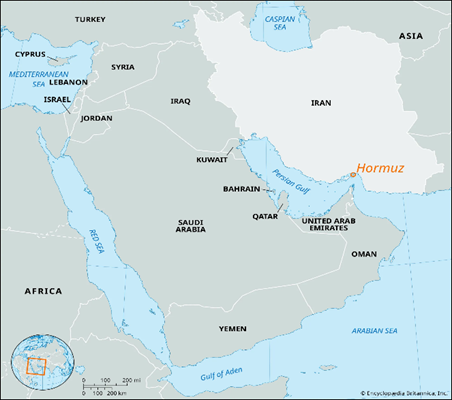
Context: Recently, the Indian Navy launched ‘Operation Urja Suraksha’ to secure energy lifelines through the Strait of Hormuz.
About the Operation
Objective: To ensure the uninterrupted and secure movement of Indian-flagged vessels carrying critical energy supplies through the Strait of Hormuz.
It aims to conduct operations with utmost precision and minimal publicity to escort, guide, and secure energy consignments like LNG, LPG, and crude oil, bound for India.
Expanded Protection: Indian Navy destroyers and frigates are also extending protection beyond the Strait of Hormuz, ensuring layered maritime security until vessels reach safer waters.
Significance: The operation underscores India’s commitment to securing energy supply chains and maintaining maritime stability in a region critical to global oil and gas flows.
Parliamentary Committee Recommends a Dedicated National Highway Safety Patrol
Context: Recently, a parliamentary committee recommended the formation of a dedicated 'National Highway Safety Patrol' on the lines of the Railway Protection Force (RPF).
More on the News
Background of the Recommendation: According to the Transport Research Wing of the Ministry of Road Transport and Highways, about 4.73 lakh road accidents and 1.70 lakh fatalities were recorded in India in 2024. National Highways alone accounted for over 52,600 deaths.
The National Highway Safety Patrol will be entitled to improve accident response, enforce traffic discipline and protect road assets across the country’s expanding highway network.
Need for the Framework
Inadequate Enforcement Mechanisms: The current reliance on State Police forces, whose responsibilities extend beyond highway safety, is inadequate to meet the demands of the vast National Highway network.
Dedicated Monitoring: High-speed corridors and expressways require dedicated, technology-driven surveillance and enforcement, which general policing systems cannot effectively provide.
Black Spot Management: Targeted patrolling and enforcement are essential for accident-prone stretches to reduce fatalities and improve overall road safety outcomes.
Significance
Real-Time Response: It could ensure timely assistance during “golden hour” (the critical first 60 minutes after a severe traumatic injury), saving lives.
Uniform Standards Across Highways: It will ensure uniform enforcement and safety measures nationwide, regardless of the differences between states.
Prevent Damage to Highway Infrastructure: It will enforce uniform rules against overloading, reckless driving, and misuse, thereby protecting road quality and reducing maintenance costs.
Global Out-of-School Population Increased to 273 Million
Context: Recently,UNESCO published a report titled “2026 GEM report — Access and equity: Countdown to 2030”, showing that the global out-of-school population has reached 273 million in 2024.
Key Findings of the Report
Global Out-of-School Population: 273 million children, adolescents and youth were out of school, and this excludes an estimated 13 million more in 10 of the countries most affected by conflict.
Low Completion Rates
Only about two-thirds of students worldwide complete secondary education.
Around one in six school-age children remains out of school, highlighting a major barrier to universal education
Enrollment Without Quality Learning
Marginalised groups such as girls, children with disabilities, rural communities, and displaced learners continue to face systemic barriers that hinder both access and meaningful participation in education.
Overcrowded classrooms, insufficiently trained teachers, and a lack of essential learning materials contribute to poor learning outcomes.
These learning gaps threaten long-term social and economic development, reinforcing cycles of poverty and exclusion.
Funding Constraints: Inadequate and poorly targeted funding, particularly in low-income countries, consistently hinders progress, leading to struggles in meeting the demands of a growing school-age population.
Digital Divide: Despite its potential to expand access and improve learning, limited access to devices, connectivity, and digital skills risks widening existing inequalities without targeted interventions.
Country Case Insights: The document includes 35 country case studies explaining factors driving faster progress in some countries and constraints holding others back.
SRY Gene Test Screening
Context: Recently, the International Olympic Committee introduced SRY gene screening and prohibited transgender women and DSD (Differences in Sex Development) athletes from competing in female categories to ensure fairness and safety.
About the SRY (Sex Determining Region Y) Gene
It is a segment of DNA that is almost always on the Y chromosome.
It indicates the presence of the testes and initiates male sexual development through the production of testosterone.
Discovered by Professor Andrew Sinclair in 1990.
SRY is not a precise indicator of sex because if it undergoes a mutation and fails to function properly, the testes do not develop, and the individual may biologically develop as a female.
About the SRY Gene Test Screening in Elite Games
Objective: To safeguard the female category in elite sports by ensuring athletes do not possess physiological advantages associated with male development.
Sampling: This screening is conducted using saliva, cheek swabs, or blood samples, and unlike other methods, it involves no internal bodily intrusion.
Single-Instance Test: The test is performed only once in an athlete's entire career.
Processing Time: It generally takes around one week, after which the results are issued and submitted to the concerned international sports body.
Biological Marker of Sex Development: The SRY gene is considered a reliable indicator of whether an athlete has undergone or is likely to undergo male sex development.
Critical Booster Engine Test of Agnikul’s Fully 3D-Printed Engine
Context: Recently, Agnikul Cosmos, an end-to-end space transportation company, has successfully completed a critical booster engine test of its 3D printed engine, ‘Agnite’.
More on the News
The tested engine is a full meter in length, making it the largest Inconel rocket engine ever fabricated as a single piece.
With its large scale, this is the first engine of its kind tested using electric motor-driven pumps, marking a major advancement in Agnikul’s propulsion technology.
Through this innovation, Agnikul now operates a fully integrated launch ecosystem, comprising an in-house mission control, dedicated ground stations, and flight-proven propulsion systems.
Significance of the Development
Faster and cheaper production:
Unlike traditional engines, which take months to build, it can be printed in a few days and respond to launch demand faster than the industry standard.
It also reduces cost by cutting material waste and labour-intensive processes.
Better Reusability:
Electric pumps are simpler than gas generators and contain fewer parts that require repair between flights, which is crucial for reusability plans.
This development marks a shift from traditional multi-part rocket engine assembly to single-piece 3D printing.
Flexible Launch Services for Critical Satellite Operators: For defence and disaster relief satellite operators, where timing is crucial, it can provide the flexibility to modify payloads up to 30 days before launch, offering greater operational control than traditional shared launch systems
Simplification and Integration of the Satellite Launch Ecosystem: Traditionally, satellite launches involve multiple stakeholders, increasing complexity, delays, and schedule risks. In contrast, Agnikul offers an end-to-end integrated platform with a single team for in-orbit operations, improving efficiency and reducing coordination challenges.
Boost to small satellite launches: The engine supports faster development of small launch vehicles and improves India’s competitiveness in the commercial space launch market.
With our training programs, learning online can be a very exciting experience! Take the next step toward achieving your professional and personal objectives
We love learning. Through our innovative solutions, we encourage ourselves, our teams, and our Students to grow. We welcome and look for diverse perspectives and opinions because they enhance our decisions. We strive to understand the big picture and how we contribute to the company’s objectives. We approach challenges with optimism and harness the power of teamwork to accomplish our goals. These aren’t just pretty words to post on the office wall. This is who we are. It’s how we work. And it’s how we approach every interaction with each other and our Students.
What Makes Us Different
Come with an open mind, hungry to learn, and you’ll experience unmatched personal and professional growth, a world of different backgrounds and perspectives, and the freedom to be you—every day. We strive to build and sustain diverse teams and foster a culture of belonging. Creating an inclusive environment where every students feels welcome, appreciated, and heard gives us something to feel (really) good about.