Explore All Exams at KGS


All Exams
Explore All Exams at KGS

Khan Sir Courses
Geography I Polity I History | World Map I Indian Map I Economics I Biology

Judiciary
CLAT

UPSC
UPSC
BPSC
BPSC
UPPSC
UP-PSC

State Exams
UP I Bihar I MP | Rajasthan
MPPSC
MP-PSC

NEET | JEE | CUET

Defence Exams
NDA I CDS I CAPF I AFCAT I SSB I Agniveer

Police Exams
UP SI | Bihar SI | Delhi Police | UP Constable

SSC Exams
CGL I CPO I CHSL I MTS I SSC GD I Delhi Police

Foundation Courses
Physics I Chemistry I Biology I History I Geography I Polity I NCERT I Math I English | Map I Reasoning

Railway Exams
RRB | RPF

Teaching Exams
TET | Teaching | UGC

Banking Exams
SBI | RBI | IBPS
UGC NET
UGC NET/JRF

Engineering Exams
Civil | Electrical | Mechanical
Current Affairs provides you with the best compilation of the Daily Current Affairs taking place across the globe: National, International, Sports, Science and Technology, Banking, Economy, Agreement, Appointments, Ranks, and Report and General Studies
Current Affairs
SYLLABUS
GS-2: Issues relating to development and management of Social Sector/Services relating to Health, Education, Human Resources.
Context: The Supreme Court directed the Food Safety and Standards Authority of India (FSSAI) to introduce mandatory front-of-package nutrition labelling (FoPNL) on packaged foods high in sugar, saturated fat and salt to protect public health and informed consumer choice.
Key Highlights of the Supreme Court Judgement
• Separate Warnings: Each nutrient must have a separate red hexagon with a standardised pictogram and the words "HIGH SUGAR", "HIGH FAT" or "HIGH SALT".
• Nutrients of Concern: FSSAI must consider total sugars and saturated fat, instead of only added sugars and added fat, alongside salt.
• Scientific Thresholds: Thresholds must be evidence-based and neither too low (causing label fatigue) nor too high (allowing unhealthy products to escape warnings). A study cited by the Court found that 94.1% of 44,109 packaged-food records would attract at least one warning under proposed thresholds.
• Size: Each hexagon must occupy at least 4–5% of the principal display panel, with prominent and legible text.
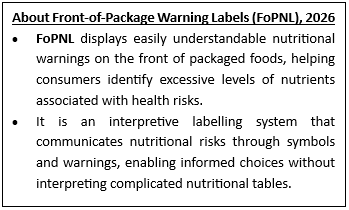
• Implementation: A single-phase system will cover products exceeding the threshold for even one nutrient.
• Timeline: FSSAI must finalise draft regulations within four months, including 60 days for stakeholder and World Trade Organization (WTO) consultations. Food Business Operators (FBOs) will receive a 365-day transition period, with safeguards against stockpiling unlabelled products.
• Other Directions: FSSAI must identify exempt foods, prevent additives and preservatives from defeating labelling objectives, and ensure beverage category labels do not resemble high-sugar warnings.
• Industry Accountability: The Court urged multinational food companies to maintain uniform product and labelling standards across countries and cautioned against industry objections delaying regulation.
• Nutritional Literacy in Schools: The Union Government must ensure implementation of the Food Safety and Standards (Safe food and balanced diets for children in school) Regulations, 2020, and promote practical nutritional education through curricula, workshops and co-curricular activities.
• Constitutional Basis: The judgement links FoPNL with Article 21 (right to health), the right to food, informed consumer choice and international obligations under the International Covenant on Economic, Social and Cultural Rights (ICESCR).
Importance of the Ruling
• Public Health: Strengthens the State's obligation to address unhealthy dietary practices and prevent non-communicable diseases (NCDs).
• Consumer Protection: Makes nutritional information accessible, including to children and people with limited literacy.
• Industry Accountability: Encourages manufacturers to reformulate products and reduce excessive sugar, salt and saturated fat.
• Preventive Healthcare: Combines food regulation with nutritional education to develop healthier dietary habits.
Evolution of FSSAI's Front-of-Package Labelling Framework
• 2022: Proposed a star-rating system indicating overall nutritional value, opposed by health experts for potentially giving unhealthy products a misleading positive impression.
• 2025: Proposed displaying nutrients as a percentage of the Recommended Dietary Allowance (RDA), criticised for requiring consumers to interpret complicated information.
• Subsequent Proposal: Suggested a single red hexagon, two-phase implementation and separate beverage category labels.
• 2026 Supreme Court Directions: Established separate nutrient-specific warnings, scientific thresholds and single-phase implementation.
Why Does India Need Front-of-Package Warning Labels?
• NCD Burden: NCDs account for approximately 63% of annual deaths in India (around six million), projected to reach 75% by 2030.
• Disease Prevalence: India has an estimated 101 million people with diabetes, 136 million with pre-diabetes, 315 million with hypertension and 254 million with generalised obesity.
• UPF Consumption: India's ultra-processed food (UPF) sector recorded 13.37% growth in retail sales value between 2011 and 2021.
• Nutritional Awareness: Complicated back-of-package information makes it difficult to identify unhealthy ingredients quickly, particularly for consumers with limited nutritional literacy.
Global Practices in Front-of-Package Nutrition Labelling
• At least 44 countries have implemented different forms of FoPNL.
• Warning Labels: Chile, Mexico, Israel, Peru, Uruguay, Brazil, Argentina, Colombia, Venezuela and Canada use different forms of warning-based labelling.
• Traffic-Light System: The UK uses red, amber and green indicators to represent nutrient levels.
• Health Star Rating: Australia and New Zealand use star ratings to indicate overall nutritional quality.
• Healthier-Choice Symbols: The Netherlands, Czech Republic and Singapore use symbols to identify healthier products.
Khan Global Studies App
With our training programs, learning online can be a very exciting experience. Take the next step toward achieving your professional and personal objectives.



Course Related Query:
Ask Your DoubtsStore Related Query:[email protected]NEET | JEE | CUET
NCERT Books
Resources
We love learning. Through our innovative solutions, we encourage ourselves, our teams, and our Students to grow. We welcome and look for diverse perspectives and opinions because they enhance our decisions. We strive to understand the big picture and how we contribute to the company’s objectives. We approach challenges with optimism and harness the power of teamwork to accomplish our goals. These aren’t just pretty words to post on the office wall. This is who we are. It’s how we work. And it’s how we approach every interaction with each other and our Students.
Come with an open mind, hungry to learn, and you’ll experience unmatched personal and professional growth, a world of different backgrounds and perspectives, and the freedom to be you—every day. We strive to build and sustain diverse teams and foster a culture of belonging. Creating an inclusive environment where every students feels welcome, appreciated, and heard gives us something to feel (really) good about.