logo

All Exams

Notifications

All Exams

Explore All Exams at KGS

All Exams
Home>Current Affairs>The Fifth edition of “Trade Watch Quarterly”
Current Affairs made simple.

Current Affairs provides you with the best compilation of the Daily Current Affairs taking place across the globe: National, International, Sports, Science and Technology, Banking, Economy, Agreement, Appointments, Ranks, and Report and General Studies

banner-image

The Fifth edition of “Trade Watch Quarterly”

SYLLABUS

GS 3:Indian Economy and issues relating to planning, mobilisation of resources, growth, development and employment and Infrastructure: Energy, Ports, Roads, Airports, Railways, etc.

Context: Recently, the fifth edition of the ‘Trade Watch Quarterly’ for Quarter I of the financial year (FY) 2025–26 (April–June 2025) was released in New Delhi by NITI Aayog.

More on the News:

  • The report presents a data-driven analysis of India’s trade performance amid evolving global conditions.
  •  The publication highlights emerging structural shifts in India’s trade profile, including the rising contribution of technology-intensive exports, the continued strength of services-led growth, and changes in import composition reflecting deeper integration into global value chains.
  • The thematic section of this quarter’s edition focuses on India’s automotive exports, examining India’s export footprint across vehicles and auto components.
  • The first edition was released on December 4, 2024, and analyses India's trade statistics for Q1 FY24 (April to June 2024), providing a snapshot of India's trade position, sectoral performance, and emerging opportunities.

Major Highlights of the Report

  • India’s Trade Analysis (Q1 FY26):
    • India’s total trade (merchandise + services) was up 3.7% y-o-y, with services trade up 7% and merchandise trade up 2% making total trade as $439 bn.
    • Merchandise Trade: Exports declined by 2.1% y-o-y to $112 bn, and imports rose marginally by ~5% reaching $180 bn.
      • Exports of electrical machinery surged, while those of mineral fuels declined, primarily due to reduced petroleum exports to the Netherlands, the US and the UAE.
      • Increase in imports was driven by growth in inorganic chemicals, electrical machinery and nuclear reactors.
    • Services Trade: Exportswitnessed a robust annual expansion of 10%, reaching $97 bn, and services imports rose marginally by 1.56% to $49.5 bn during the same period, resulting in a net services trade surplus of $48 bn.
    •  The combined balance of trade in goods and services registered a net deficit of $21 bn for this quarter.
    • Regional Contribution: India’s exports to its top markets, including the USA, UAE, the Netherlands, China and the UK, remained steady.
      • Exports increased to the USA, China, and Germany, but declined to the UK and the Netherlands, partly due to lower petroleum exports.
      • India’s share of imports from its top markets - China, UAE, Russia, USA increased, though declined with Iraq, Russia and Saudi Arabia.
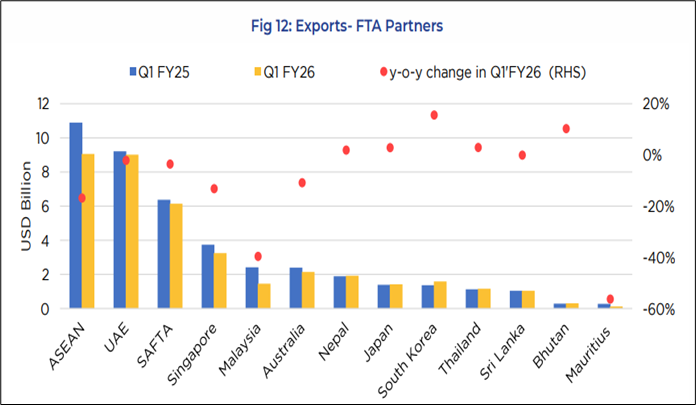
    • Trade with FTA partners: India’s trade performance with its Free Trade Agreement (FTA) partner countries in Q1 FY26 reflected a widening trade deficit.
    • Sectoral Contribution: Technology-intensive sectors, electronics, machinery, and chemicals, now anchor India’s trade performance.
      • Electronics emerged as the standout performer, contributing to over 11% of total exports, reflecting deeper integration into global electronics supply chains.
    • Creative Economy: India ranks modestly in creative goods exports ($20.6bn) dominated by software and R&D, but performs far more strongly in creative services ($94.2bn), ranking fourth globally
      • This contrast highlights India’s core strength in skill-intensive, digital, and innovation-driven creative activities, thus well-positioning itself in the rapidly evolving global creative economy.
  • Thematic analysis: Automotive exports
    • India’s automobile exports expanded from $9.4 bn to $13.2 bn, registering a compound annual growth rate of 3.5%.In contrast, exports of auto components grew much faster, nearly doubling from $8.2 bn to $16.9 bn.
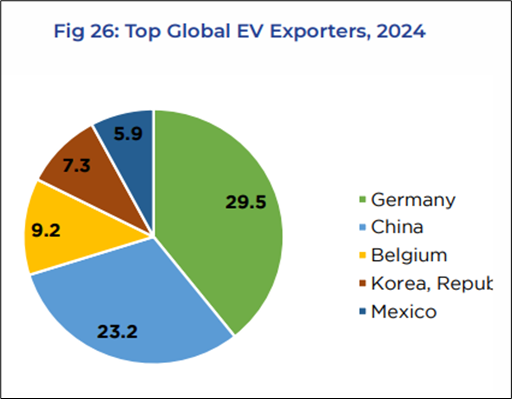
  • Technology transition: India’s Electric Vehicle (EV) exports increased from $1.2 mn in 2020 to $84 mn in 2024, showing high growth but still accounting for about 0.1% of global exports ($145 bn).
    • Export destination: India mainly sells small and affordable EV to Nepal (46.4%) Indonesia (20.9%) and Japan (20.1%).
    • Import market: Germany remains the top source, largely due to high-end car imports, while China’s share is also increasing.
    • Key Issues: India exports low-value vehicles but imports high-spec models and key components, limiting its competitiveness and long-term role in the global EV value chain.

Key Recommendations of the Report

  • Enhance export competitiveness: The report emphasises rationalising incentives, expanding export-linked financing for emerging markets, and accelerating domestic production of critical inputs such as EV batteries to enhance export competitiveness.
  • Strategic Engagement with Key Markets: India’s export push needs to be recalibrated toward neighbouring and emerging markets such as Sri Lanka, Africa, and Latin America, where significant untapped demand persists.
  • Strengthening Quality Standards: Reviving the Indian Brand Equity Foundation (IBEF) can play a central role in improving India’s global branding, quality standards through “Made in India” as a credible and competitive label.
  • Addressing Non-Tariff Barriers: Enhance government-to-government engagement to streamline regulatory compliance and reduce market-specific NTBs.
footer image

The most trusted learning platform on your phone

With our training programs, learning online can be a very exciting experience! Take the next step toward achieving your professional and personal objectives


app-storeplay-store
logo
Khan Global Studies Pvt. Ltd. 5th Floor,
A13A, Graphix 1 Tower B, Sector 62,
Noida, Uttar Pradesh 201309

Course Related Query: [email protected] Store Related Query: [email protected]

Get Free Academic Counseling & Course Details

KGS best learning platform

About Khan Global Studies

We love learning. Through our innovative solutions, we encourage ourselves, our teams, and our Students to grow. We welcome and look for diverse perspectives and opinions because they enhance our decisions. We strive to understand the big picture and how we contribute to the company’s objectives. We approach challenges with optimism and harness the power of teamwork to accomplish our goals. These aren’t just pretty words to post on the office wall. This is who we are. It’s how we work. And it’s how we approach every interaction with each other and our Students.


What Makes Us Different

Come with an open mind, hungry to learn, and you’ll experience unmatched personal and professional growth, a world of different backgrounds and perspectives, and the freedom to be you—every day. We strive to build and sustain diverse teams and foster a culture of belonging. Creating an inclusive environment where every students feels welcome, appreciated, and heard gives us something to feel (really) good about.

Copyright 2026 KhanGlobalStudies

Have a question?

Get Free academic Counseling & Course Details

floatButton
The Fifth edition of “Trade Watch Quarterly” | Current Affairs