You're all caught up—no notifications available.
Explore All Exams at KGS


All Exams
Explore All Exams at KGS

Khan Sir Courses
Geography I Polity I History | World Map I Indian Map I Economics I Biology

UPSC & State PSC
UPSC I BPSC I UP-PSC I MP-PSC

State Exams
UP I Bihar I MP | Rajasthan

NEET | JEE | CUET | Boards
NEET | JEE | CUET | Boards

Defence Exams
NDA I CDS I CAPF I AFCAT I SSB I Agniveer

Police Exams
UP SI | Bihar SI | Delhi Police | UP Constable

SSC Exams
CGL I CPO I CHSL I MTS I SSC GD I Delhi Police

Foundation Courses
Physics I Chemistry I Biology I History I Geography I Polity I NCERT I Math I English | Map I Reasoning

Railway Exams
RRB | RPF

Teaching Exams
TET | Teaching | UGC

Banking Exams
SBI | RBI | IBPS

Engineering Exams
Civil | Electrical | Mechanical
UGC NET
UGC NET/JRF
Current Affairs provides you with the best compilation of the Daily Current Affairs taking place across the globe: National, International, Sports, Science and Technology, Banking, Economy, Agreement, Appointments, Ranks, and Report and General Studies

SYLLABUS
GS-3: Infrastructure: Energy; Conservation, environmental pollution and degradation.
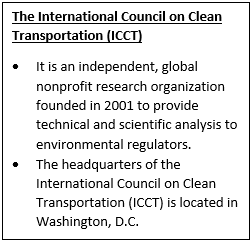
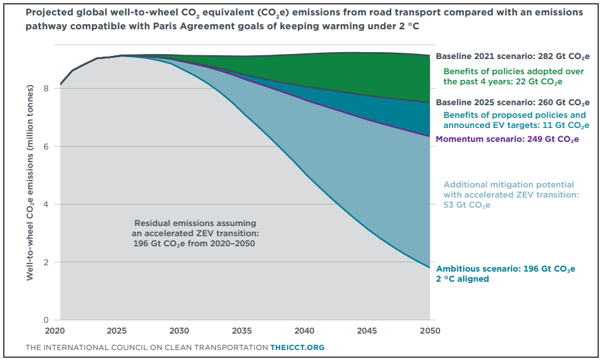
Context: Recently, a global assessment published by the International Council on Clean Transportation (ICCT) highlights that full implementation of India’s national and state-level electric vehicle (EV) targets could reduce road transport CO2 equivalent emissions by nearly 50% by 2050.
More on the News
• The findings are part of the fourth edition of Vision 2050, ICCT’s annual assessment of the global transition to zero-emission vehicles.
• The study models the impact of current and proposed policies on vehicle sales, energy use, and emissions through 2050.
• It further highlights that such reductions would support India’s net zero target for 2070 and reduce dependence on fossil fuel imports.
• ICCT researchers stress that India’s EV transition is both a climate and economic opportunity: strong domestic manufacturing plus robust policies can strengthen value chains, create jobs and improve air quality.
Key Findings of the Study
• Emissions and Energy Use: Achieving India’s current national and State EV targets could cut road-transport CO2-equivalent emissions by half by 2050, and similarly halve liquid fuel demand.
• Domestic Manufacturing Strength: Nearly 80% of EVs sold in India are manufactured domestically, putting India in a group with the EU and Japan, where EV demand is largely met by local production rather than imports.
• Heavy-Duty Vehicles as the Next Frontier:
• Policy as the Primary Driver: The report projects that India’s EV adoption will steepen sharply after 2030, as proposed fuel-efficiency standards, zero-emission vehicle (ZEV) targets, and State EV policies bite, especially across two- and three-wheelers, passenger cars and eventually heavy-duty freight.
• India as a Global Decarbonisation Hotspot: Given the size of its vehicle market and its rising energy demand, India represents one of the largest single-country opportunities for transport emissions reduction worldwide.
India’s Policy Developments Driving Emission Trends
• National-Level Initiatives:
• Sub-National Initiatives:
Source:
Indian Express
Down To Earth
The most trusted learning platform on your phone
With our training programs, learning online can be a very exciting experience! Take the next step toward achieving your professional and personal objectives



Course Related Query:
Ask Your DoubtsStore Related Query:[email protected]NCERT Books
Resources
We love learning. Through our innovative solutions, we encourage ourselves, our teams, and our Students to grow. We welcome and look for diverse perspectives and opinions because they enhance our decisions. We strive to understand the big picture and how we contribute to the company’s objectives. We approach challenges with optimism and harness the power of teamwork to accomplish our goals. These aren’t just pretty words to post on the office wall. This is who we are. It’s how we work. And it’s how we approach every interaction with each other and our Students.
Come with an open mind, hungry to learn, and you’ll experience unmatched personal and professional growth, a world of different backgrounds and perspectives, and the freedom to be you—every day. We strive to build and sustain diverse teams and foster a culture of belonging. Creating an inclusive environment where every students feels welcome, appreciated, and heard gives us something to feel (really) good about.
Get Free academic Counseling & Course Details