Current Affairs provides you with the best compilation of the Daily Current Affairs taking place across the globe: National, International, Sports, Science and Technology, Banking, Economy, Agreement, Appointments, Ranks, and Report and General Studies
UN World Water Development Report 2026
SYLLABUS
GS-3: Conservation, environmental pollution and degradation, environmental impact assessment.
Context: The United Nations World Water Development Report 2026 highlights that global water security continues to be undermined by gender inequalities, disproportionately affecting women and girls.
About the Report
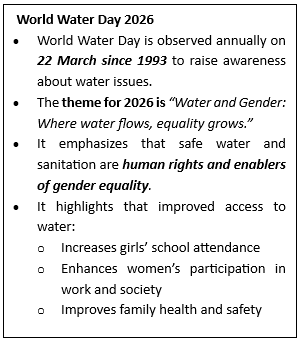
The United Nations World Water Development Report 2026, titled “Water for All People: Equal Rights and Opportunities,” is published by UNESCO on behalf of UN-Water.
It is released annually on World Water Day (22 March).
The report provides a comprehensive, evidence-based analysis of the linkages between water and gender equality, emphasizing that access to safe drinking water, sanitation, and hygiene (WASH) is essential for fulfilling basic human needs and fundamental human rights.
It highlights that gender equality—defined as equal rights, responsibilities, and opportunities for all—is central to achieving fair and just access to water, as well as to poverty reduction, health, and sustainable development.
Key Highlights of the Report
Persistent Global Water Inequality: 2.1 billion peoplestill lack safely managed drinking water, while 3.4 billion lack sanitation and 1.7 billion lack basic hygiene services.
Additionally, 1.8 billion people do not have drinking water on premises and must rely on collection. Despite progress, stark disparities persist, especially among the poorest and most vulnerable populations.
Disproportionate Burden on Women and Girls: Women are responsible for water collection in over 70% of unserved rural households, spending about 250 million hours daily, with girls under 15 more likely than boys to fetch water.
This unpaid labour results in physical strain, lost education and employment opportunities, and increased exposure to gender-based violence. It also causes mental stress and limits women’s participation in social and economic life.
WASH Challenges and Social Impacts: Inadequate access to safe water and sanitation undermines health, dignity, and education, with many girls missing school due to poor menstrual hygiene facilities.
Women also bear the burden of managing household water rationing and caregiving. Improved WASH access in schools and healthcare facilities enhances attendance, public health, and workforce productivity.
Underrepresentation in Water Governance: Despite their central role, women remain underrepresented in leadership, governance, and technical roles, with fewer than 1 in 5 water utility workers being women in many countries.
Their participation is often tokenistic rather than meaningful. This limits access to resources, reduces policy effectiveness, and hinders equitable benefit-sharing.
Link Between Water, Land and Economic Inequality: Access to water is closely tied to land ownership and tenure rights, where discriminatory laws often restrict women’s access to water for agriculture.
Women’s contributions to agriculture and ecosystem management remain undervalued. These inequalities adversely affect food security, livelihoods, and household nutrition.
Climate Change and Disaster Vulnerability: Climate change is exacerbating inequalities, exposing women to greater risks from water scarcity and disasters while limiting their access to early warning systems and recovery support.
A 1°C rise in temperature disproportionately reduces the incomes of female-headed households. Hydrometeorological disasters further intensify vulnerabilities due to structural inequalities.
Role in Agriculture, Industry and Ecosystems: Women play a crucial role in agriculture, water management, and ecosystem stewardship but face barriers in accessing irrigation, technology, and decision-making power.
They are also underrepresented in technical and leadership roles in industry. Enhancing access to irrigation, energy, skills, and training can boost productivity and reduce labour burdens.
Governance, Data and Financing Gaps: The lack of sex-disaggregated data obscures the extent of gender inequalities, while many “low-cost” water solutions depend on unpaid female labour.
Gender-responsive financing remains limited and often tokenistic.
The report emphasizes the need for accountability, inclusive financing, and recognition of unpaid labour in economic planning.
Regional Dimensions of Gender Inequality: Across regions such as Africa, Asia-Pacific, Latin America, Europe, and the Arab region, women face systemic barriers in access, participation, and leadership due to socio-cultural norms and legal constraints.
Rural and Indigenous women are particularly affected. However, evidence shows that inclusive policies and women’s participation improve water governance and sustainability.
Key Recommendations: The report calls for removing legal, institutional, and financial barriers and expanding gender-responsive financing and budgeting.
It emphasizes investment in sex-disaggregated data, recognition of unpaid labour, and strengthening women’s leadership and technical capacity.
It also stresses moving beyond technical solutions to address deeper structural inequalities.
With our training programs, learning online can be a very exciting experience! Take the next step toward achieving your professional and personal objectives

We love learning. Through our innovative solutions, we encourage ourselves, our teams, and our Students to grow. We welcome and look for diverse perspectives and opinions because they enhance our decisions. We strive to understand the big picture and how we contribute to the company’s objectives. We approach challenges with optimism and harness the power of teamwork to accomplish our goals. These aren’t just pretty words to post on the office wall. This is who we are. It’s how we work. And it’s how we approach every interaction with each other and our Students.
What Makes Us Different
Come with an open mind, hungry to learn, and you’ll experience unmatched personal and professional growth, a world of different backgrounds and perspectives, and the freedom to be you—every day. We strive to build and sustain diverse teams and foster a culture of belonging. Creating an inclusive environment where every students feels welcome, appreciated, and heard gives us something to feel (really) good about.