You're all caught up—no notifications available.
Explore All Exams at KGS


All Exams
Explore All Exams at KGS

Khan Sir Courses
Geography I Polity I History | World Map I Indian Map I Economics I Biology

UPSC & State PSC
UPSC I BPSC I UP-PSC I MP-PSC

State Exams
UP I Bihar I MP | Rajasthan

NEET | JEE | CUET
NEET | JEE | CUET

Defence Exams
NDA I CDS I CAPF I AFCAT I SSB I Agniveer

Police Exams
UP SI | Bihar SI | Delhi Police | UP Constable

SSC Exams
CGL I CPO I CHSL I MTS I SSC GD I Delhi Police

Foundation Courses
Physics I Chemistry I Biology I History I Geography I Polity I NCERT I Math I English | Map I Reasoning

Railway Exams
RRB | RPF

Teaching Exams
TET | Teaching | UGC

Banking Exams
SBI | RBI | IBPS

Engineering Exams
Civil | Electrical | Mechanical
UGC NET
UGC NET/JRF
Current Affairs provides you with the best compilation of the Daily Current Affairs taking place across the globe: National, International, Sports, Science and Technology, Banking, Economy, Agreement, Appointments, Ranks, and Report and General Studies

SYLLABUS
GS-2: Issues relating to development and management of Social Sector/Services relating to Health.
GS-3: Science and Technology- developments and their applications and effects in everyday life.
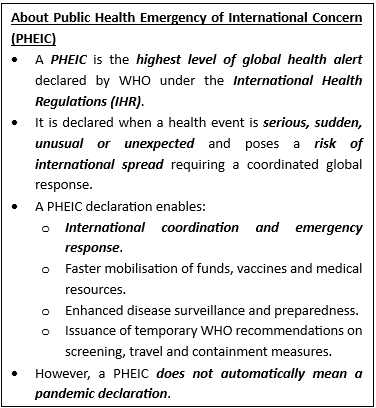
Context: The World Health Organization has declared the Ebola outbreak in the Democratic Republic of the Congo and Uganda a Public Health Emergency of International Concern (PHEIC) following the spread of the rare Bundibugyo strain of Ebola across border regions.
More on the News
• The latest Ebola outbreak originated in Ituri Province of eastern DRC and later spread to Uganda through cross-border movement, with confirmed cases reported in Kampala.
• The outbreak is caused by the Bundibugyo ebolavirus (BDBV) strain, first identified in Uganda in 2007, for which no approved vaccine or specific treatment currently exists.
• The outbreak zone is affected by armed conflict, displacement, porous borders and weak healthcare infrastructure, complicating containment efforts and raising concerns over wider transmission.
• WHO has declared the outbreak a Public Health Emergency of International Concern (PHEIC) to strengthen global coordination, surveillance and emergency response measures.
About Ebola Disease
• Ebola disease (EVD/EBOD) is a rare but severe zoonotic viral disease caused by viruses belonging to the Orthoebolavirus genus of the Filoviridae family.
• The disease was first identified in 1976 near the Ebola River in present-day DRC.
• Fruit bats are considered the natural hosts of the virus.
• The disease spreads to humans through contact with infected animals and later through direct contact with bodily fluids of infected persons.
• Human-to-human transmission occurs through contact with blood, vomit, saliva, urine, faeces, semen or contaminated surfaces/materials.
• A person infected with Ebola becomes contagious only after symptoms appear.
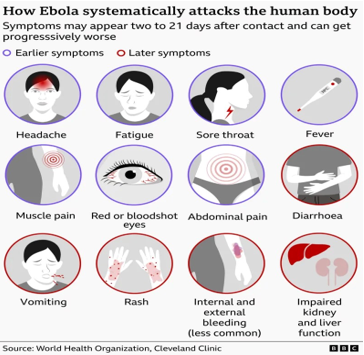
• The incubation period ranges from 2–21 days, with symptoms usually appearing within 8–10 days after exposure.
• The average fatality rate is around 50%, though it varies depending on the strain and quality of treatment.
• Types of Ebola Viruses Causing Human Disease
• Diagnosis: Diagnosis is confirmed through laboratory tests such as:
• Treatment and Vaccines: Early intensive supportive care, including rehydration and symptom management, significantly improves survival chances.
• Prevention and Control Measures: Prevention and control measures include rapid case isolation, contact tracing, safe burials, strict infection-control practices and community awareness campaigns.
The most trusted learning platform on your phone
With our training programs, learning online can be a very exciting experience! Take the next step toward achieving your professional and personal objectives



Course Related Query:
Ask Your DoubtsStore Related Query:[email protected]NCERT Books
Resources
We love learning. Through our innovative solutions, we encourage ourselves, our teams, and our Students to grow. We welcome and look for diverse perspectives and opinions because they enhance our decisions. We strive to understand the big picture and how we contribute to the company’s objectives. We approach challenges with optimism and harness the power of teamwork to accomplish our goals. These aren’t just pretty words to post on the office wall. This is who we are. It’s how we work. And it’s how we approach every interaction with each other and our Students.
Come with an open mind, hungry to learn, and you’ll experience unmatched personal and professional growth, a world of different backgrounds and perspectives, and the freedom to be you—every day. We strive to build and sustain diverse teams and foster a culture of belonging. Creating an inclusive environment where every students feels welcome, appreciated, and heard gives us something to feel (really) good about.
Get Free academic Counseling & Course Details