You're all caught up—no notifications available.
Explore All Exams at KGS


All Exams
Explore All Exams at KGS

Khan Sir Courses
Geography I Polity I History | World Map I Indian Map I Economics I Biology

UPSC & State PSC
UPSC I BPSC I UP-PSC I MP-PSC

State Exams
UP I Bihar I MP | Rajasthan

NEET | JEE | CUET | Boards
NEET | JEE | CUET | Boards

Defence Exams
NDA I CDS I CAPF I AFCAT I SSB I Agniveer

Police Exams
UP SI | Bihar SI | Delhi Police | UP Constable

SSC Exams
CGL I CPO I CHSL I MTS I SSC GD I Delhi Police

Foundation Courses
Physics I Chemistry I Biology I History I Geography I Polity I NCERT I Math I English | Map I Reasoning

Railway Exams
RRB | RPF

Teaching Exams
TET | Teaching | UGC

Banking Exams
SBI | RBI | IBPS

Engineering Exams
Civil | Electrical | Mechanical
UGC NET
UGC NET/JRF
Current Affairs provides you with the best compilation of the Daily Current Affairs taking place across the globe: National, International, Sports, Science and Technology, Banking, Economy, Agreement, Appointments, Ranks, and Report and General Studies

SYLLABUS
GS-2: Government policies and interventions for development in various sectors and issues arising out of their design and implementation.
Context: An Abhinav Bindra-led Task Force has pointed out "systemic deficits" in India's sports administration in its 170-page report submitted to the Sports Minister.
More on the News
• The nine-member Task Force was set up in August 2025 by the Ministry of Youth Affairs & Sports and featured Abhinav Bindra as Chairperson, including World Athletics vice-president Adille Sumariwalla and former Target Olympic Podium Scheme's CEO Cdr. Rajesh Rajagopalan.
• The Task Force was entrusted with a wide-ranging mandate, and it included evaluation of the current administrative framework across institutions such as the Sports Authority of India (SAI), National Sports Federations (NSFs) and state associations.
Key Findings of the Bindra Panel
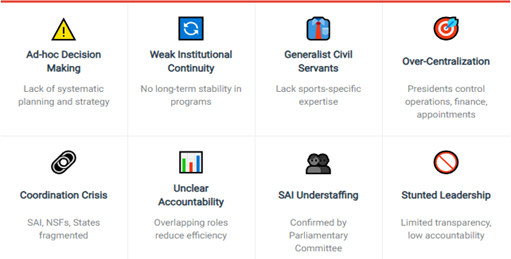
• Inadequate Capacity: The two, Sports Authority of India (SAI) and National Sports Federations (NSFs), form the "backbone" of India's sports administration, and face deep systemic and capacity challenges that hinder professionalism, efficiency, and governance effectiveness.
• Lack of a professional cadre of sports administrators: Neither SAI nor state departments have a dedicated sports administration service. Instead, roles are filled by generalist civil servants or contractual staff that often lack sector-specific expertise, resulting in ad-hoc decision-making, weak institutional continuity, and an absence of long-term professionalisation.
• Fragmented sports ecosystem: Poor coordination among government bodies, federations, private academies, and sponsors, limiting India's ability to build a modern, athlete-centric sports ecosystem.
• No clear pathway for athletes in governance: The panel noted that while the soon-to-be-implemented National Sports Governance Act makes athlete representation in NSF Executive Committees mandatory, there is no system in place to train them for the job.The National Sports Governance Act, 2025, is a landmark reform-oriented sports legislation aimed at overhauling the governance, transparency, and accountability of sports administration, especially National Sports Federations (NSFs).
• Governance Gaps in NSFs: Over-centralisation of authority in NSFs, combined with limited transparency, leads to low accountability and stunted leadership development.
Key Recommendations by the Task Force
• National Council for Sports Education and Capacity Building (NCSECB): An autonomous statutory body under the Sports Ministry, to regulate, accredit, and certify sports administration training.
• Civil Service Integration: Civil service academies should integrate sports governance training to sensitise future bureaucrats.
• Structured Dual Athlete Career Pathway: India should adopt global norms like the Long-Term Athlete Development (LTAD) model, which supports athletes in combining elite performance with education, leadership, and governance skills.
• Digital Integration: Unique Administrator IDs, a national registry and performance dashboards - alongside international partnerships with institutions like the IOC, AISTS and Loughborough for benchmarking and exposure.
Significance of the Report
• Roadmap for Sports transformation: The report is both diagnostic and prescriptive, identifying the structural, functional, and systemic gaps that currently constrain sports governance.
• Athlete-Centric Governance: As India is aggressively bidding for the 2036 Olympics, a task force headed by Beijing Games gold medallist Abhinav Bindra marks a shift toward athlete-first, performance-oriented policymaking.
• Bridging the gap: The blueprint links India’s abundant talent toward a professional and results-oriented sports culture, crucial for India’s long-term Olympic ambitions.

Environment Panel Clears Kalai-II Hydropower Project Amid Concerns Over The White-Bellied Heron
News in Short
Abhinav Bindra Panel Flags Gaps in India’s Sports System
Draft Pesticides Management Bill, 2025
Trump's 'Donroe Doctrine' seeks influence over Western Hemisphere citing old US policy
Global Minimum Corporate Tax Deal
The Fifth edition of “Trade Watch Quarterly”
Environment Panel Clears Kalai-II Hydropower Project Amid Concerns Over The White-Bellied Heron
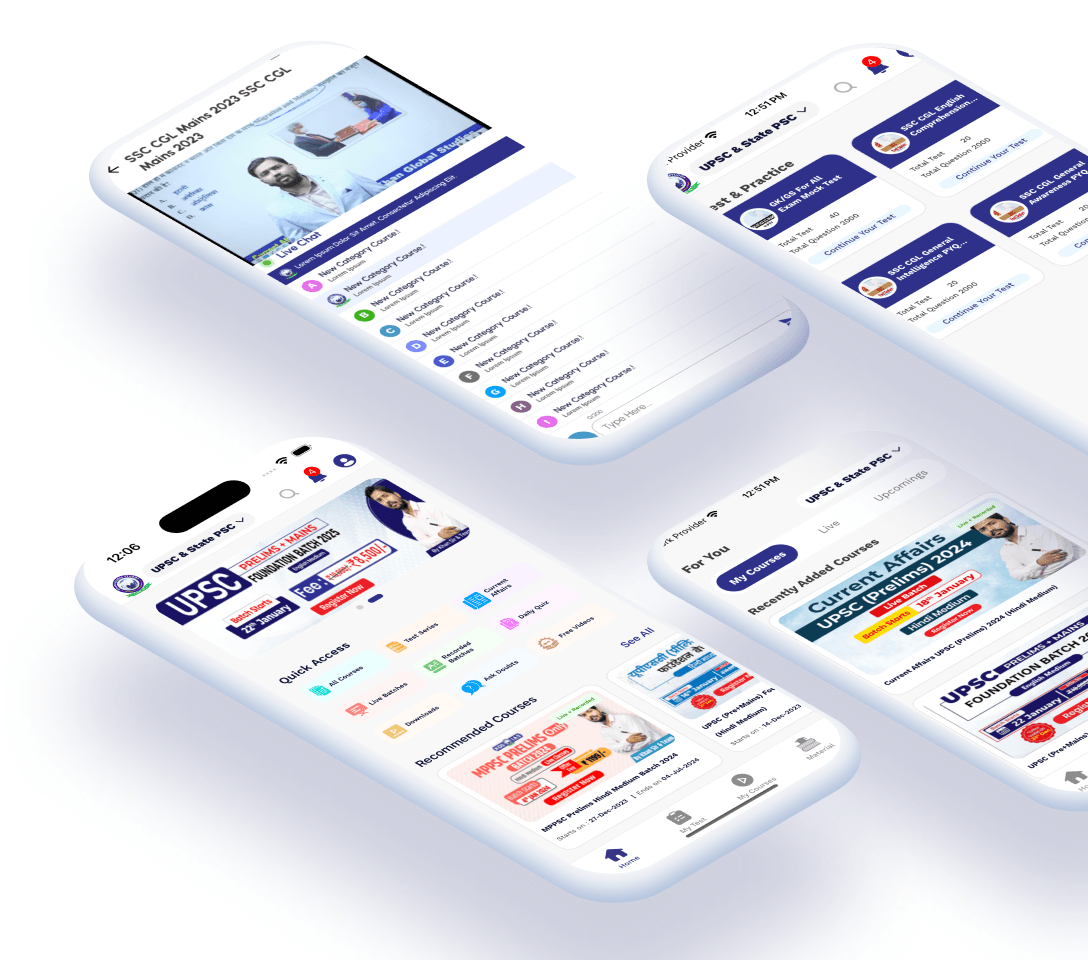
The most trusted learning platform on your phone
With our training programs, learning online can be a very exciting experience! Take the next step toward achieving your professional and personal objectives


NCERT Books
Resources
We love learning. Through our innovative solutions, we encourage ourselves, our teams, and our Students to grow. We welcome and look for diverse perspectives and opinions because they enhance our decisions. We strive to understand the big picture and how we contribute to the company’s objectives. We approach challenges with optimism and harness the power of teamwork to accomplish our goals. These aren’t just pretty words to post on the office wall. This is who we are. It’s how we work. And it’s how we approach every interaction with each other and our Students.
Come with an open mind, hungry to learn, and you’ll experience unmatched personal and professional growth, a world of different backgrounds and perspectives, and the freedom to be you—every day. We strive to build and sustain diverse teams and foster a culture of belonging. Creating an inclusive environment where every students feels welcome, appreciated, and heard gives us something to feel (really) good about.
Get Free academic Counseling & Course Details