You're all caught up—no notifications available.
Explore All Exams at KGS


All Exams
Explore All Exams at KGS

Khan Sir Courses
Geography I Polity I History | World Map I Indian Map I Economics I Biology

UPSC & State PSC
UPSC I BPSC I UP-PSC I MP-PSC

State Exams
UP I Bihar I MP | Rajasthan

NEET | JEE | CUET | Boards
NEET | JEE | CUET | Boards

Defence Exams
NDA I CDS I CAPF I AFCAT I SSB I Agniveer

Police Exams
UP SI | Bihar SI | Delhi Police | UP Constable

SSC Exams
CGL I CPO I CHSL I MTS I SSC GD I Delhi Police

Foundation Courses
Physics I Chemistry I Biology I History I Geography I Polity I NCERT I Math I English | Map I Reasoning

Railway Exams
RRB | RPF

Teaching Exams
TET | Teaching | UGC

Banking Exams
SBI | RBI | IBPS

Engineering Exams
Civil | Electrical | Mechanical
UGC NET
UGC NET/JRF
Current Affairs provides you with the best compilation of the Daily Current Affairs taking place across the globe: National, International, Sports, Science and Technology, Banking, Economy, Agreement, Appointments, Ranks, and Report and General Studies

SYLLABUS
GS-3: Security challenges and their management in border areas; linkages of organized crime with terrorism.
Context: Recently, the Ministry of Home Affairs (MHA) has unveiled India’s inaugural National Counter-Terrorism Policy and Strategy, titled PRAHAAR, marking a major milestone in institutionalising a unified and proactive counter-terror doctrine.
About PRAHAAR (National Counter-Terrorism Policy and Strategy)
• First comprehensive national counter-terror policy integrating prevention, response, resilience, and international cooperation.
• The term “PRAHAAR” (meaning strike) signifies a proactive and decisive approach to dismantling terror ecosystems.
• Institutionalises intelligence-driven operations as the core of counter-terror efforts.
• Strengthens legal, technological, operational, and institutional capacities.
• Builds upon earlier frameworks such as the National Policy and Action Plan for Left Wing Extremism (2015).
• Establishes a whole-of-government and whole-of-society approach.
Core Philosophy of PRAHAAR
• Zero Tolerance Policy: PRAHAAR adopts a zero-tolerance approach to terrorism, making no distinction between “good” and “bad” terrorists and taking a firm stand against state-sponsored terrorism and cross-border terror networks.
• Prevention Over Reaction: It prioritises intelligence-led pre-emption over post-attack response, ensuring real-time intelligence sharing through coordinated nodal mechanisms.
• Rule of Law & Human Rights: All counter-terror operations are conducted within constitutional and legal safeguards, ensuring protection of fundamental rights and strict judicial oversight.
• Ecosystem Disruption: The strategy focuses on dismantling the entire terror ecosystem by targeting financing, logistics, recruitment, propaganda, and safe havens.
• International Cooperation: Recognising terrorism as a transnational threat, PRAHAAR emphasises strong global alignment and collaborative international counter-terror efforts.
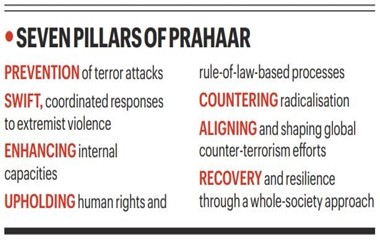
Seven Pillars of PRAHAAR
• Prevention (Intelligence-Led Operations): Prevention focuses on intelligence-led operations by strengthening MAC and JTFI, enhancing cyber surveillance to counter online radicalisation, and improving border and critical infrastructure security through advanced technologies.
• Response (Swift & Proportionate): Local police act as first responders, supported by specialised state forces and the NSG under coordinated SOPs, with investigations led by the NIA to ensure timely and proportionate action.
• Aggregating Capacity Building & Modernisation: This pillar emphasises upgrading advanced weaponry, forensic and cyber capabilities, while standardising procedures and enhancing training through BPR&D across all states.
• Human Rights & Legal Framework: Counter-terror efforts operate under laws such as UAPA, Bharatiya Nyaya Sanhita, Bharatiya Nagarik Suraksha Sanhita, Bharatiya Sakshya Adhiniyam, PMLA, and the Arms and Explosives Acts, ensuring judicial review, due process, and protection of civil liberties.
• Attenuating Radicalisation (Counter & De-Radicalisation): It promotes community engagement with religious leaders and NGOs, monitoring and counselling vulnerable youth, prison de-radicalisation programmes, and addressing socio-economic vulnerabilities like education and employment.
• Aligning International Cooperation: India strengthens counter-terror efforts through MLATs, extradition treaties, intelligence sharing, engagement at the UN, and participation in bilateral and multilateral counter-terror forums.
• Recovery & Resilience: This pillar adopts a whole-of-society approach through public-private partnerships, psychological and social rehabilitation, and community reassurance and reconstruction after terror incidents.
Nature of Threats
• Cross-border terrorism remains a primary threat, with extremist outfits and global organisations such as Al-Qaeda and ISIS targeting India through sleeper cells.
• Evidence of state-sponsored terrorism and foreign-based handlers orchestrating attacks.
• Increasing use of advanced technologies including drones, encryption tools, dark web platforms, and cryptocurrencies.
• Growing terror–organised crime nexus, facilitating logistics, recruitment, and financing.
• Rising cyber threats from criminal hackers and hostile nation states.
• Concerns over terrorist attempts to access CBRNED capabilities (chemical, biological, radiological, nuclear, explosive, digital).
• Use of social media and encrypted platforms for propaganda, recruitment, and operational coordination.
• Exploitation of local networks and overground workers by foreign terror outfits.
• Threats across all domains — land, air, maritime, and digital.
Significance
• First Unified Counter-Terror Doctrine: PRAHAAR is India’s first formal national counter-terror strategy, institutionalising a unified framework shaped by evolving terror threats and incidents like the 2025 Pahalgam attack.
• Shift to Preventive Security Model: The policy marks a transition from reactive responses to intelligence-led prevention, pre-emptive disruption, and real-time coordination.
• Evolution of Counter-Terror Framework: It builds on earlier initiatives such as the 2015 LWE Action Plan and consolidates fragmented responses into a single national doctrine.
• Whole-of-Government Approach: PRAHAAR institutionalises inter-agency coordination among intelligence agencies, central forces, state police, and specialised bodies like the NIA.
• Whole-of-Society Participation: The policy expands counter-terror efforts beyond security agencies by involving civil society and private stakeholders to enhance societal resilience.
• Future-Ready Security Architecture: It recognises emerging threats such as cyber terrorism, drone warfare, and digital radicalisation, making India’s security framework technology-driven.
• Recognition of Transnational Terrorism: The doctrine emphasises global cooperation through intelligence sharing, extradition mechanisms, and multilateral engagement.
• Normative and Strategic Importance: PRAHAAR reinforces India’s position that terrorism has no religious identity and strengthens its role in shaping global counter-terror norms.
Sources:
The Hindu
Indian Express
Economic Times
DD News
The most trusted learning platform on your phone
With our training programs, learning online can be a very exciting experience! Take the next step toward achieving your professional and personal objectives



Course Related Query:
Ask Your DoubtsStore Related Query:[email protected]NCERT Books
Resources
We love learning. Through our innovative solutions, we encourage ourselves, our teams, and our Students to grow. We welcome and look for diverse perspectives and opinions because they enhance our decisions. We strive to understand the big picture and how we contribute to the company’s objectives. We approach challenges with optimism and harness the power of teamwork to accomplish our goals. These aren’t just pretty words to post on the office wall. This is who we are. It’s how we work. And it’s how we approach every interaction with each other and our Students.
Come with an open mind, hungry to learn, and you’ll experience unmatched personal and professional growth, a world of different backgrounds and perspectives, and the freedom to be you—every day. We strive to build and sustain diverse teams and foster a culture of belonging. Creating an inclusive environment where every students feels welcome, appreciated, and heard gives us something to feel (really) good about.
Get Free academic Counseling & Course Details