You're all caught up—no notifications available.
Explore All Exams at KGS


All Exams
Explore All Exams at KGS

Khan Sir Courses
Geography I Polity I History | World Map I Indian Map I Economics I Biology

UPSC & State PSC
UPSC I BPSC I UP-PSC I MP-PSC

State Exams
UP I Bihar I MP | Rajasthan

NEET | JEE | CUET | Boards
NEET | JEE | CUET | Boards

Defence Exams
NDA I CDS I CAPF I AFCAT I SSB I Agniveer

Police Exams
UP SI | Bihar SI | Delhi Police | UP Constable

SSC Exams
CGL I CPO I CHSL I MTS I SSC GD I Delhi Police

Foundation Courses
Physics I Chemistry I Biology I History I Geography I Polity I NCERT I Math I English | Map I Reasoning

Railway Exams
RRB | RPF

Teaching Exams
TET | Teaching | UGC

Banking Exams
SBI | RBI | IBPS

Engineering Exams
Civil | Electrical | Mechanical
UGC NET
UGC NET/JRF
Current Affairs provides you with the best compilation of the Daily Current Affairs taking place across the globe: National, International, Sports, Science and Technology, Banking, Economy, Agreement, Appointments, Ranks, and Report and General Studies

SYLLABUS
GS-2: Functions and responsibilities of the Union and the States, issues and challenges pertaining to the federal structure. Parliament and State legislatures—structure, functioning, conduct of business, powers & privileges and issues arising out of these.
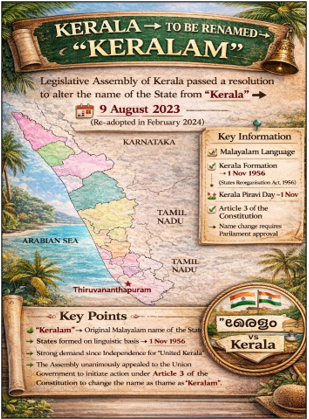
Context: Recently, the Union Cabinet approved the proposal for the alteration of the name of the State of Kerala to ‘Keralam’.
More on the News
• The demand for a change of the state’s name in the Constitution from “Kerala” to “Keralam” aligns with its Malayalam language pronunciation.
• Earlier, the Legislative Assembly of Kerala passed a resolution on June 24, 2024 to alter the name of Kerala to Keralam.
• After approval of the Union Cabinet, the President of India will refer a Bill, namely the Kerala (Alteration of Name) Bill, 2026 to the State Legislative Assembly of Kerala for expressing its views under the proviso to Article 3 of the Constitution of India.
Evolution of the Name “Keralam”
• The earliest historical trace of the name dates back to the 3rd century BCE, when the region was referred to as “Keralaputra” in Rock Edict II of Ashoka.
• In the 1920s and 1940s, the Aikya Kerala Movement emerged as a strong socio-political campaign demanding the unification of Malayalam-speaking regions into one state, laying the ideological foundation for a linguistically cohesive Kerala.
• A major administrative shift occurred on 1 July 1949, when the princely states of Travancore and Cochin were merged to create Travancore–Cochin.
• The decisive reorganisation came on 1 November 1956, under the States Reorganisation Act, when the modern state was formed on linguistic lines. Although popularly known in Malayalam as “Keralam,” it was officially entered as “Kerala” in the First Schedule of the Constitution of India.
• Decades later, on 9 August 2023, the Kerala Legislative Assembly unanimously passed a resolution requesting the Central Government to amend the Constitution and officially adopt “Keralam” in all languages listed in the Eighth Schedule.
• Following technical observations by the Ministry of Home Affairs, the Assembly refined its proposal and, on 24 June 2024, passed a second unanimous resolution limiting the amendment to the First Schedule of the Constitution.
The Procedure to Rename a State in India
• Constitutional Basis: The Parliament holds the authority to change the name of a state, as granted by the Constitution of India under Article 3.
• Introduction of the Bill: A Bill for renaming a State can be introduced in either House of Parliament only on the recommendation of the President.
• Consultation with Affected States: States affected by the proposed changes must be presented with the bill. The State Legislature can present its views on the bill within a specified time period.
• Parliamentary Consideration and Passage: After the expiry of the specified period or receipt of the State’s views, the Bill is introduced and deliberated in Parliament. It must be passed by a simple majority of members present and voting (as in an ordinary law).
• Applicability of Article 4: Under Article 4, any law made under Article 3 may include consequential amendments to the First Schedule (names and territories of States) and Fourth Schedule (Rajya Sabha representation). Such a law is not treated as a constitutional amendment under Article 368.
• Presidential Ratification: After being passed by both Houses of Parliament, the Bill is presented to the President for assent. Upon receiving assent, it becomes law and the State’s name stands officially altered.
Some Recent Instances of Similar Demands
• West Bengal to Bangla: Proposals have included "Paschim Bongo" (2011), a multi-lingual name — Bangla (Bengali), Bengal (English), Bangal (Hindi) in 2016, and finally a single name "Bangla" for all languages (2018). However, the proposal has not yet received final approval from the Union Government.
• Delhi to Indraprastha: Following the Kerala approval, an MP proposed renaming the national capital to "Indraprastha" in February 2026 to restore its ancient civilizational identity from the Mahabharata era.
• Odisha: Renamed from Orissa in 2011 (with the language changed from Oriya to Odia) to better reflect local pronunciation.
• Uttarakhand: Initially separated from Uttar Pradesh, the region was renamed Uttaranchal by the government. In 2007, responding to popular demand, it was officially renamed Uttarakhand.
• Puducherry (2006) was renamed from Pondicherry to reflect Tamil linguistic identity.

The most trusted learning platform on your phone
With our training programs, learning online can be a very exciting experience! Take the next step toward achieving your professional and personal objectives



Course Related Query:
Ask Your DoubtsStore Related Query:[email protected]NCERT Books
Resources
We love learning. Through our innovative solutions, we encourage ourselves, our teams, and our Students to grow. We welcome and look for diverse perspectives and opinions because they enhance our decisions. We strive to understand the big picture and how we contribute to the company’s objectives. We approach challenges with optimism and harness the power of teamwork to accomplish our goals. These aren’t just pretty words to post on the office wall. This is who we are. It’s how we work. And it’s how we approach every interaction with each other and our Students.
Come with an open mind, hungry to learn, and you’ll experience unmatched personal and professional growth, a world of different backgrounds and perspectives, and the freedom to be you—every day. We strive to build and sustain diverse teams and foster a culture of belonging. Creating an inclusive environment where every students feels welcome, appreciated, and heard gives us something to feel (really) good about.
Get Free academic Counseling & Course Details